Best Carbon Diet Coach Alternatives 2026 (7 Apps Compared)
 ChatGPT
  Claude
  AI Mode
  Perplexity
 Carbon Diet Coach costs $99.99 a year with no free tier, tied with RP Diet at the top of this group. Six of the seven alternatives cost less, from YAZIO PRO at $47.90 a year to MacroFactor at $71.99, and five keep a free plan you can fall back to. NutriScan is about $59 a year and gives 5 AI photo scans a week free, with an oil-level prompt after every scan.
Last verified: August 23, 2026

A study of 90 adults in Obesity Science and Practice found that both the number of weeks people kept up app-based dietary self-monitoring and how often they logged were significantly associated with percent weight loss. The group logged on 50.1 percent of days on average and lost a mean of 1.5 kg over 8 weeks (Payne et al., 2022). As a NutriScan nutritionist, I have tested macro coaching apps with hundreds of clients, and the data confirms what I see in practice: the app that keeps you logging regularly beats the app with the most impressive feature list.
Carbon Diet Coach is a well-built macro coaching tool. Dr. Layne Norton, who holds a PhD in nutritional sciences, founded it around a clear principle: log your week, check in, and the app moves your targets from what the week showed (joincarbon.com). For disciplined trackers who hit macros 6 out of 7 days, this model works well. Carbon holds 4.8 out of 5 from 8K ratings on the App Store and 4.7 out of 5 from about 2,890 reviews on Google Play, checked August 2026.
Three things push users toward alternatives in 2026: the price, which at $99.99/yr sits at the top of this group alongside RP Diet; the one check-in branch that parks your targets for a week when you only tracked part of it; and the absence of any free tier once the 14-day trial ends. If any of those match your situation, one of the seven apps below covers it more directly.
IMPORTANT
Your Carbon-switching plan at a glance.
A quick roadmap so you can decide fast and switch without wrecking your progress.
⏱️ Progress 0/4 • ~0 minutes in • Keep going
⏳ Step 1: The 3 reasons people leave Carbon
⏳ Step 2: All 7 alternatives, priced and compared
⏳ Step 3: How to switch without losing your calibration
🔍 The 60-second test that picks your app for you (revealed near the end)
 Picking a macro app is a real decision - the three gaps below tell you whether to stay or switch.
Why Users Switch From Carbon Diet Coach
The Check-In Still Stalls on a Partly Tracked Week
Carbon's weekly check-in asks how you tracked, and gives you four answers (Carbon help center). Say you tracked everything you ate and Carbon adjusts on your metabolic response. Say you did not track but met your targets and Carbon treats the week as compliant, then reviews your weight change. Say you tracked in another app and Carbon takes your weekly totals and adjusts from those. Only one answer, "I only tracked some of my meals", holds your targets where they are until next week.
That last branch is the one people actually hit. A week with three untracked restaurant meals is a partly tracked week, and the honest answer parks your plan for seven days. You can route around it by claiming you met your targets, which quietly teaches you to estimate instead of log.
MacroFactor takes a different route. Its expenditure model reads whatever intake you did enter and updates targets from that, with no compliance question in front of it. FeastGood's macro app roundup puts the difference plainly: "MacroFactor offers more flexibility without penalizing imperfect tracking" (FeastGood, an affiliate review site rather than a study).
The Annual Price Sits at the Top of the Group
Carbon costs $99.99 per year (Carbon pricing). RP Diet lists at the same $99.99 per year (RP Strength), so the two are joint most expensive here rather than Carbon standing alone. MacroFactor costs $71.99 per year, a $28 gap for apps that do similar things, or $84 across three years.
Monthly pricing is identical at $11.99 for Carbon and MacroFactor. The gap shows up on the annual plan, which is where most dedicated trackers end up paying.
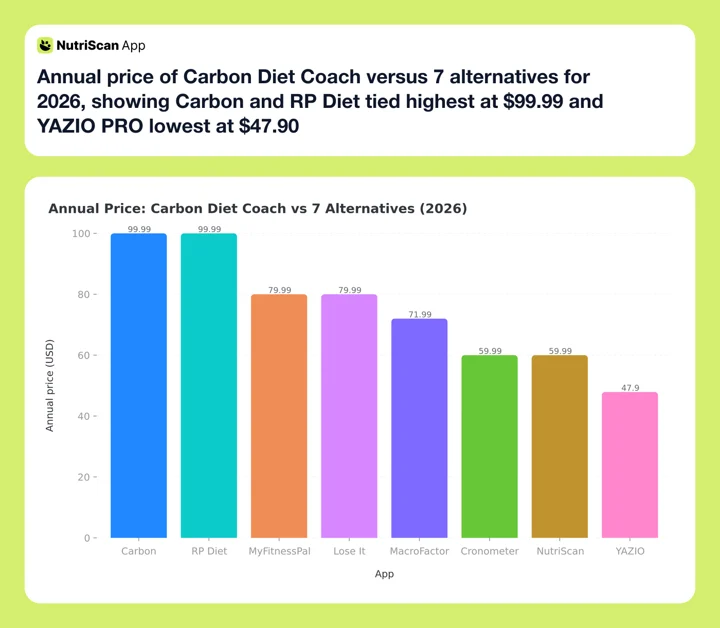 Figure 1: Carbon Diet Coach at $99.99/yr is tied with RP Diet at the top of this group. Six of the seven alternatives cost less, and YAZIO PRO at $47.90/yr is the cheapest. Sources: Carbon pricing, RP Strength, Lose It Membership Tiers and Pricing.
No Free Tier, and the Trial Is the Only Free Look
The two gaps this guide used to lead with have closed. Carbon's Smart Logger takes a meal photo on the Meal tab and text or voice on the Describe tab, matched against Carbon's verified database (Carbon help center). Carbon also reads weight and body fat from Apple Health on iOS and Google Health Connect on Android, and writes calories, macros and available micronutrients back out (Carbon integrations). If photo logging or health sync is why you were looking elsewhere, that reason is gone.
What has not changed is that Carbon is paid-only. You get a 14-day free trial, then $11.99/mo, $59.99 for six months, or $99.99/yr, with nothing to drop back to (Carbon pricing). Five of the seven apps below keep a free tier running indefinitely, so you can pause a subscription for a month without losing access to your own history.
If you want to sanity-check your own numbers before you compare apps, our free macro calculator gives you a target to carry into any tracker below.
IMPORTANT
Checkpoint: you now know why people leave.
Quick status update so you always know the next best move.
⏱️ Progress 1/4 • ~1 minute in • Keep going
✅ Step 1: The 3 reasons people leave Carbon (done)
👉 Step 2: All 7 alternatives, priced and compared (you're here)
⏳ Step 3: How to switch without losing your calibration
🧩 The 60-second test that picks your app (coming soon)
Related: Carbon Diet Coach pricing and plans 2026.
At a Glance: 7 Carbon Alternatives
| App | Best For | Annual Price | Free Tier | Photo Logging | Wearable Sync |
|---|---|---|---|---|---|
| MacroFactor | Flexible adaptive coaching | $71.99 | No (7-day trial) | Yes (AI photo) | Apple Health, Health Connect |
| RP Diet | Strict meal-by-meal structure | About $99.99 list, promo tiers vary | No | Yes (AI Food Scanner) | Yes (HealthKit) |
| Cronometer Gold | Micronutrient depth + macros | $59.99 | Yes (with ads) | Yes (Photo Log) | Yes |
| Lose It Premium | Photo + voice logging | $79.99 | Yes | Yes (Snap It) | Yes |
| MyFitnessPal Premium | Restaurant and branded coverage | $79.99 | Yes | Yes (Meal Scan) | Yes |
| YAZIO PRO | Fasting + macro tracking, lowest price here | $47.90 | Yes | Yes (AI photo) | Yes |
| NutriScan Premium | Photo logging free tier | about $59/yr | Yes (5 scans/wk) | Yes + oil prompt | Yes (Apple Health, Google Fit) |
Prices are standard US prices as of mid 2026 and change by region. Sources: Carbon pricing, MacroFactor press kit, RP Strength, Lose It Membership Tiers and Pricing, Cronometer Gold, MyFitnessPal Premium.
1. MacroFactor - Best Flexible Adaptive Alternative
MacroFactor, built by Stronger By Science Technologies LLC with lead creator Greg Nuckols (world-record powerlifter and co-founder of the MASS research review) and Dr. Eric Trexler (PhD in human movement science), is the most direct Carbon alternative in 2026.
The core difference is in the coaching algorithm. MacroFactor uses an expenditure estimation model that learns from your daily food logs and body weight entries. It needs 3 to 4 weeks of consistent logging before that estimate settles (MacroFactor help center). After that, the algorithm sets targets based on what you prove you can do, not what a generic formula predicts. It adapts whether or not you report perfect adherence.
You get three coaching modes that Carbon does not offer:
- Coached - the app controls all target updates automatically
- Collaborative - the app suggests changes and you decide whether to apply them
- Manual - you set your own targets, useful if you work with a human coach
MacroFactor also includes a calorie floor feature, a minimum safe intake level below which the app will not push your deficit, even if weight loss stalls. Carbon has no equivalent safety floor.
Food database: MacroFactor maintains its database against more than 10 sources including the Nutrition Coordinating Center and FoodData Central, so a food entry carries amino acid profiles, vitamins, minerals and fiber alongside macros (MacroFactor). Carbon's database is powered by FatSecret and does surface micronutrients, though a shorter list: the "i" icon on the diary tab opens a daily nutrient summary covering saturated fat, fiber, sugar, added sugars, cholesterol, sodium, potassium and calcium (Carbon help center).
Photo logging: MacroFactor does AI photo food logging and speech-to-text logging. You can snap a meal photo and the app estimates calories and macros from the image, with the option to edit results before saving.
Wearable integration: Apple Health on iOS and Google Health Connect on Android. Fitbit support has been deprecated and removed (MacroFactor integrations).
Price in 2026: $11.99/mo, $47.99 for 6 months, or $71.99/yr (MacroFactor press kit). A 7-day free trial is available and there is no free subscription tier. 4.8 out of 5 from 20K ratings on the App Store, 4.8 out of 5 from 15.9K reviews on Google Play, checked August 2026.
Who it fits: Anyone currently on Carbon who misses targets occasionally, travels, or wants a coaching model that uses their actual eating patterns rather than their self-reported compliance.
Related: Carbon vs MacroFactor vs MyFitnessPal for athletes.

2. RP Diet - Best Strict Meal-by-Meal Alternative
RP Diet, built by the Renaissance Periodization team led by Dr. Mike Israetel (PhD in sports science, competitive bodybuilder), is the alternative for users who want stricter structure than Carbon, not less.
Where Carbon checks in weekly, RP Diet sets targets for each individual meal and tells you when to eat them. The App Store listing describes meal timing guidance aimed at reducing hunger and holding muscle, plus flexible scheduling that fits night shifts and intermittent fasting (RP Diet Coach on the App Store). If you want to know the grams of protein to eat at breakfast versus dinner on a squat day, this is the app that answers in that shape.
Key difference from Carbon: RP Diet works meal by meal where Carbon works week by week. The old "it is not really a food tracker" framing no longer holds: RP Diet now sets personalized daily calories as well as macros, and adjusts both on a weekly review of your progress. It also ships an AI Food Scanner that identifies foods from a meal photo and estimates portions, and HealthKit sync for weigh-ins and connected scales.
Price in 2026: about $99.99/yr or $19.99/mo at list (RP Strength), which puts it level with Carbon rather than under it. Treat that as a list price. The App Store listing carries $149.99, $89.99, $34.99 and $14.99 referral SKUs at the same time, so RP runs frequent promotions. There is no free tier.
Who it fits: Intermediate to advanced bodybuilders, powerlifters, and CrossFit athletes who want meal-by-meal precision and are comfortable with a structured, non-flexible system.
3. Cronometer Gold - Best for Micronutrients Alongside Macros
Cronometer Gold is the right Carbon alternative if your macros feel dialed in but you want to understand what is happening at the vitamin and mineral level.
Carbon tracks calories, the three macronutrients and an eight-item daily nutrient summary. Cronometer Gold tracks up to 95 nutrients and compounds, and the free tier tracks up to 84 (Cronometer Gold). The data comes from research-grade databases including USDA, NCCDB, CNF, NUTTAB, CoFID, NEVO and IFCDB, and Cronometer describes the result as over 1 million lab-analyzed or verified foods. Every entry carries a breakdown that Carbon and most macro trackers do not show.
What Cronometer adds over Carbon:
- Oracle Nutrient Search (Gold feature): find foods that fill specific nutrient gaps, for example, searching for the highest magnesium sources you actually eat
- Custom biometrics (Gold): create your own biometric beyond the built-in list and log it alongside food data
- Nutrition data and charts over any time frame with unlimited history (Gold); the free plan is capped at a 7-day reporting window
- Printable reports for sharing with a dietitian or doctor
Where Cronometer falls short compared to Carbon: nothing in the Gold feature list recalculates your calorie or macro targets from your progress. Gold includes Crono Coach for AI guidance and a Macro Scheduler, but you set the targets and log against them. This makes it a tracker with deep data plus a chat layer, not a coaching tool that moves your numbers for you.
Price in 2026: Free Basic (with ads, barcode scanner, 7-day reports), Gold at $4.99/mo billed annually at $59.99/yr or $10.99/mo billed monthly (Cronometer Gold), Pro at $39.99/mo for nutrition professionals (Cronometer Pro). A free tier exists, so you can test the food database before committing. Gold also adds Photo Log, Voice Log, and a fasting timer. 4.8 out of 5 from 96K ratings on the App Store, 4.6 out of 5 from 56.8K reviews on Google Play, checked August 2026.
Who it fits: Strength athletes or dieters who already know their macros and want to audit micronutrient gaps; people working with a registered dietitian who needs exportable data; anyone who suspects nutrient deficiency is affecting training or recovery.
TIP
Weighing Cronometer specifically? We break down its free-plan limits and seven micronutrient-focused options in Best Cronometer Alternatives 2026.
4. Lose It Premium - Best Photo Plus Voice Logging
Lose It Premium used to be the budget pick in this list at $39.99 per year. It is now $79.99 per year (Lose It Membership Tiers and Pricing), the same price as MyFitnessPal Premium and only $20 below Carbon. If you were switching from Carbon to save money, YAZIO PRO at $47.90 or Cronometer Gold at $59.99 is the cheaper move.
What Lose It does well is the input side. Premium pairs photo logging, voice logging and device sync in one subscription, though that combination is no longer unusual: MyFitnessPal Premium, Cronometer Gold and YAZIO PRO all cover the same three.
The free Lose It plan includes a calorie budget and basic food logging. Premium adds:
- Snap It: photograph a meal and the AI estimates calories and macros
- Say It: speak a food item and the app logs it
- Detailed macro and nutrient targets
- Wearable sync with Apple Watch, Fitbit, and Garmin
- Branded food with verified database entries
- Meal planning and recipe import
Lose It does not have adaptive coaching like MacroFactor or Carbon. You set your calorie and macro goals manually during setup, and they stay fixed unless you update them. This is the same model as MyFitnessPal - you are the coach, and the app is the log.
A 2025 randomized controlled trial in Obesity (Burke LE et al.) found that higher adherence to diet, physical activity and weight self-monitoring, and to calorie and activity goals, was associated with greater odds of reaching at least 5 percent weight loss (Burke et al., 2025). For a straightforward deficit or macro goal where you already know your targets, the fastest way to log is worth more than the coaching layer. That is the case for Lose It now that price is no longer the argument.
Price in 2026: Free plan with basic logging; Premium at $79.99/yr, with no monthly Premium plan. Lifetime is $299.99, or $229.99 if you are already an active Premium member (Lose It Membership Tiers and Pricing). 4.8 out of 5 from 770K ratings on the App Store, 4.6 out of 5 from 181K reviews on Google Play, checked August 2026.
Who it fits: Trackers who log by photo and voice more than by search and want both in one app; people who already know their targets and do not need adaptive coaching. If the reason you are leaving Carbon is the annual price, Lose It no longer solves that.
IMPORTANT
Checkpoint: midway through the seven.
You're halfway - the pattern is getting clear, and the decision gets easier from here.
⏱️ Progress 2/4 • ~2 minutes in • Keep going
✅ Step 1: The 3 reasons people leave Carbon
👉 Step 2: All 7 alternatives, priced and compared (current)
⏳ Step 3: How to switch without losing your calibration
🧩 The 60-second test that picks your app (next up)
5. MyFitnessPal Premium - Best Restaurant and Branded Coverage
MyFitnessPal logs from a database of over 20.5 million foods, including restaurant dishes and branded products (App Store listing). It is not the biggest count on the market, Lose It's help center claims 50M+, but if you eat out often or scan a lot of packaged food, MFP's coverage is the reason people stay on it.
Premium adds:
- Macro targets in grams (free version only allows percentage targets)
- Calorie and macro breakdown by meal and by day
- Barcode scan and Meal Scan, both of which the free tier no longer includes
- Voice logging and multi-day logging
Meal Planner, the recipe library and grocery app delivery syncing are not in Premium. They sit in Premium+ at $99.99/yr (MyFitnessPal Premium).
The limitation versus Carbon or MacroFactor is that MFP targets are user-set. Nothing in the Premium or Premium+ feature list adjusts them from your progress, so you set your calorie and macro goals once and the app logs against them until you change the numbers yourself. For someone who needs an algorithm to manage weekly target updates, MFP does not replace Carbon's coaching layer.
Price in 2026: Free plan (with ads, limited features); Premium at $19.99/mo or $79.99/yr; Premium+ at $99.99/yr (MyFitnessPal Premium). 4.7 out of 5 from 2.3M ratings on the App Store, 4.4 out of 5 from 2.91M reviews on Google Play, checked August 2026.
Who it fits: High-volume restaurant eaters, international travelers, barcode-heavy packaged food loggers, and users who want the widest restaurant and branded coverage even if adaptive coaching is not a priority.
6. YAZIO PRO - Best for Fasting Plus Macro Tracking
YAZIO combines intermittent fasting tracking with calorie and macro logging in one app, at a price that undercuts Carbon by more than $50 per year.
If you use Carbon for macros and a separate app for fasting windows, YAZIO replaces both. The fasting tracker includes a countdown ring, schedule presets (16:8, 18:6, 5:2, custom), and a log of your fasting history. The calorie side tracks macros, has a barcode scanner, and includes over 4 million searchable foods. YAZIO also does AI photo logging, which makes it one of the more complete trackers at its price point.
YAZIO PRO does not offer adaptive coaching. Like Lose It and MyFitnessPal, you set your targets manually and log against them. The fasting integration means you can see whether your fasting windows correlate with your macro adherence without exporting data to a separate app.
Price in 2026: Free plan (no barcode scanner); PRO at $47.90/yr standard or $23.90 during promotional pricing. YAZIO runs several subscription SKUs at once, so prices vary by region and promotion. 4.7 out of 5 from 50K ratings on the App Store, 4.4 out of 5 from 843K reviews on Google Play, checked August 2026.
Who it fits: Carbon users who also intermittent fast and want a single app to manage both; anyone who wants a lower-cost macro tracker with a solid food database and doesn't need adaptive target adjustments.
7. NutriScan - Best for Photo Logging With a Free Scan Allowance
NutriScan takes a different approach to the Carbon gap: instead of adapting macro targets, it handles the part of logging that every manual tracker makes difficult - identifying calories in a meal from a photo.
 The single biggest friction in manual macro tracking is entry. Photo logging removes it - snap the plate and edit from there.
The free plan includes 5 meal scans per week, enough to point the scanner at the meals a text database usually gets wrong. Each scan includes an oil level slider (No Oil, Low Oil, Medium Oil, High Oil) and 11 cooking methods (Mixed, Deep-fried, Air-fried, Stir-fried, Oven-baked, Roasted, Steamed, Boiled, Grilled, Raw, or Not Sure). These inputs adjust the estimated calorie and macro output for the same dish depending on how it was actually prepared. For mixed dishes, curries, restaurant plates, and home-cooked meals where the same food can absorb very different amounts of oil, this detail changes the estimate meaningfully.
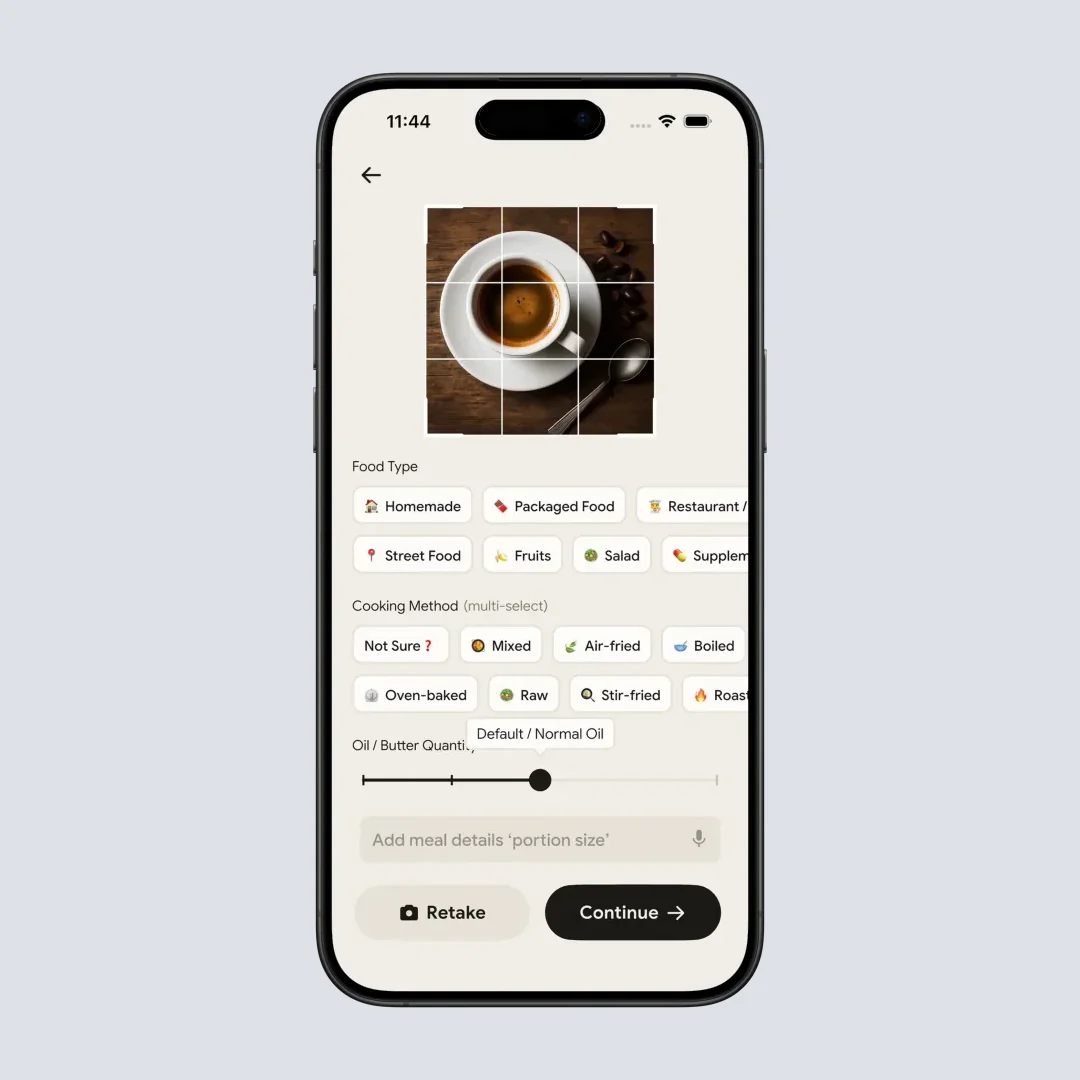
NutriScan: Home > Camera Icon > Crop Picture. You frame the dish, then set oil level and cooking method before the estimate is generated.
A 2023 meta-analysis of 12 randomized controlled trials found that smartphone app-based interventions produced small-to-moderate effects on body weight, BMI and body fat percentage, and that the effect grew with older participants and longer interventions (PMID 36379104). That says nothing about oil sliders specifically. What the oil prompt and the cooking method do is narrow the range on a dish whose calories swing most with preparation, which is where a photo estimate is otherwise weakest. You can see how the scan flow works in our meal scan guide.
Price in 2026: Free plan includes 5 photo scans per week, NutriBites AI nutrition Q&A, and macro tracking. Premium at region-dependent pricing, typically about $59 a year in the US with a 7-day trial that starts through your app store; whether a card is collected depends on your platform and region. 4.6 star rating with 150k+ downloads, checked August 2026.
Who it fits: Carbon users who want photo logging as a primary input; anyone logging Indian food, mixed dishes, or restaurant meals where manual search entries are consistently inaccurate; users who want to spend their free scans on the dishes that break a text database before committing to a paid plan.
Who Should Stay With Carbon Diet Coach
Not everyone should leave. Carbon's strict model works well for specific users, and switching to a more flexible app is the wrong move if you are in this group.
WARNING
Stay with Carbon if any of these describe you. Switching to a more flexible app would remove the exact structure you benefit from.
You hit your macro targets within 10 to 15 grams consistently across 6 or 7 days per week. Carbon's check-in model delivers its best output when adherence is high. You will see weekly adjustments, clear guidance, and a coaching loop that reinforces your discipline.
You are preparing for a physique competition or a structured gaining phase where you want weekly calorie redistribution across training and rest days. Carbon's built-in weekly planner handles this directly, and its dedicated reverse diet mode adds calories back safely after a cut.
You use Dr. Layne Norton's broader content ecosystem (BioLayne videos, scientific publications on metabolic adaptation) alongside the app. Carbon functions as the practical layer of that educational framework.
You want photo, text and voice logging plus health-app sync inside the coaching app you already pay for. Carbon's Smart Logger covers the first three and its Apple Health and Google Health Connect integrations cover the fourth, so switching buys you nothing on the input side.
IMPORTANT
Checkpoint: final stretch before the reveal.
One last nudge - the 60-second test that picks your app is next.
⏱️ Progress 3/4 • ~3 minutes in • Keep going
✅ Step 1: The 3 reasons people leave Carbon
✅ Step 2: All 7 alternatives, priced and compared
✨ Step 3 + the 60-second test (about to reveal)

Tips for Making the Switch
Switching macro tracking apps mid-cut or mid-bulk carries real disruption risk if you do it carelessly. These five steps reduce that risk.
Carry over your current targets manually. Before you cancel Carbon, screenshot your current calorie, protein, fat, and carb targets. Enter those numbers as your starting point in the new app during onboarding. Do not rely on the new app's calculator to match what Carbon built over weeks of check-ins.
Re-enter your top 20 foods first. Most people eat the same 20 to 30 foods regularly. Find those in the new app's database and save them as favorites before your first logging day. This cuts the transition friction from days to minutes.
Run both apps for one week. Log in Carbon and the new app simultaneously for 7 days. Compare how the databases handle your most common meals. If the calorie difference is under 100 calories per day, the switch is safe.
Wait until a weekly check-in boundary. If you are mid-week in Carbon's check-in cycle, finish that cycle before switching. Leaving mid-cycle means losing the data from that partial week.
Watch for algorithm calibration time. MacroFactor needs 3 to 4 weeks of consistent weight and nutrition logging before its expenditure estimate settles (MacroFactor help center). RP Diet needs 1 to 2 weeks to calibrate per-meal targets. Do not evaluate whether the new app is "working" before that calibration window closes.
Step-by-Step: How to Pick Your Carbon Alternative
Here is the 60-second test. Use this five-question decision process to pick the right app from the seven options above before you subscribe.
Do I need adaptive coaching (targets that change based on my actual results)? Yes ➡️ MacroFactor. No ➡️ any of the other six options.
Do I need a free tier I can fall back to? Yes ➡️ Cronometer, Lose It, MyFitnessPal, YAZIO, or NutriScan. No ➡️ MacroFactor or RP Diet, both paid-only after a trial. All seven do photo logging in 2026, so that question no longer separates them.
Do I want micronutrient tracking alongside macros? Yes ➡️ Cronometer Gold. No ➡️ proceed to question 4.
Is price a primary constraint? Under $50/yr ➡️ YAZIO ($47.90). Under $70/yr ➡️ Cronometer Gold ($59.99 a year). NutriScan Premium is about $59. Willing to pay more for the widest restaurant and branded coverage ➡️ MyFitnessPal ($79.99), which is now the same annual price as Lose It. RP Diet at about $99.99 buys structure, not savings.
Do I also intermittent fast and want one app for both? Yes ➡️ YAZIO PRO. No ➡️ any of the other options.
If you answered yes to question 1, MacroFactor is the direct replacement for Carbon with the fewest gaps. If budget is the primary driver, YAZIO PRO at $47.90/yr covers macros, photo logging, wearable sync, and fasting for less than half of Carbon's annual cost.
IMPORTANT
Recap: everything you worked through this round.
You finished the run - save this for next time you compare trackers.
⏱️ Progress 4/4 • ~4 minutes in • Nicely done
✅ Step 1: The 3 reasons people leave Carbon
✅ Step 2: All 7 alternatives, priced and compared
✅ Step 3: How to switch without losing your calibration
✅ The 60-second test (revealed)
What the Research Says About Macro Coaching Apps
The evidence for app-assisted dietary tracking continues to grow. A 2023 meta-analysis of 12 randomized controlled trials found small-to-moderate effects on body weight, BMI and body fat percentage, and its meta-regression identified two things that increased the effect: older participants and a longer intervention (PMID 36379104). Coaching features were not among the moderators it tested.
For users choosing between Carbon and its alternatives, duration is the finding that matters. The app you are still logging in at month six does more for you than the one that impressed you in week one. That is an argument for picking on friction and price, which you control, rather than on which coaching model reads better on a feature page.
A 2026 systematic review on mobile health apps in healthy adults found that high-quality evidence for specific app features remains limited - which means how consistently you use a chosen app matters more than which particular one you select (Leuzzi et al., 2026).
Conclusion
Carbon Diet Coach works well for its intended user: the disciplined macro tracker who hits targets consistently and wants structured weekly check-ins from a coaching team with serious credentials. Dr. Layne Norton's background in nutritional sciences is reflected in the app's logic, and the dedicated reverse diet mode is a genuine differentiator for anyone coming off a cut (joincarbon.com).
For everyone else, there is a better fit in 2026. MacroFactor at $71.99/yr handles the same macro coaching with more flexibility and a deeper micronutrient breakdown. Lose It at $79.99/yr adds photo and voice logging with no coaching layer, though it costs the same as MyFitnessPal now and is no longer the cheap way out of Carbon. RP Diet adds more structure than Carbon, not less, at the same $99.99/yr list price, for bodybuilders who need per-meal precision. Cronometer Gold goes to 95 nutrients where Carbon shows eight. YAZIO at $47.90/yr is the lowest annual price here and covers fasting plus macros in one subscription. NutriScan offers 5 free photo scans a week with oil-level adjustments.
The best alternative is the one that fits how you actually eat, not how you plan to eat on your cleanest week.
Track your macros, photograph your meals, and check your nutrient gaps with NutriScan - free to start, with 5 photo scans a week on the free plan.
Frequently Asked Questions ❓
Q: Is MacroFactor actually better than Carbon Diet Coach?
A: For most users, yes. MacroFactor's expenditure algorithm adapts from your actual intake with no compliance question in front of it. Carbon's check-in holds your targets where they are if you report that you only tracked some of your meals. MacroFactor also costs $71.99/yr against Carbon's $99.99/yr, and goes deeper on micronutrients: amino acids, vitamins and minerals, against Carbon's eight-item daily nutrient summary. Both now do AI photo logging, so that is no longer a reason to switch. Carbon holds an edge for disciplined prep athletes who want the strictest coaching model and a dedicated reverse diet mode.
Q: Does Carbon Diet Coach have a free trial?
A: Carbon Diet Coach offers a 14-day free trial on its current pricing flow. After the trial, the subscription charges at $11.99/mo, $59.99 for 6 months, or $99.99/yr. There is no ongoing free tier - the app requires a paid subscription to use after the trial period.
Q: What is the cheapest macro tracker with adaptive coaching?
A: MacroFactor at $71.99/yr is the cheapest macro tracker with an adaptive coaching algorithm in 2026. RP Diet lists at about $99.99/yr, $28 more, and adjusts calories and macros on a weekly review of progress rather than through a TDEE expenditure model. Both require a paid subscription with no free tier beyond trial periods. If adaptive coaching is not required, YAZIO PRO at $47.90/yr is the cheapest paid option here with macro tracking and photo logging. Lose It used to hold that spot, but Premium moved to $79.99/yr.
Q: Can I export my data from Carbon before switching?
A: Carbon does not offer a direct data export in the same format as apps like Cronometer or MyFitnessPal. You can take screenshots of your weekly check-in history and manually record your most recent calorie and macro targets. Before switching, note your current protein, carb, and fat targets in grams, as well as your current body weight trend - this is the minimum data you need to start fresh in a new app without losing your calibration baseline.
Q: Which Carbon alternative works best for Indian food or mixed dishes?
A: NutriScan handles mixed dishes and Indian food more directly than Carbon alternatives that rely on text-search databases. The oil level slider (No Oil, Low Oil, Medium Oil, High Oil) adjusts calorie estimates for the same dish based on cooking style, which matters for curries, stir-fries, dal tadka, and restaurant plates where oil absorption drives most of the calorie range. Five scans a week are free with no subscription required, which is enough to test the scanner on the dishes a text database misreads. HealthifyMe is another option with a large India-specific food database, though it is structured differently as a coaching platform rather than a pure macro tracker.