Carbon vs MacroFactor vs MyFitnessPal 2026 for Athletes
 ChatGPT
  Claude
  AI Mode
  Perplexity
TL;DR - Best Macro App for Athletes 2026
- Default pick: MacroFactor - best expenditure algorithm, verified database, lowest annual price of the three at $71.99
- Physique athletes and contest preppers: Carbon - adherence-gated coaching, automated reverse diet, $99.99/year
- Casual or maintenance athletes: MyFitnessPal free - fine for awareness, not for serious fueling decisions
- Key finding: the 2025 Morello study found MyFitnessPal had poor validity for total energy, carbohydrate and protein in real endurance athlete use
- Hidden trick: no macro app accounts for portion estimation error - scroll to the calibration section to see how top athletes fix this
Which macro app should a serious athlete actually pay for in 2026? After comparing pricing, database accuracy, and coaching philosophy across Carbon, MacroFactor, and MyFitnessPal, the answer depends on one question: who do you want making your weekly macro decisions?
A 2025 study of Canadian endurance athletes found that MyFitnessPal showed poor validity for total energy, carbohydrate, protein, cholesterol, sugar and fiber when checked against the 2015 Canadian Nutrient File reference standard (Morello et al., 2025, PMC12550805). For an athlete, the first three are the numbers that matter most. Carbohydrate fuels training, protein drives recovery, and total energy decides whether you recover or slowly slide into underfueling.
IMPORTANT
Your macro app comparison plan at a glance.
Covering 4 things so you can make a confident decision in under 6 minutes.
⏱️ Progress 0/4 - ~0 minutes in - Keep going
⏳ What athletes actually need from a tracking app
⏳ Carbon vs MacroFactor vs MyFitnessPal - full breakdown
⏳ Pricing, real athlete scenarios, and the research
🔍 The logging calibration trick elite athletes use to make any macro app more accurate (revealed near the end)
As a NutriScan nutritionist, I work with lifters, runners, and team sport athletes who all ask a version of the same question: which macro app should I actually pay for? In 2026, the three names that come up most are Carbon (by Dr. Layne Norton's Biolayne), MacroFactor (by Stronger By Science), and MyFitnessPal. Here is the short answer first, then the full breakdown.
Short answer: Carbon is a strict automated coach. MacroFactor is an adaptive engine that learns your real metabolism. MyFitnessPal is a general tracker with the biggest database and the weakest coaching. Most serious athletes should buy MacroFactor or Carbon, not MyFitnessPal.
At a Glance: Three Apps, Three Philosophies 📊
| Factor | Carbon | MacroFactor | MyFitnessPal |
|---|---|---|---|
| Core approach | Automated macro coaching | Adaptive expenditure tracking | General food logging |
| Made by | Dr. Layne Norton (PhD) + Keith Kraker (RD) | Greg Nuckols, Stronger By Science | Under Armour spinoff, now independent |
| Target adjustments | Weekly, adherence-based | Weekly, expenditure-based | Static (you edit manually) |
| Food database | FatSecret-powered, no published entry count | 1.36M+ verified entries | 20M+ crowdsourced entries |
| Reverse diet support | Built-in goal mode | Manual setup | None |
| Contest prep fit | Excellent | Good | Poor |
| Free version | No (7-day trial) | No (7-day trial) | Yes (with ads) |
| Monthly price | $11.99 | $11.99 | $19.99 (Premium) |
| Annual price | $99.99 | $71.99 | $79.99 (Premium) |
| App Store rating | 4.8/5, 8K ratings | 4.8/5, 20K ratings | 4.7/5, 2.3M ratings |
Store ratings checked 2026-08-07. Prices are standard US prices as of mid 2026 and change by region.
The monthly prices look similar, but the annual gap is real. MacroFactor at $71.99 undercuts both MyFitnessPal tiers, while Carbon at $99.99 costs exactly what MyFitnessPal Premium+ costs, so Carbon runs $28 a year above MacroFactor.
What Athletes Actually Need From a Macro App 🏋️
 Most athletes start with any app. Serious athletes pick the right one.
Casual users want easy logging. Athletes need more specific things, and this is where the three apps separate.
Accurate energy targets that move with training load. Your energy expenditure during a competition prep block is not the same as during off-season. A static calorie target set in January is wrong by March. A review of Relative Energy Deficiency in Sport (RED-S) in the female athlete describes sustained low energy availability as compromising bone health and hormones while raising the risk of injury or illness and blunting performance (Cabre et al., 2022, PMC9724109). A 2024 study of male athletes presenting to two sports medicine clinics found 14.6% were in low energy availability, and that group was heavier with a higher body mass index than the adequately fueled group, so BMI alone does not flag it (Holtzman et al., 2024, PMC11671938). An app that keeps you anchored to a realistic energy number is a health tool, not just a physique tool.
Reliable food data. A database error of 20% on your main protein source compounds across hundreds of meals. MyFitnessPal's crowdsourced database is huge but uneven: a 2020 validation study found it accurate for energy, macronutrients, sugar and fiber once implausible outlier entries were removed, but unreliable for cholesterol and sodium (Evenepoel et al., 2020, JMIR). The 2025 endurance athlete study went further and flagged poor validity for total energy, carbohydrate and protein in real-world use.
Structure you will follow. A 2025 randomized controlled trial of 502 adults found that higher adherence to dietary self-monitoring and calorie goals predicted significantly greater odds of reaching 5% or more weight loss (Burke et al., 2025, PMC11897847). Adherence is the active ingredient. The best app for you is the one whose style you will follow for 16 weeks, not 16 days.
Pro Tip
Before paying for any app, use the free NutriScan Macro Calculator to know your actual targets first. Then pick the app that handles those numbers best for your training style.
IMPORTANT
Checkpoint: you covered what athletes need.
Quick status update so you always know the next best move.
⏱️ Progress 1/4 - ~1 minute in - Keep going
✅ What athletes actually need (done)
👉 Carbon vs MacroFactor vs MyFitnessPal breakdown (you're here)
⏳ Pricing, scenarios, and research
🧩 The calibration trick (coming soon)
Carbon: The Strict Macro Coach 💪
Carbon was built by Dr. Layne Norton, a natural pro bodybuilder and powerlifter with a PhD in nutritional sciences, together with registered dietitian Keith Kraker (App Store listing). The app behaves like a strict coach: it assigns macros, checks your weight trend weekly, and adjusts your plan based on your progress and your adherence.
What Carbon does well for athletes
Four goal modes built for physique sport. Carbon's own four goals are Lose Weight, Gain Weight, Maintain Weight and Reverse Diet (Carbon help center). The reverse diet mode matters: after a long cut or contest prep, Carbon walks your calories back up in controlled weekly steps. Neither MyFitnessPal nor MacroFactor offers reverse dieting as a built-in automated mode; in MacroFactor you set it up yourself.
Adherence-gated adjustments. Every week Carbon reads your logged intake against your prescribed targets and recalibrates, and it says outright that inconsistent weeks produce less accurate adjustments (Carbon help center). In practice it holds your targets rather than chasing noise: FeastGood's hands-on review found it would not change targets after a week marked non-compliant (FeastGood). This is strict, and that is the point.
Contest prep understanding. Carbon handles prep timelines and phase transitions in a way general trackers simply do not. For competitive physique athletes, this is its strongest selling point.
Where Carbon falls short
Carbon Limitations for Athletes
- Short runway to judge it - the 7-day trial gives you one check-in, so you see a single adjustment cycle before the $99.99 annual plan renews, the highest of the three
- No published database size - Carbon runs on FatSecret and states no entry count, so audit your own staple foods during the trial rather than assuming coverage
- Macros-first nutrient view - the daily nutrient summary covers saturated fat, fiber, sugar, added sugars, cholesterol, sodium, potassium and calcium (Carbon help center); iron, vitamin D and zinc are not in it, while MacroFactor advertises full micronutrient tracking
- Rigid by design - if you travel often, eat out unpredictably, or want flexibility, the "follow the plan" philosophy can feel heavy

MacroFactor: The Adaptive Expenditure Engine 📈
MacroFactor comes from Stronger By Science, founded by powerlifter and researcher Greg Nuckols. Its core feature is an expenditure algorithm that calculates your actual total daily energy expenditure (TDEE) from your food log and weight trend, with no fitness tracker required (Stronger By Science, algorithm philosophy).
What MacroFactor does well for athletes
It measures you instead of estimating you. The alternative is a prediction equation, and a 2023 systematic review in Sports Medicine found that the accuracy and precision of resting metabolic rate equations in athletes varies widely (O'Neill et al., 2023). MacroFactor skips the equation after the first fortnight: Stronger By Science says the expenditure estimate settles after roughly 14 to 30 days of consistent logging and weigh-ins, then keeps adjusting as your metabolism adapts through a cut or a gaining phase (algorithm philosophy). For athletes whose training volume swings across a season, this is the most useful single feature in any nutrition app.
Verified food database with fast logging. The database holds more than 1.36 million verified entries, and MacroFactor markets logging speed as its main edge over general trackers (macrofactor.com). It also logs by AI photo, barcode, nutrition label, recipe URL and speech-to-text, so the manual-entry reputation is out of date.
Three coaching styles plus macro cycling. Coached mode hands you targets, Collaborative mode lets you negotiate, Manual mode leaves you in charge while the expenditure engine keeps measuring. You can also set different macros for training and rest days, which suits strength and team sport athletes.
Cheapest of the three. $11.99 monthly, $47.99 for 6 months ($7.99 a month), or $71.99 per year ($5.99 a month), with a 7-day free trial (macrofactor.com).
Where MacroFactor falls short
MacroFactor Limitations for Athletes
- No automated reverse dieting or contest prep mode - you build these manually, which requires judgment calls Carbon automates
- It will not police you - MacroFactor adjusts to whatever you do, including poor adherence; athletes who need external discipline sometimes do better with Carbon's stricter model
- No free tier at all, and MacroFactor says there never will be one (macrofactor.com FAQ)
- Barcode coverage is market-specific: MacroFactor names the US, Canada, UK, Australia, Ireland, New Zealand, Japan, France and Spain as strong, with Germany improving, and says countries outside that list see fewer localized options
IMPORTANT
Checkpoint: halfway through the app breakdown.
You are halfway - decisions get easier here.
⏱️ Progress 2/4 - ~3 minutes in - Keep going
✅ What athletes actually need (done)
✅ Carbon and MacroFactor breakdown (done)
👉 MyFitnessPal + pricing + real athlete scenarios (current)
⏳ The calibration trick (next)
MyFitnessPal: The Big Database Generalist 📱
MyFitnessPal is where most athletes start, because the free tier exists and everyone knows the name. The database is one of the largest in the market at over 20 million entries, which is how MyFitnessPal describes it itself (myfitnesspal.com), and it connects to a long list of watches, scales and training apps.
What MyFitnessPal does well
Free entry point. You can log food today without paying. For a recreational athlete in maintenance who just wants awareness, that may be enough.
Database breadth and integrations. Restaurant meals, international packaged foods, and niche brands are more likely to exist here than anywhere else. MyFitnessPal publishes more than 35 connected apps and devices, including Apple Watch, Fitbit, Garmin, Samsung Health, Google Fit, Health Connect and smart scales (myfitnesspal.com).
Where MyFitnessPal falls short for athletes
MyFitnessPal Problems for Athletes
- Static targets: sets a calorie goal with a standard formula and leaves it alone forever - it does not learn your expenditure, does not adjust weekly, and does not understand a training season
- Database accuracy: the 2025 endurance athlete study found poor validity for total energy, carbohydrate and protein - the exact metrics athletes rely on most
- Paywalled basics: barcode scanning sits behind Premium ($19.99/month or $79.99/year); the free tier carries ads (myfitnesspal.com)
- Rough 2026: users pushed back hard on the new Today tab that shipped in the 2026 redesign, which MyFitnessPal is still collecting feedback on (myfitnesspal.com support)
- Exercise calorie error: watch-estimated burn gets added to your daily budget with all of its measurement error included, which can actively mislead
Real Athletes, Real Choices 🏃
 The right app depends entirely on what you are optimizing for and who you want making adjustment calls.
Three composite examples from athletes I advise, with the choice I would make for each.
Priya, 28, powerlifter cutting to a weight class. She needs to make 63kg in 14 weeks without losing strength. Her training is 4 days per week year-round, so her expenditure is fairly stable but her deficit must be precise. MacroFactor fits best: the expenditure algorithm will pin her real TDEE within weeks, and macro cycling lets her keep carbs higher on squat and deadlift days. Cost: $71.99 for the year, and the cut itself spans half of that.
Marcus, 35, first-time physique competitor. He has never done a prep, does not trust himself to make adjustment calls, and wants someone to just tell him what to eat. Carbon fits best: weekly adherence-gated adjustments, a built-in path through prep, and automated reverse dieting for the months after the show, when most first-timers rebound hard. Cost: $99.99 for the year, which is less than one month with a human prep coach. Published physique coaching packages start around $199 to $249 a month and run past $400 at the top end.
Elena, 23, club distance runner. She is not chasing a physique goal, but her training volume is high and her appetite does not keep up in heavy weeks - the classic setup for low energy availability. A free MyFitnessPal account undersells her needs because of the accuracy problem. MacroFactor's verified database and expenditure tracking serve her better, and Coached mode set to maintenance will quietly raise her target when her expenditure climbs.
IMPORTANT
Checkpoint: almost at the reveal.
One last nudge - the calibration trick is next.
⏱️ Progress 3/4 - ~4 minutes in - Keep going
✅ What athletes actually need
✅ Carbon, MacroFactor, MyFitnessPal breakdown
✅ Real athlete scenarios
✨ The logging calibration trick elite athletes use (about to reveal)
Pricing: What Each App Costs an Athlete Per Year 💰
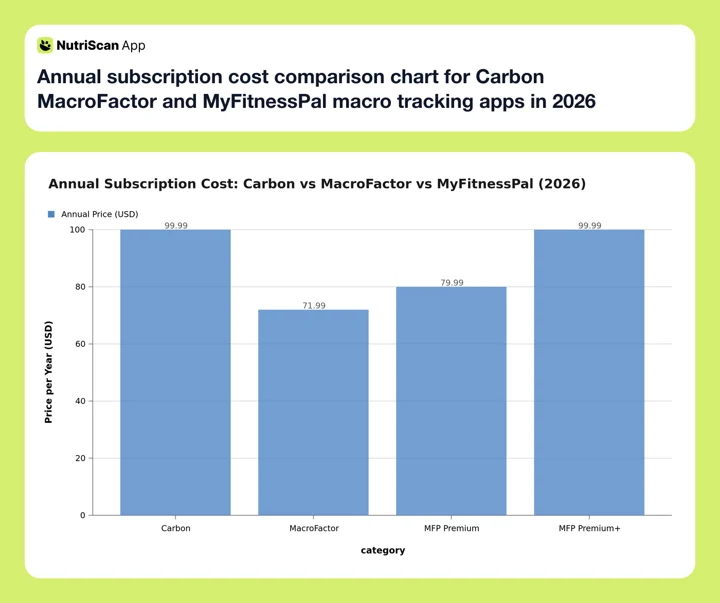 Figure 1: MacroFactor is the cheapest coaching-grade app by a meaningful margin. MFP Premium+ costs as much as Carbon but delivers none of the adaptive coaching.
| Plan | Carbon | MacroFactor | MFP Premium | MFP Premium+ |
|---|---|---|---|---|
| Monthly | $11.99 | $11.99 | $19.99 | $24.99 |
| 6-month | $59.99 ($9.99/mo) | $47.99 ($7.99/mo) | - | - |
| Annual | $99.99 ($8.33/mo) | $71.99 ($5.99/mo) | $79.99 ($6.67/mo) | $99.99 ($8.34/mo) |
| Free trial | 7 days | 7 days | 7 days | 7 days |
| Free tier | No | No | Yes, with ads | Yes, with ads |
Prices are standard US prices as of mid 2026 and change by region.
Three practical notes. First, MacroFactor is the cheapest annual option here, at $8 a year less than MyFitnessPal Premium and $28 less than Carbon. Second, all three run a 7-day trial, so you can test each coaching style before paying, though Carbon's week buys you exactly one check-in, which is one adjustment cycle to judge it on. Third, MyFitnessPal's free tier is not free coaching, it is free logging with ads, a paywalled barcode scanner, and a static target you manage yourself.
For the deeper two-app breakdown on cutting specifically, see MacroFactor vs Carbon 2026: which macro coach wins for cutting. The long-form case for MacroFactor's pricing is in Is MacroFactor worth it in 2026?.
What the Research Says About Tracking and Performance 🔬
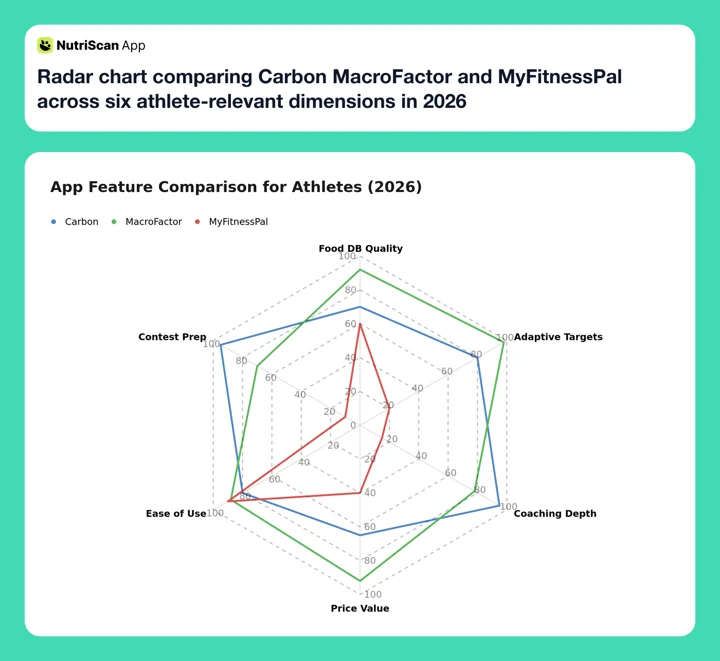 Figure 2: our own scoring of the three apps across six athlete-relevant dimensions, built from the sourced facts in the table above rather than any published benchmark. MacroFactor leads on database quality, adaptive targets and price value. Carbon leads on coaching depth and contest prep. MyFitnessPal scores on ease of use and little else that an athlete is buying.
The evidence behind macro tracking for athletes rests on three pillars.
Self-monitoring works, when you do it. The 2025 RCT of 502 adults found that higher adherence to diet self-monitoring and to the calorie goal was associated with greater odds of losing 5% or more of body weight (Burke et al., 2025). A 2025 meta-analysis of 11 randomized trials with 1,717 participants found app-based interventions produced modest but significant reductions in weight and BMI over 4 to 6 months, while warning that effectiveness fades when apps lack personalized support (Pujia et al., 2025, JMIR). Adaptive apps like Carbon and MacroFactor are direct answers to that personalization gap.
Tool accuracy sets the ceiling. The Morello 2025 athlete study and the Evenepoel 2020 validation draw the same line from two directions: MyFitnessPal's numbers hold up against a reference food-composition database only after the wild outlier entries are stripped out, and in untouched real-world athlete logs they do not. An athlete making 300-calorie decisions on data with larger error than that is guessing, not measuring.
Underfueling is the quiet failure mode. The RED-S literature shows that athletes, especially those in endurance and aesthetic sports, drift into low energy availability without noticing, with consequences for bone, hormones, and performance (Cabre et al., 2022; Holtzman et al., 2024). This is an argument for expenditure-aware tracking in both directions: a good app stops you from under-eating just as much as over-eating.
Research Caveat
No study has directly compared Carbon, MacroFactor, and MyFitnessPal head-to-head on athletic outcomes. The research supports the categories (self-monitoring, verified data, adaptive targets), not specific brand claims.
How to Choose: A 5-Step Decision Guide 🧭
- Name your next 6 months. Contest prep or first structured cut with low confidence: lean Carbon. Weight-class sport, recomposition, or season-long fueling: lean MacroFactor. Casual awareness in maintenance: MyFitnessPal free may be enough.
- Decide who makes adjustment calls. If you want to be told what to eat, pick Carbon. If you want to be informed and stay in charge, pick MacroFactor. If you are happy doing your own math monthly, MyFitnessPal works.
- Audit your foods. Spend 10 minutes searching your 15 most common foods in each app's database. All three let you do this without paying, MacroFactor and Carbon inside their 7-day trials and MyFitnessPal on the free tier. Frequent missing entries predict daily friction.
- Run a 2-week calibration. Whichever app you pick, log everything and weigh in daily for 14 days before judging your targets. Adaptive algorithms need this data, and your own consistency baseline matters more than the app's first guess.
- Set a 12-week review date. Check weight trend, performance in training, and how many days you actually logged. If logging adherence is below roughly 80%, the problem is fit, not effort: switch coaching styles rather than quitting tracking.
You can start with your macro targets pre-calculated so you know exactly what numbers the app needs to hit on day one.

The Trick That Makes Any Macro App More Accurate 🧩
Here is the calibration problem no macro app solves on its own.
Every macro app - including Carbon and MacroFactor - relies on you accurately estimating portion sizes when you log. Self-reported intake runs low against doubly labeled water, the reference method, and how low depends on which reporting tool you use (Burrows et al., 2019). Even with a food scale, mixed meals (stir fry, salad, pasta dish) introduce multi-ingredient estimation error that compounds across every day.
This is the hidden ceiling on tracking accuracy that the apps themselves cannot address.
What elite athletes actually do about this:
The pattern I see among athletes who consistently hit their physique goals is that they use a photo-based scan to audit their estimates before confirming a log entry. They photograph the plate, compare the visual analysis to their logged amounts, and adjust. It takes 15 seconds and catches the kind of systematic under-logging that defeats an otherwise good macro app.
How to use this with NutriScan:
NutriScan's Meal Scan feature uses AI photo analysis to identify foods, estimate portions, and calculate macros from a single photo - including mixed dishes, cooking oil, and restaurant meals where ingredient lists do not exist. The workflow looks like this:
Photograph your plate ➡️ NutriScan identifies and estimates portions ➡️ Compare to your logged entry in Carbon/MacroFactor/MFP ➡️ Adjust if there is a meaningful gap
Over 2 to 3 weeks of this, you learn your systematic errors: you were logging your chicken 30g low, you were underestimating oil every time. Your manual logging tightens up. The expenditure algorithm in MacroFactor converges faster. The adherence that Carbon tracks becomes more meaningful. The database you build in any app reflects your real eating instead of a slightly optimistic version of it.
The free plan includes 5 scans per week - enough to audit the five meals you are least sure about, usually the mixed and restaurant plates, and see whether photo logging fits your training life before you commit to anything.
Why This Works
Photo scanning is not a replacement for macro apps - it is the calibration layer they are all missing. Run it alongside whichever app you choose for 3 weeks and your portion accuracy will visibly improve.
 When your nutrition tracking is finally accurate - the results show up in training.
App Screenshots: NutriScan Meal Scan in Action 📸
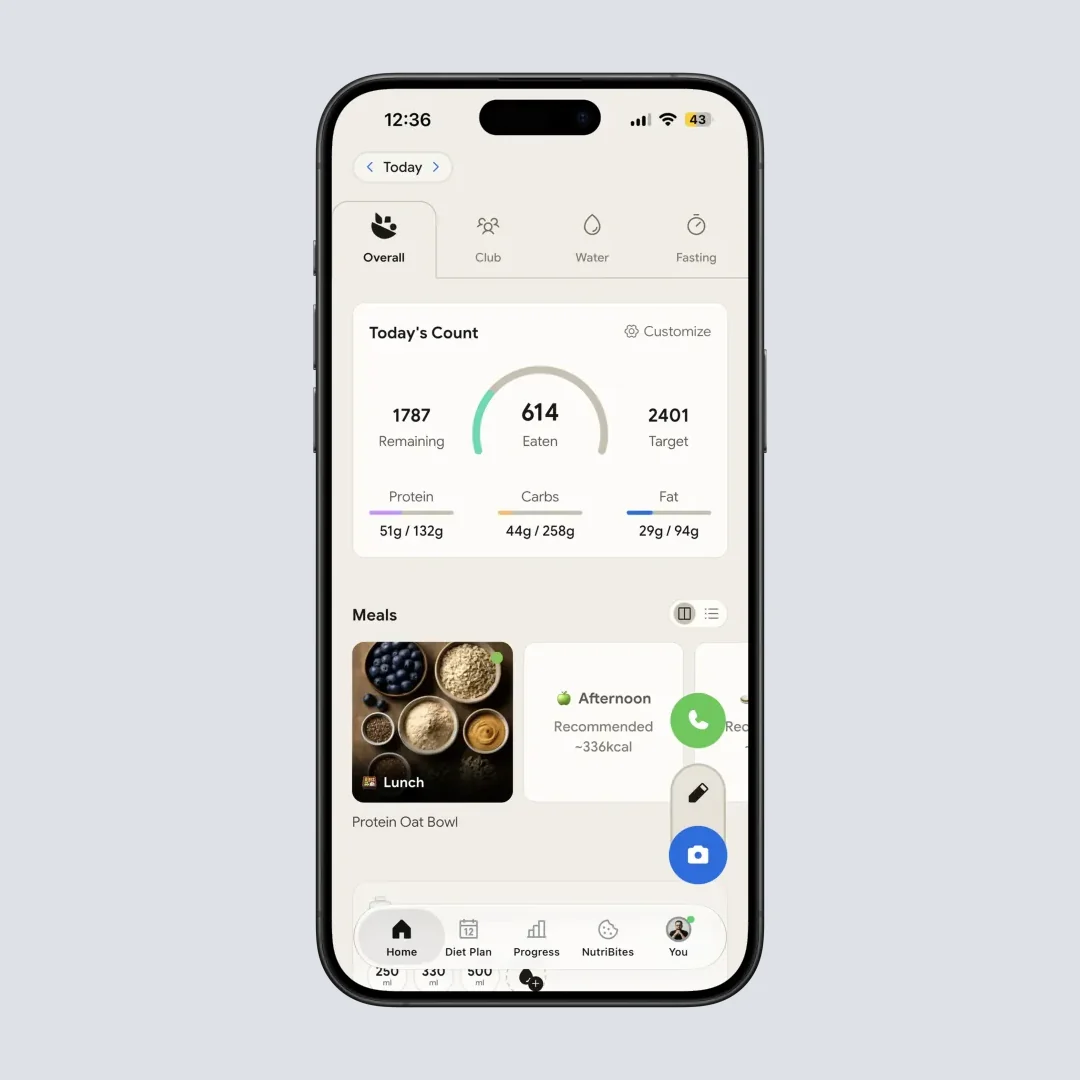
NutriScan Home - Daily macro breakdown at a glance. Navigate via Home > Camera Icon to start a scan.
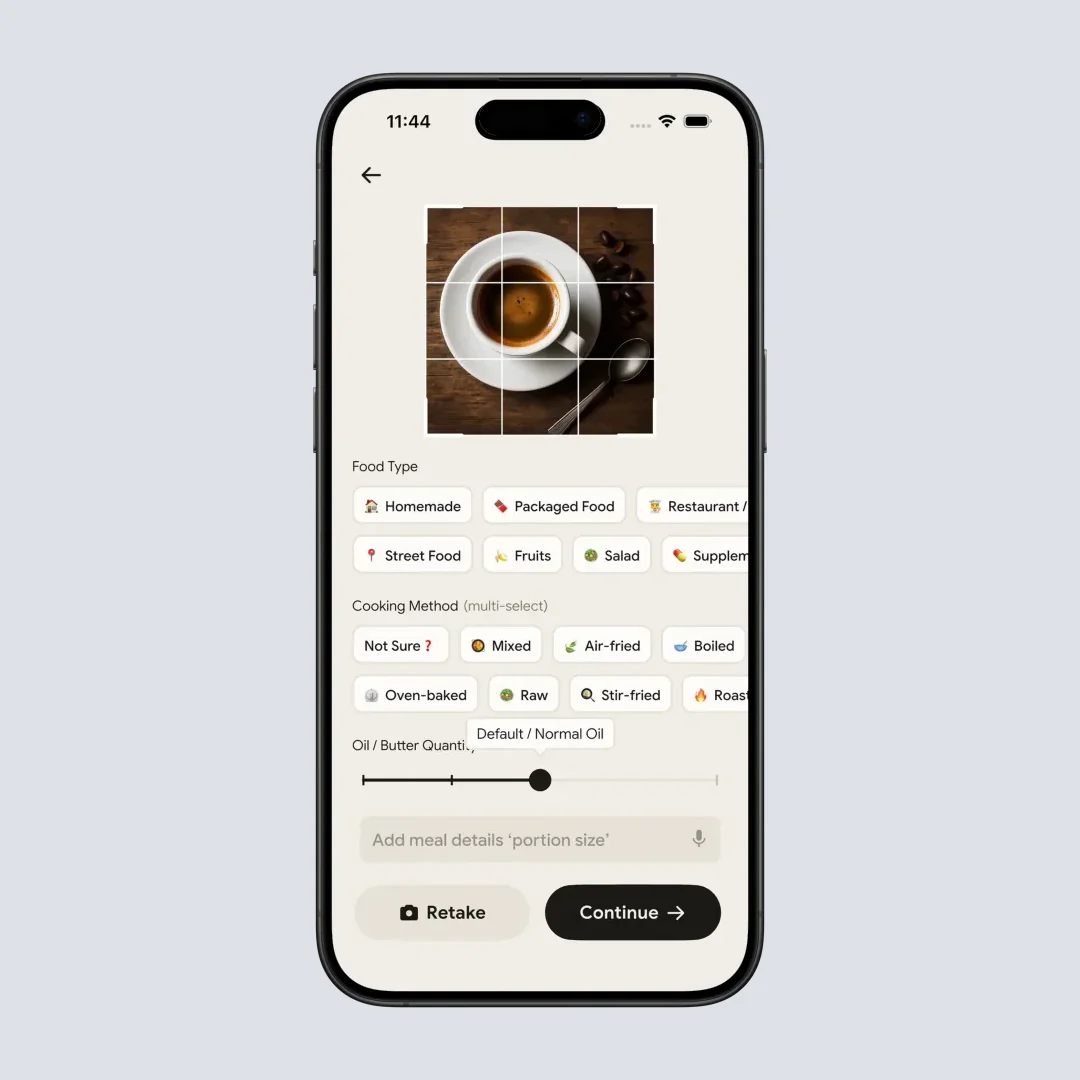
Meal Scan - Crop your plate, confirm the dish, and get macro data in seconds. Home > Camera Icon > Crop Picture.
Tips to Get More From Whichever App You Buy 💡
- Weigh in daily, same conditions, and trust the trend line. All three apps smooth weight data, but daily inputs make every algorithm smarter. Single weigh-ins are noise.
- Prefer verified database entries. In MyFitnessPal, look for verified checkmarks; in MacroFactor, use the curated results; in Carbon, build accurate custom entries once and reuse them forever.
- Turn off exercise calorie syncing for your calorie budget. Watch-estimated burn carries large error. Let Carbon and MacroFactor infer expenditure from results; in MyFitnessPal, set activity level manually and ignore exercise add-backs.
- Batch-log your staples. Save meals and recipes in week one. Athletes eat repetitively; logging should take under 3 minutes per day by week two.
- Protect carbohydrate on hard training days. Whichever app you use, set training-day carbs deliberately. Underfueled sessions are the first symptom of a too-aggressive deficit.
- Schedule diet breaks on the calendar. Carbon builds these in; in MacroFactor and MyFitnessPal, plan 1 to 2 weeks at maintenance every 8 to 12 weeks of cutting.
- Watch for warning signs, not just weight. Sleep quality, training output, mood, and (for women) cycle regularity are your RED-S early-warning system. No app replaces that check.
IMPORTANT
Recap: everything you covered this round.
You finished the full comparison - save this for when you are ready to pick.
⏱️ Progress 4/4 - ~6 minutes in - Nicely done
✅ What athletes actually need from a macro app
✅ Carbon, MacroFactor, and MyFitnessPal full breakdown
✅ Pricing, real athlete scenarios, and research
✅ The photo-calibration trick that closes the accuracy gap (revealed)
The Verdict 🏆
Buy MacroFactor if you are a self-directed athlete. It has the best expenditure algorithm, fast logging, a verified database, the lowest annual price of the three at $71.99, and a 7-day trial. It is the default recommendation for most serious lifters and endurance athletes in 2026.
Buy Carbon if you want to be coached, especially for physique sport. Contest prep support, adherence-gated weekly adjustments, and automated reverse dieting justify the $99.99 per year for bodybuilders, first-time preppers, and anyone who wants decisions made for them.
Keep MyFitnessPal only if you are casual. The free tier is a fine awareness tool, but for athletes the static targets and inconsistent database make Premium hard to justify when MacroFactor costs less per year and delivers far more.
And whichever app you choose, add the NutriScan Meal Scan as your calibration layer. It is the 15-second step that makes the other app's data actually reliable - and the free plan gives you 5 scans per week to test it before you commit.
If you are a physique athlete rather than an endurance athlete, we break the same three apps down by season phase, covering bulk, cut, peak week, and reverse diet, in our best macro tracker for bodybuilding guide.
FAQ
Is MacroFactor or Carbon better for bodybuilding contest prep? Carbon. It was built around physique sport: prep timelines, adherence-gated weekly adjustments, and a built-in reverse diet for post-show recovery. MacroFactor can do a prep in Collaborative or Manual mode, but you make the judgment calls yourself.
Can MyFitnessPal adjust my calories automatically like Carbon or MacroFactor? No. MyFitnessPal sets a target with a standard formula and leaves it static until you edit it. Neither Premium nor Premium+ adds adaptive weekly adjustments, which is the core feature athletes are paying Carbon or MacroFactor for.
Do I need a fitness watch for MacroFactor's expenditure algorithm? No. The algorithm uses only your logged food and scale weight to calculate expenditure. A watch is optional and does not feed the calorie math, which avoids the error that watch-estimated burn introduces.
Is Carbon worth $28 more per year than MacroFactor? Only if you will use the coaching layer. You are paying for automated decisions: weekly macro calls, diet breaks, and reverse dieting. If you would override those decisions anyway, MacroFactor at $71.99 gives you better logging and a better database for less.
Which macro app is most accurate for endurance athletes? Accuracy depends mostly on database quality and your logging consistency. A 2025 validation study in Canadian endurance athletes found MyFitnessPal had poor validity for total energy, carbohydrate, protein, cholesterol, sugar and fiber against the 2015 Canadian Nutrient File reference standard (Morello et al., 2025). That argues for verified databases in general, whether that means MacroFactor or careful custom entries in Carbon. Worth knowing: the paper's own suggested alternative was Cronometer, not either of them.