How Many Calories to Lose Weight, 1 kg a Week
 ChatGPT
  Claude
  AI Mode
  Perplexity
TL;DR - calories to lose weight
• The number: one kilogram of body weight costs about 7,700 kcal, so 1 kg a week needs roughly 1,100 kcal of deficit a day. • Realistic pace: 400 to 600 kcal a day, which is about 0.5 kg a week for most adults. • By body weight: an 80 kg man lands near 1,880 kcal a day, an 80 kg woman near 1,540 kcal. • The sequence: find maintenance ➡️ subtract a deficit that clears your floor ➡️ set protein ➡️ track 21 days ➡️ adjust once. • Fast timelines: 10 kg in a month needs a 2,570 kcal daily deficit, more than most people burn in total.
The arithmetic behind most questions about weekly weight loss is the same. Losing a kilogram of body weight takes a cumulative energy deficit of roughly 7,700 kcal, the metric form of the familiar 3,500 kcal per pound rule, which Kevin Hall's modeling paper states as 32.2 MJ per kilogram (Hall, 2008). Divide 7,700 by seven days and you get about 1,100 kcal a day. That single number explains why 1 kg a week feels impossible for some people and easy for others. NutriScan publishes this post and makes a calorie tracking app.
The same paper explains the part most calculators skip. Hall found the deficit required per unit of weight lost is larger for people carrying more body fat, and that the 3,500 rule overestimates it for leaner people. He notes this may be why men lose more weight than women at the same deficit. So the answer to "how many calories to lose weight" is your maintenance number minus a deficit you can hold.
Your calorie target in four moves
A quick roadmap so you can act fast.
⏱️ Progress 0/4 • ~0 minutes in • Keep going
⏳ Step 1: Find your maintenance, not an average
⏳ Step 2: Pick a deficit your floor allows
⏳ Step 3: Set protein first, then fill the rest
🔍 Step 4: The three week rule that beats the calculator (revealed near the end)
Three Worked Examples, Including the 80 kg Case 🧮
All three use the Mifflin St Jeor equation with a light to moderate activity multiplier, and all three are illustrative examples, not real clients.
Take an 80 kg man, 178 cm, age 30, lightly active. His estimated resting burn is about 1,770 kcal and his daily maintenance lands near 2,430 kcal. A 550 kcal deficit puts him at roughly 1,880 kcal a day, which produces about 0.5 kg a week. If he chased a full 1 kg a week he would need to eat near 1,330 kcal, below the 1,500 kcal line this page uses for men without medical supervision. That is the honest answer to the "diet plan for 80 kg man" question: half a kilogram a week is the ceiling, with about 130 g of protein (1.6 g per kg, the figure from Morton et al., 2018) and two resistance sessions to keep muscle.
Take an 80 kg woman, 165 cm, age 30, lightly active. Her resting burn is around 1,520 kcal and maintenance sits near 2,090 kcal. The same 550 kcal deficit gives about 1,540 kcal a day. Pushing to 1 kg a week would mean 990 kcal, below the 1,200 kcal line this page uses for women. NIH NHLBI puts weight-loss eating plans at 1,200 to 1,500 kcal a day for most women and 1,500 to 1,800 for men, so 1,200 and 1,500 are the lowest targets used here (NHLBI, archived 2023).
Take a 23 year old man, 75 kg, 175 cm, who trains three or four times a week. His maintenance is about 2,690 kcal, so a 500 kcal deficit puts him near 2,190 kcal a day. A 23 year old woman at 65 kg and 163 cm with the same training maintains near 2,160 kcal and lands around 1,660 kcal. Young maintenance is usually high enough that a modest deficit moves the scale.
Run your own version with the TDEE calculator for maintenance and the weight loss calculator for the target that matches your goal date.

Dressings and oils, added at the end of a meal, are what portion estimates miss most often.
What the Evidence Says About Deficit Size 📊
The rule of thumb is a starting point. Three findings matter more than a calculator output.
The energy cost of a kilogram is not fixed. Hall's analysis found the required cumulative deficit per unit of weight loss rises with initial body fat, and the 3,500 kcal per pound rule approximately matches people with an initial body fat above 30 kg while overestimating the requirement for leaner people (Hall, 2008). A leaner person loses more weight per 7,700 kcal than the rule predicts, but more of that loss is lean tissue.
The deficit should scale to how much fat you carry. The International Society of Sports Nutrition position stand on diets and body composition states that fat loss is driven by a sustained calorie deficit, that the higher the baseline body fat level the more aggressively the deficit may be imposed, and that slower rates of loss better preserve lean mass in leaner people (Aragon et al., 2017). That is the clearest argument against copying someone else's plan.
Guidelines converge on the slow version. The CDC states that people who lose weight at a gradual, steady pace of about 1 to 2 pounds a week are more likely to keep it off, and it names "losing 20 pounds in 2 weeks" as the kind of unrealistic goal that leaves people feeling defeated (CDC, 2025). The NHS gives the metric equivalent: aim to lose 1 to 2 lbs, or 0.5 to 1 kg, a week (NHS, 2026). One pound a week needs 500 kcal a day, two pounds needs 1,000 kcal, one kilogram needs about 1,100 kcal.
Checkpoint: here's where you are right now
Quick status update so you always know the next best move.
⏱️ Progress 1/4 • ~1 minute in • Keep going
✅ Step 1 (done)
👉 Step 2 (you're here)
⏳ Step 3
🧩 The three week rule (coming soon)

Calorie Targets by Body Weight and Goal Speed 📋
Applied to bodies rather than to deficits, the arithmetic looks like this. Each row assumes a lightly active adult of average height.
| Body weight | Sex | Estimated maintenance | Target for 0.5 kg per week | Can they run 1 kg per week? |
|---|---|---|---|---|
| 60 kg | Female | About 1,800 kcal | About 1,250 kcal | No, falls below 1,200 kcal |
| 70 kg | Female | About 1,950 kcal | About 1,400 kcal | No |
| 80 kg | Female | About 2,090 kcal | About 1,540 kcal | No, 990 kcal is too low |
| 75 kg | Male | About 2,360 kcal | About 1,810 kcal | No, 1,260 kcal is too low |
| 80 kg | Male | About 2,430 kcal | About 1,880 kcal | No, 1,330 kcal is too low |
| 100 kg | Male | About 2,710 kcal | About 2,160 kcal | Briefly, with supervision |
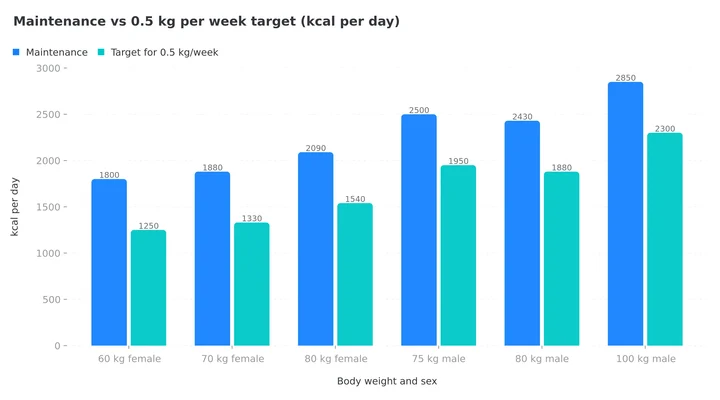
Figure 1: the gap between the bars is always 550 kcal, so maintenance decides the target, not the deficit.
The chart plots those same six rows. For most adults under 100 kg, 1 kg a week only works on paper, and a 1,200 calorie day is a floor rather than a plan.
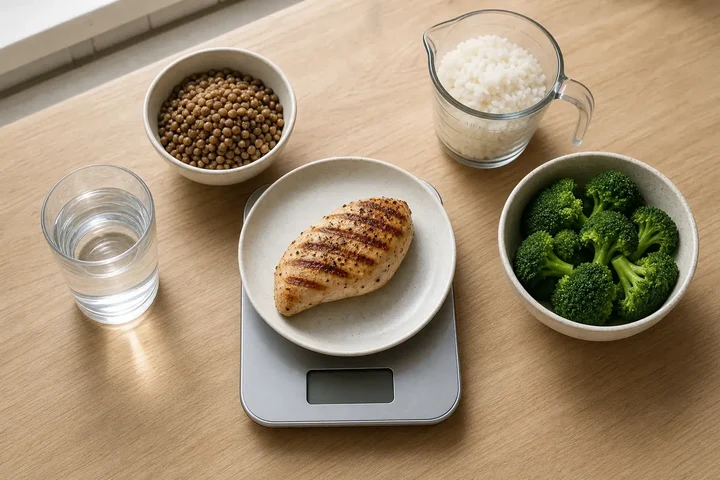
Two weeks of weighing recalibrates your eye, after which you can log most meals by sight.
Reality Check on 3 kg a Week and 30 Pounds a Month ⏳
Here is what the popular timelines require as a daily deficit. Every figure is the goal multiplied by 7,700 kcal, divided by the days.
| Goal | Daily deficit required | Verdict |
|---|---|---|
| 3 kg in 1 week | About 3,300 kcal | Not possible |
| 10 kg in 10 days | About 7,700 kcal | Not possible |
| 4 kg in a month | About 1,030 kcal | Only with high starting body fat |
| 5 kg in a month | About 1,280 kcal | Very hard, rarely holds |
| 10 kg in a month | About 2,570 kcal | More than most people burn |
| 10 kg in 3 months | About 860 kcal | Achievable with effort |
| 10 kg in 4 months | About 640 kcal | Usually works |
| 30 lb in 6 weeks | About 2,490 kcal | Not realistic |
| 30 lb in 6 months | About 580 kcal | Durable |
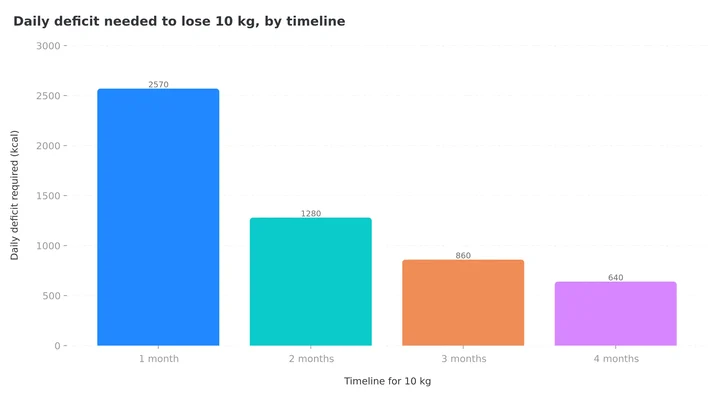
Figure 2: the same 10 kg costs 2,570 kcal a day in one month and 640 kcal a day in four, the whole argument for a longer calendar.
The scale drops faster in week one because glycogen and its bound water leave with the first cut in carbohydrate, so that early 2 to 3 kg is real weight but not fat. If your goal is tied to a date, work backwards: 12 kg over five months is about 610 kcal a day. The same 12 kg in six weeks is 2,200 kcal a day, which no plan delivers.
Weight loss you did not plan for is a medical question
People who lost 30 pounds "without trying" usually had an unplanned change in appetite, an illness or a new medication. Unexplained weight loss deserves a doctor's visit, not a calorie target.
Checkpoint: midway progress update
You're halfway, and decisions get easier here.
⏱️ Progress 2/4 • ~2 minutes in • Keep going
✅ Step 1 (done)
✅ Step 2 (done)
👉 Step 3 (current)
⏳ The three week rule (next)
Six Habits That Make a Deficit Hold 💡
The target is arithmetic. Holding it is behavior. These six change outcomes most.
- Set protein before anything else. The ISSN position stand notes that intakes of 2.3 to 3.1 g per kg of fat free mass may be needed to maximize muscle retention in lean, resistance trained people eating below maintenance (Aragon et al., 2017). Start near 1.6 g per kg of body weight, the level a meta-analysis of resistance training trials found adds the most muscle (Morton et al., 2018), and adjust with the protein intake calculator.
- Weigh food for two weeks, then stop. Portion estimates drift badly with calorie dense foods.
- Log the whole day, including the parts you regret. A partial log is worse than none, because it produces a confident wrong number.
- Add resistance training twice a week. It does not burn many calories, and that is not the point. It changes what the body gives up when you run a deficit.
- Judge progress on a weekly average, never a single morning. Sodium, sleep and the menstrual cycle move scale weight by a kilogram or more.
- Plan the maintenance phase before you need it. A review of weight regain describes reduced anorectic hormone secretion, increased orexigenic signaling and resting energy expenditure below what body composition predicts, a gap called metabolic adaptation (Busetto et al., 2021). Regain is physiology, not a character flaw.

Resistance work and the weekly weigh-in live in the same corner, and both belong in a deficit.
Set the floor before the deficit
Write your floor down first. NIH NHLBI puts weight-loss eating plans at 1,200 to 1,500 kcal a day for most women and 1,500 to 1,800 for men (archived source), so this page uses 1,200 kcal for women and 1,500 kcal for men as the lowest targets without medical supervision, then subtract your deficit from maintenance. If the answer sits below the floor, the timeline moves, not the floor.
How to Set Your Own Calorie Target in Six Steps 🪜
- Estimate your maintenance. Use a calculator or the NIDDK Body Weight Planner, which builds a calorie and activity plan for a goal weight in a set time. The NHS average of 2,500 kcal for men and 2,000 kcal for women is a sanity check, not a target (NHS, 2026).
- Choose a goal that fits the calendar. NIDDK suggests losing 5% of body weight over six months, which is 10 pounds for someone at 200 pounds (NIDDK, 2026). That pace needs about 200 kcal a day.
- Subtract the deficit and check the floor. If the result falls under 1,200 kcal for a woman or 1,500 kcal for a man (the lowest targets this page uses, set from NIH NHLBI's ranges), take the smaller deficit and the longer timeline instead.
- Fix protein, then fill the rest. Set protein grams first, then split the remaining calories between carbohydrate and fat as you prefer. The position stand found approaches from low fat to ketogenic work equally well for body composition.
- Track for 14 to 21 days without changing anything. Weigh yourself at the same time on the same days and take a weekly average.
- Adjust once, using your own data. If the average dropped less than predicted, cut 150 to 200 kcal or add movement. If it dropped faster than 1% of body weight a week, eat more.
Checkpoint: final stretch before the reveal
One last nudge, the reveal is next.
⏱️ Progress 3/4 • ~3 minutes in • Keep going
✅ Step 1
✅ Step 2
✅ Step 3
✨ The three week rule (about to reveal)
Building the Plate for Different Bodies and Goals 🍽️
The target sets the pace. What you put inside it decides how you feel and what you keep.
Belly fat. No eating pattern removes fat from one region, and abdominal exercise does not change where the body draws from. A waistline shrinks when a whole body deficit runs long enough, with enough protein that most of the loss is fat.
Lowering cholesterol at the same time. The choices that lower LDL sit comfortably inside a deficit: more soluble fiber from oats, beans and lentils, more unsaturated fat from nuts and oils, less saturated fat from fatty meat and butter. A calorie deficit chart for beginners shows how this works with everyday meals.
Menopause. Maintenance falls with age and lost lean mass, so the food that once held weight steady now creates a small surplus. Our guide to meal planning for women after 30 has the practical version, and if PCOS is in play, start with the plateau guide.
Breastfeeding, children and teenagers. Milk production adds a real energy cost and cutting hard can affect supply, so gradual loss with a doctor in the loop is standard. Adult deficits do not suit growing bodies at all. See our guide for teenagers, and take any plan for a child to a pediatrician.
Constraints and preferences. Gluten free, dairy free, vegetarian, low sodium or built around a low appetite: the target does not change, only the food list does. With a small appetite, calorie density helps, so nuts, olive oil and greek yogurt do more work per bite.
Weight loss medication. Semaglutide, tirzepatide and their branded versions do not change the 7,700 kcal arithmetic. They change appetite, so the deficit is easier to reach. NIDDK lists prescription medicines as an option when lifestyle changes are not enough (NIDDK, 2026). Protein matters more on these drugs, because appetite suppression makes it easy to undereat it.

What the Research Says About Tracking 🔬
Self-monitoring is the behavior most consistently linked to weight loss, and the format matters. A systematic review and meta-analysis of 20 studies on mobile self-monitoring found a moderate decrease in weight, with smartphones the most effective delivery route and better adherence than paper recording at six and twelve months (Cavero-Redondo et al., 2020).
NIDDK describes what a safe program contains: 14 or more counseling sessions over six months, an eating plan built on your own calorie needs, at least 150 minutes a week of moderate aerobic activity, daily monitoring of food and activity, and weekly weight monitoring (NIDDK, 2026). Notice the cadence: food daily, weight weekly. Most people invert it and react to noise.
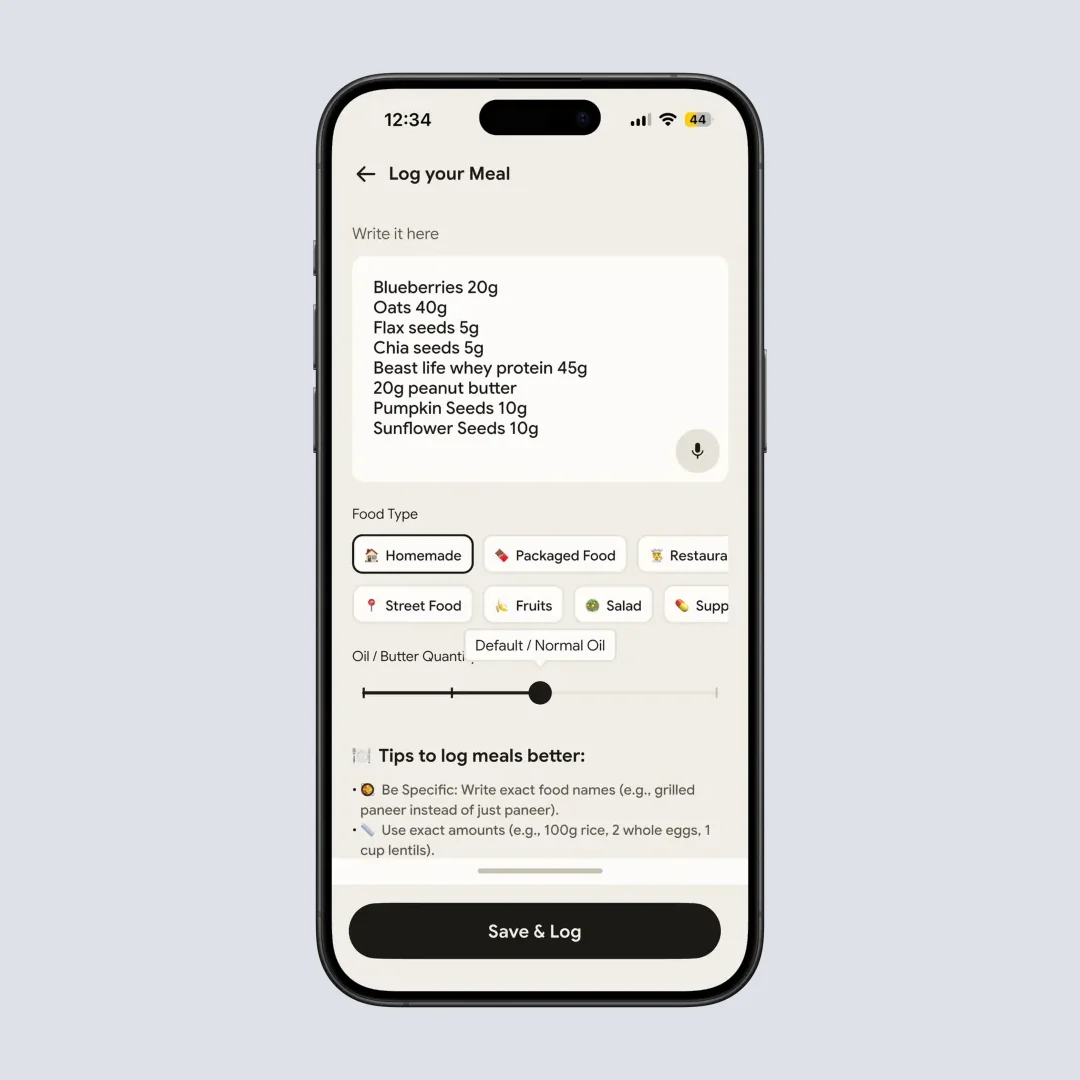
A manual entry screen is the fallback for anything a photo cannot resolve, such as a restaurant portion.

One reading is noise. The number that matters is the average of your same-day weekly readings.
The Three Week Rule That Beats Any Calculator 🔍
Here is the step 4 promised at the top. Every equation in this post, the 7,700 kcal figure included, is a population average applied to one body. Hall's paper says the cost per kilogram shifts with how much fat you start with, so two people at 80 kg eating 1,880 kcal will not lose at the same rate (Hall, 2008).
The rule: log honestly for 14 to 21 days without changing anything, take the weekly average, and treat that number as the real answer. Then adjust once. Less loss than predicted, cut 150 to 200 kcal or add daily movement. More than 1% of body weight a week, eat more. That matches NIDDK's cadence of food daily and weight weekly (NIDDK, 2026).
The table earlier carries the counterintuitive part. Of its six rows, only one, the 100 kg man at 2,710 kcal maintenance, can run a 1 kg week without dropping under a sensible floor. Everyone else asking for 1 kg a week is really asking for a longer calendar, and three weeks of your own data tells you which you are.
Putting Your Number to Work ✅
Your target is your maintenance minus a deficit your floor allows. For most adults that lands between 400 and 600 kcal a day, gives about half a kilogram a week, and reaches 10 kg in about four to six months. One kilogram a week is legitimate only when maintenance is high enough that the target still clears a sensible floor.
What decides the outcome is whether you log honestly for three weeks and adjust from your own average. A free calorie tracker handles the daily logging, and NutriScan's free plan includes 5 scans a week, with unlimited scanning on Premium at about $59 a year. Pick the one you will still open on a Thursday night.
Recap: everything you completed this round
You finished the run, so save this for next time.
⏱️ Progress 4/4 • ~4 minutes in • Nicely done
✅ Step 1: Maintenance found
✅ Step 2: Deficit set above your floor
✅ Step 3: Protein fixed first
✅ Step 4: The three week rule (revealed)
Frequently Asked Questions ❓
How many calories do I need to cut to lose 1 kg? About 7,700 kcal in total. Kevin Hall's modeling paper puts the classic rule at 3,500 kcal per pound, or 32.2 MJ per kilogram, which is roughly 7,700 kcal per kilogram of body weight. Spread across seven days that is about 1,100 kcal a day, which is why 1 kg a week is hard for anyone not carrying a lot of body fat.
How many calories a day should a woman eat to lose weight? The NHS puts the average woman's daily need at about 2,000 kcal, so a 500 to 550 kcal deficit lands near 1,450 to 1,500 kcal a day and about 0.5 kg per week. Your own maintenance depends on age, height, weight and activity, so calculate it rather than using the average. NIH NHLBI puts most women's weight-loss plans at 1,200 to 1,500 kcal a day, so this page treats 1,200 as the lowest target without medical supervision.
How many calories a day should a man eat to lose weight? The NHS puts the average man's daily need at about 2,500 kcal, so a 500 to 550 kcal deficit gives roughly 1,950 to 2,000 kcal a day. An 80 kg lightly active man in his thirties maintains near 2,430 kcal, so his target sits closer to 1,880 kcal. NIH NHLBI puts men's weight-loss plans at 1,500 to 1,800 kcal a day, so this page treats 1,500 as the lowest target without supervision.
Is it realistic to lose 10 kg in a month? No. Ten kilograms in 30 days needs a deficit of about 2,570 kcal every single day, more than most people burn in total. The CDC recommends 1 to 2 pounds a week and warns that unrealistic goals leave people feeling defeated. Ten kilograms over three to four months is the version that holds.
How long does it take to lose 30 pounds? At the CDC's recommended 1 to 2 pounds a week, 30 pounds takes 15 to 30 weeks, so four to seven months. Doing it in a month would need a deficit near 3,500 kcal a day, which no ordinary eating plan produces. Weight loss drugs do not change that math, they change appetite so the deficit is easier to hold.
Is there a free app that counts calories? Yes, several trackers have free tiers covering logging, a calorie target and a food database. Free plans usually limit extras such as photo scanning, micronutrient views or coaching. A pooled analysis of 20 studies found people stuck with mobile self-monitoring better than paper diaries at six and twelve months, so the app you will actually open is the right one.
Do the calories on my Apple Watch tell me how much to eat? Treat them as a rough signal. Wrist devices estimate activity energy from heart rate and motion, and those estimates carry real error, especially for strength work. Set your target from a maintenance estimate and your own weight trend over two to three weeks. Our Apple Watch tracker comparison covers which apps read those numbers well.