Intermittent Fasting: Plans, Hours, and What the Evidence Shows
 ChatGPT
 Claude
 AI Mode
 Perplexity
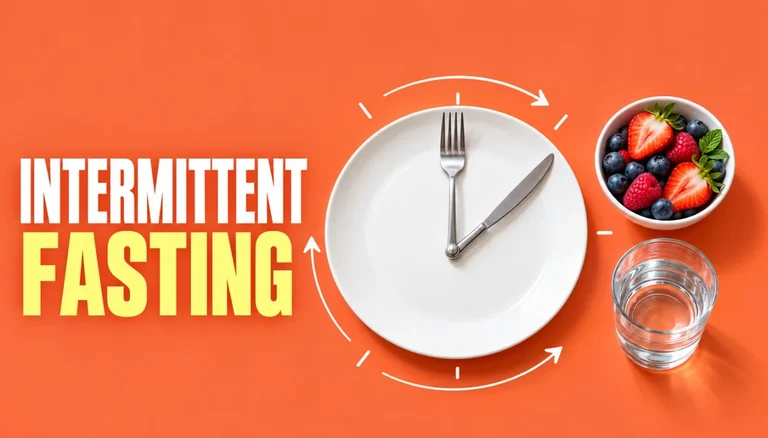
Intermittent fasting means eating inside set hours or on set days and eating little or nothing the rest of the time. It changes when you eat, not what you eat. The daily versions fast for 14 to 18 hours. Alternate-day fasting fasts every other day; the 5:2 plan uses two very low-calorie days a week.
Evidence checked on October 14, 2026 against the 2026 Cochrane review "Intermittent fasting for adults with overweight or obesity" (Garegnani and colleagues), the 2022 New England Journal of Medicine trial by Liu and colleagues, a meta-analysis of randomized trials in type 2 diabetes, and a 2022 review in the journal Nutrients (Vasim, Majeed and DeBoer).
Summary
- Hours: time-restricted eating fasts 14 to 18 hours a day. Alternate-day fasting fasts 24 hours every other day. The 5:2 plan uses two low-calorie days a week.
- Weight loss: the 2026 Cochrane review of 22 trials and 1,995 adults found little to no difference against regular dietary advice (-0.33 percentage points of body weight, 95% CI -0.92 to 0.26).
- Compared with counting calories: in a 12-month trial of 139 adults, an 8:00 a.m. to 4:00 p.m. eating window plus calorie restriction lost 8.0 kg and calorie restriction alone lost 6.3 kg. The gap was not statistically significant.
- A1c: a meta-analysis of 11 studies in type 2 diabetes found no difference in HbA1c against a usual diet.
- Pick the plan you can keep. The Cochrane authors say patients need to weigh "willingness and readiness" and how practical and sustainable the pattern is for them.
What are the types of intermittent fasting?
A 2022 review in Nutrients lists the common protocols this way:
| Protocol | How often | Fast length | Detail |
|---|---|---|---|
| Time-restricted eating | Every day | 14 to 18 hours | Food is eaten over about a 6-hour period |
| Alternate-day fasting | Every other day | 24 hours | Normal eating on the days between |
| 5:2 | Two days a week | Two low-calorie days | 500 to 600 kcal on each of those two days in the trial below; normal eating the other five days |
The Cochrane review groups these as time-restricted feeding, periodic fasting, alternate-day fasting and modified alternate-day fasting, and it counts a trial only if the intervention ran at least four weeks.

How many hours do you fast on intermittent fasting?
It depends on the plan. The ratio names give the fasting hours first and the eating hours second:
| Plan | Fasting | Eating window |
|---|---|---|
| 14:10 | 14 hours | 10 hours |
| 16:8 | 16 hours | 8 hours |
| 18:6 | 18 hours | 6 hours |
| 20:4 | 20 hours | 4 hours |
The Liu trial in the New England Journal of Medicine used an eating window from 8:00 a.m. to 4:00 p.m., which is a 16:8 pattern.
The fasting plans in the NutriScan app match this table, with 16:8 marked as the most popular. They are covered further down.
How much does intermittent fasting help with weight loss?
Less than the headlines suggest. The 2026 Cochrane review pooled 22 randomized trials with 1,995 adults who had overweight or obesity. The trials were published between 2016 and 2024, and outcomes were measured up to 12 months.
| Comparison | Result (percentage of starting body weight) | Trials and people | Certainty |
|---|---|---|---|
| Intermittent fasting vs regular dietary advice | -0.33 (95% CI -0.92 to 0.26) | 21 trials, 1,430 | Low |
| Intermittent fasting vs no intervention | -3.42 (95% CI -4.95 to -1.90) | 6 trials, 427 | Moderate |
Read the first row as a tie. People who followed a fasting pattern lost about the same as people who got ordinary diet advice. Only 4 trials with 472 people reported how many reached a 5% loss, and that result was very uncertain (risk ratio 0.98, 95% CI 0.82 to 1.18).
The second row shows that fasting beats doing nothing by about 3.4 percentage points. For a person who weighs 90 kg, 3.4% is roughly 3 kg. The review authors still rated that as likely little to no difference (moderate certainty), and they wrote that the studies were short and that data beyond 12 months are missing.
Does time-restricted eating beat counting calories?
One of the larger single trials asked that question directly. Liu and colleagues randomly assigned 139 adults with obesity in China to eat only between 8:00 a.m. and 4:00 p.m. or to eat at any hour. Both groups followed the same calorie limit for 12 months: 1,500 to 1,800 kcal a day for men and 1,200 to 1,500 kcal for women.
- Eating-window group: -8.0 kg (95% CI -9.6 to -6.4).
- Calorie-limit-only group: -6.3 kg (95% CI -7.8 to -4.7).
- Difference: -1.8 kg (95% CI -4.0 to 0.4, P = 0.11).
The authors concluded that time-restricted eating "was not more beneficial" for weight, body fat or metabolic risk factors than daily calorie restriction. Both groups followed the same calorie limit.
How much does intermittent fasting lower A1c?
For people with type 2 diabetes, the pooled answer is that it does not lower it more than a normal diet. A meta-analysis of randomized trials combined 11 studies with 879 patients. The pooled standardized mean difference in HbA1c was -0.08 (95% CI -0.20 to 0.04, p = 0.19), and the authors concluded that intermittent fasting and a usual diet "have no difference in terms of glycaemic control". Fasting blood glucose also showed no difference (SMD 0.06, 95% CI -0.25 to 0.38).
The same meta-analysis found a small effect in people aged 60 or under (SMD -0.20, 95% CI -0.39 to -0.01), so age may matter, but that is a subgroup split and should be read as a lead and not a result.
A 52-week trial described in the Nutrients review compared a 5:2 plan (500 to 600 kcal on two days a week) with a steady 1,200 to 1,500 kcal a day in 137 adults with obesity and type 2 diabetes. HbA1c fell by 0.3 points on 5:2 and 0.5 points on the daily limit, which the authors judged equivalent. Weight loss was 6.8 kg vs 5.0 kg, and that gap was not statistically significant (Carter 2018, JAMA Netw Open).
If you have diabetes or take glucose-lowering medication
Fasting can cause low blood sugar, and a multi-country study of Ramadan fasting cited in the Nutrients review found that the risk rose when people also took antidiabetic drugs. Talk to your doctor before you try any fasting plan, because your doses may need to change.

What are the side effects and who should avoid it?
The Nutrients review lists hypoglycemia, dizziness and weakness as the commonly reported side effects, and says evidence on harms is thin because most trials last weeks to months. The Cochrane review found no clear difference in adverse events against regular advice (risk ratio 1.45, 95% CI 0.64 to 3.28), and it rated that evidence very low certainty.
The same Nutrients review says fasting is not recommended for people with hormonal imbalances, pregnant and breastfeeding women, young children, adults of advanced age and people with weakened immune systems, and that people with eating disorders should avoid it. If any of that applies to you, a fasting plan is a conversation for your doctor first.
Should you try intermittent fasting?
The evidence supports a narrow answer. Fasting trials show weight loss close to what ordinary diet advice gives, and the Cochrane authors list calorie restriction first among the mechanisms. If a 16:8 window makes it easy for you to skip late-night snacking, it is a fair tool. If it leaves you tired, hungry at work or overeating in the window, a different pattern with the same calorie target will give you the same result.
Whatever you choose, what you eat in the window still counts. Oatmeal, a banana or eggs each have a calorie count on their NutriScan food pages. If you are not sure whether black coffee breaks a fast, read our guide on whether coffee breaks a fast, and our page on black coffee lists what a cup contains. For a long fast, see one person's account in the 36-hour water fast.
How do you track a fast and your meals in one app?
The Fasting tab on the NutriScan Home screen is on the free plan. The first time you open it, you pick a plan: 14:10, 16:8 (marked most popular), 18:6, 20:4, or Custom. Custom lets you choose 12 to 23 hours, or a longer fast of 24, 36, 48, 72 hours or 7 days, and it shows "Stay hydrated. Consult your doctor before extended fasts."
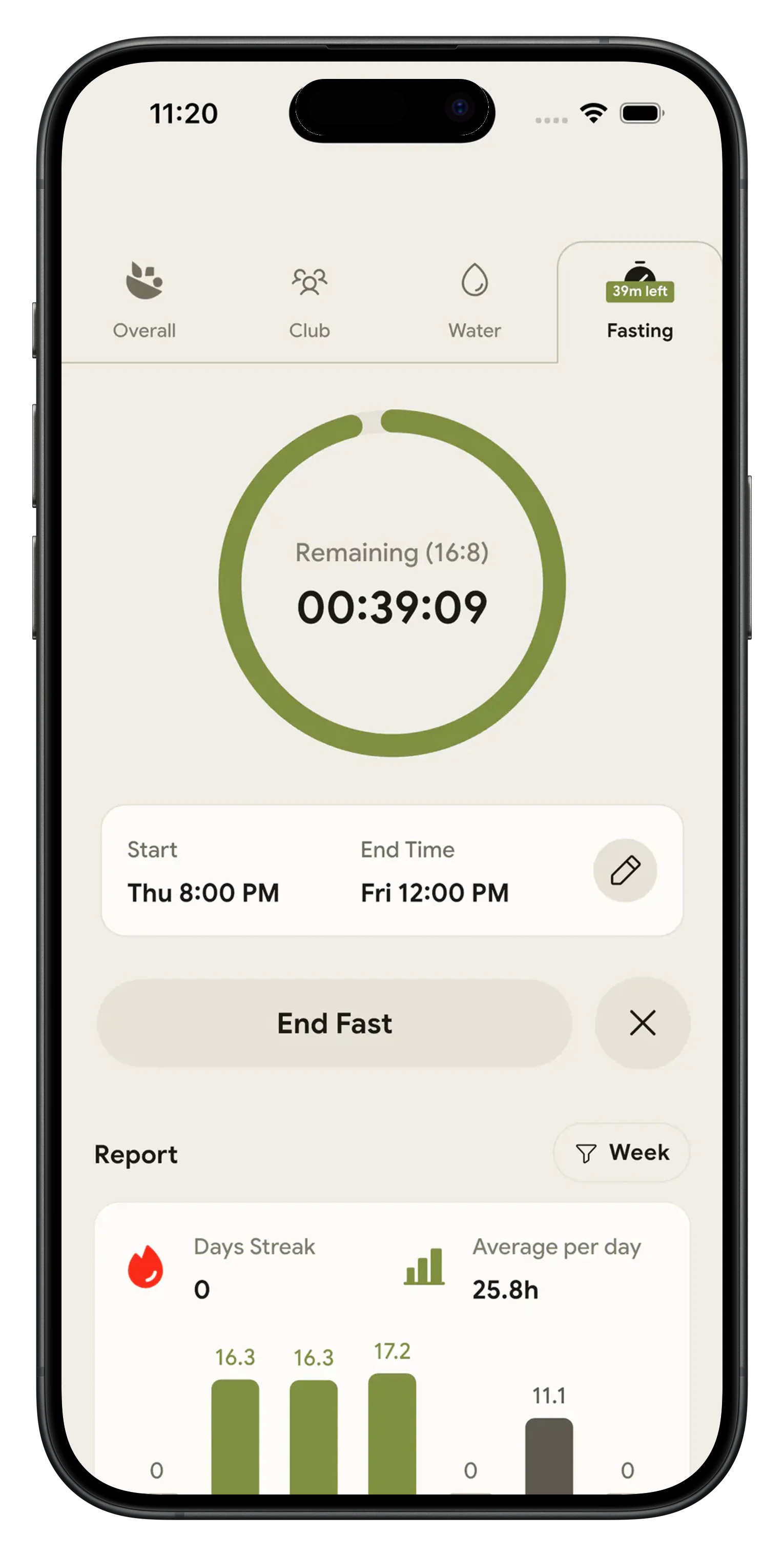
An active fast in NutriScan. The ring counts down the time left and shows "Bonus" once you pass your target.
- Countdown: a live timer sits on the lock screen while you fast, as an Android notification or an iOS Live Activity.
- Streak: a day counts when you finish a fast at 70% or more of your target. Ending a fast early shows the percentage and tells you whether it counts.
- History and report: the last 20 fasts are listed with a status icon, and the Report card shows your streak and average fasting hours over a week, a month or 3 months.
- Edit and undo: change a start time up to 7 days back, or swipe a past fast to delete it, with 5 seconds to undo.
Because the timer lives next to your food log, you can see what you ate in your window. Photo scanning is on the free plan at 5 scans a week. Our comparison of fasting timer and food log apps shows how other apps handle the two together, and if you track glucose, the guide to apps for CGM users covers that side.
What else do people ask about intermittent fasting?
What is intermittent fasting?
Intermittent fasting is an eating pattern that alternates periods of eating with periods of little or no food. The main versions are time-restricted eating (a fast of 14 to 18 hours each day), alternate-day fasting (24 hours of fasting every other day) and the 5:2 pattern (two low-calorie days a week), as described in a 2022 review in the journal Nutrients.
How many hours should you fast for intermittent fasting?
The daily plans fast 14 to 18 hours. 16:8 means 16 hours without food and an 8-hour eating window. The 12-month NEJM trial from Nanfang Hospital used an eating window of 8:00 a.m. to 4:00 p.m., which is a 16-hour fast. Alternate-day fasting uses a 24-hour fast every other day, and the 5:2 plan uses two low-calorie days a week.
How much does intermittent fasting help with weight loss?
Not more than ordinary diet advice. The 2026 Cochrane review of 22 trials and 1,995 adults found a mean difference of -0.33 percentage points of body weight against regular dietary advice (95% CI -0.92 to 0.26), which the authors rate as little to no difference. Against no intervention, intermittent fasting groups lost 3.42 percentage points more (95% CI -4.95 to -1.90).
Does time-restricted eating beat counting calories?
In one 12-month trial of 139 adults with obesity, eating only between 8:00 a.m. and 4:00 p.m. on top of calorie restriction led to 8.0 kg of weight loss, against 6.3 kg for calorie restriction alone. The 1.8 kg gap was not statistically significant (95% CI -4.0 to 0.4, P = 0.11).
How much does intermittent fasting lower A1c?
A meta-analysis of 11 studies and 879 people with type 2 diabetes found no difference in HbA1c against a usual diet (standardized mean difference -0.08, 95% CI -0.20 to 0.04). In a 12-month trial of 137 adults, HbA1c fell by 0.3 points on the 5:2 plan and 0.5 points on the daily calorie limit, a difference the authors judged equivalent. Intermittent fasting did not beat the other approach.
Who should not try intermittent fasting?
A 2022 review in Nutrients says fasting is not recommended for people with hormonal imbalances, pregnant and breastfeeding women, young children, older adults in advanced age, people with weakened immune systems, and people with eating disorders. People who take insulin or other glucose-lowering drugs face a risk of low blood sugar and should talk to their care team before they fast.
Is there a free fasting timer?
Yes. The Fasting tab in NutriScan is on the free plan. It has 14:10, 16:8, 18:6 and 20:4 plans plus a custom plan, a live countdown, a streak and a history of your last 20 fasts.