Is Henry Meds Free? Henry Meds GLP-1 Cost, Insurance and Refunds
 ChatGPT
 Claude
 AI Mode
 Perplexity
Henry Meds is not free: the evaluation is, but a GLP-1 plan starts at $179 a month, per Henry's GLP-1 page, and that one price includes the drug, provider visits, supplies and shipping. Paying 12 months up front lowers the rate to $119 a month for liraglutide and $197 for injectable semaglutide, according to Henry's programs page. Month to month, injectable semaglutide is $297. Every GLP-1 on the list is a compounded drug, and none of it goes through insurance.
I work on the NutriScan team, which makes a food tracking app, so read this as an outsider's summary of Henry's public pages. I did not sign up. I read every Henry page below directly on October 23, 2026, and again on November 8, 2026. Prices and terms did not change between the two reads, and none of the pages was captcha-gated. The pages disagree with each other more than once, and I flag each gap where it shows up. Henry changes prices often, so check the live page before you pay.
Here is the checklist I worked through, and the order I cover it in:
- [ ] What the free evaluation covers
- [ ] The monthly and prepaid prices, plan by plan
- [ ] Insurance, HSA and FSA
- [ ] Cancellation and the 48-hour rule
- [ ] The one clause that can get part of a prepaid year refunded (last, in the refunds section)
Prices and policies reflect Henry Meds pages re-read November 8, 2026. The programs page is dated December 3, 2025 and the terms of service August 6, 2026. Henry serves members in the states it supports. Plans, fees and drug prices change, and nothing here is medical advice. Talk to a clinician about whether a GLP-1 drug is right for you.
Henry Meds pricing at a glance (Henry pages re-read November 8, 2026)
- Evaluation: free, up to 15 minutes, no charge if you are not approved (terms of service).
- Plans: $179 a month for compounded liraglutide, $297 for injectable semaglutide, $149 for phentermine, month to month (programs page).
- Prepaid 12 months: $119 a month for liraglutide, $197 for injectable semaglutide (programs page).
- Insurance: self-pay only; Medicare and Medicaid are not accepted (terms of service).
- HSA and FSA: possible in some cases, not guaranteed (terms of service).
- Refunds: subscription fees are generally non-refundable; a $30 consultation fee is not refundable once a prescription is issued (refund policy).
- App ratings (read October 23, 2026): 2.3 stars from 9 ratings on the App Store and 3.0 from 6 on Google Play (App Store).
Is Henry Meds free? The quick answer
No. Henry Meds is a paid telehealth subscription with a free front door. The weight management page says "Free evaluations offered for many of our treatments," and the terms define it as an evaluation of up to 15 minutes that checks your health history. If the provider does not approve treatment, the terms say you are not charged and no subscription starts. If the provider writes a prescription, you are enrolled right away and your card is charged.
The plan price is meant to cover everything. The GLP-1 page says the monthly price "includes the cost of your provider visits, medication, supplies, and ongoing support." That differs from a membership-plus-drug model, where you pay a monthly fee and then pay for the drug separately. I found no separate drug line on any Henry page.

Three choices set your bill:
- Which product. Month-to-month prices run from $149 for phentermine to $297 for injectable semaglutide.
- How long you pay for. A 12-month term paid in full cuts injectable semaglutide by $100 a month.
- How much the pages agree. Several prices on the landing page do not appear on the programs page, so the checkout screen is the price that counts.
What Henry Meds costs, plan by plan
Henry has no pricing page. The address henrymeds.com/pricing returns a 404, and the real list sits on the programs page under the legal links, last updated December 3, 2025. The terms link to it as the current list of programs and prices.
| Product | Month to month | 6 months | 6 months paid in full | 12 months | 12 months paid in full |
|---|---|---|---|---|---|
| Liraglutide, daily injection | $179 | $1,074 | $894 | $2,148 | $1,428 |
| Semaglutide, weekly or biweekly injection | $297 | $1,782 | $1,482 | $3,564 | $2,364 |
| Sublingual semaglutide, tablets or drops | $179 or $249 | $1,074 | $1,014 | $2,148 | $1,788 |
| Phentermine, daily tablets | $149 | none listed | none listed | none listed | none listed |
The "paid in full" column is the lump-sum price, so the lowest monthly rates are $149 for 6 months of liraglutide, $119 for 12 months of liraglutide, $247 and $197 for the same terms of injectable semaglutide, and $149 for 12 months of sublingual semaglutide. The higher column equals the month-to-month price times the number of months, so a term plan without the up-front payment saves nothing.
The weight management page shows lower "from" prices with a footnote: "With a 12-month plan, paid up front in full." It lists semaglutide injection at $197, oral semaglutide at $164, microdose injection at $149, microdose oral at $99 on a 3-month plan, tirzepatide tablets at $234, liraglutide at $119 and phentermine at $149. On November 8, 2026, it still carried "Up to $150 off for new patients" and a "New Year. New You." banner, so the offer text is old.
Where the pages conflict:
- The "starts at" price. The GLP-1 page FAQ says GLP-1 medication "starts at $179/month." The weight management page lists $99, $119, $149 and $164 for GLP-1 products. The $179 is the month-to-month floor, and the lower figures need a prepaid term.
- Sublingual semaglutide has two monthly prices. The programs page lists $249 a month under one heading and $179 a month under a second heading, with the same 6-month and 12-month totals under each.
- Tirzepatide tablets. The programs page shows $1,047, or $891 paid in full, for a "3-month supply," and the description underneath says 6 months. The weight management page shows $234 a month on a 12-month plan, which would be $2,808 a year, a figure that is not on the programs page.
- Semaglutide tablets. The programs page lists $747, or $537 paid in full, for a 3-month supply, and the description names tirzepatide. That looks like a copied line.
- Shipping rhythm. The GLP-1 page says injectables ship every 45 days and tablets every 90 days. The programs page lists shipments every 60 days for liraglutide and every 60, 70 or 90 days for semaglutide.
- Who can join. The FAQ says Henry "is open to all adults," and the GLP-1 page says you must be at least 18 and no older than 70.
What the plan includes, and what it does not
The FAQ says the monthly bill covers provider visits, medication and supplies, shipping and ongoing care, "without any hidden or surprise fees." A visit is a video call or, in some states, an independent provider review without video. You message the provider through a patient portal, and most people receive their first shipment within 8 to 10 business days after speaking to the provider. California can take longer because of extra compound testing.

The terms add three limits that the marketing pages skip:
- Henry does not practice medicine. The terms say licensed providers, pharmacies and labs fill those roles independently, and "enrollment in Henry Meds does not guarantee that you will be prescribed any medication."
- The $30 consultation fee. Under a heading called Medical Consultation Fee, the terms say Henry "collects a medical consultation fee of $30.00 for each provider evaluation that results in a prescription." The wording says it is part of the "bundled billing structure." I could not tell whether it is added to the plan price or taken out of it. Ask at checkout.
- Labs. The terms say a lab cost ordered through Henry is "included in your subscription or total charges." The programs page lists labs as included only on the testosterone plans, and the GLP-1 rows mention none. If your provider orders blood work, ask who pays.
Two items checked off, three to go. Insurance and HSA come next, and the refund clause is still waiting at the end.

Compounded drugs: what you are buying
Every GLP-1 on Henry's list is compounded: liraglutide, semaglutide and tirzepatide tablets. I found no branded Wegovy, Ozempic, Zepbound or Mounjaro product on any page. The GLP-1 page defines the term plainly: "Compounded medications do not undergo pre-market review or an FDA-approval process. They may differ from commercially available or FDA-approved drugs in efficacy, safety, risk, and side-effect profiles." The terms repeat that compounded drugs are "not reviewed or approved by the U.S. Food and Drug Administration (FDA) for safety, effectiveness, or quality."
The same page then says something that matters for the next section: "Data from clinical trials on FDA-approved medications should not be used to make assessments related to compounded medications." Henry states that itself. I use it as the rule for reading its weight loss claims.
The pharmacy side also differs by page. The GLP-1 page says compounding happens in a 503(A) pharmacy or a 503(B) outsourcing facility. The terms name only Section 503A.
Insurance, Medicare and Medicaid
There is no insurance route. The terms of service put it in a plain-language box: "Henry Meds is self-pay only. We do not participate in Medicare, Medicaid, or insurance. We do not submit insurance claims, and you agree not to do so." The long version says you also agree not to submit claims to Medicare, Medicaid or other government payors, and that you will not be balance-billed. It adds that payment for Henry services is "generally not eligible for reimbursement through health insurance."
That is a real tradeoff. A no-insurance plan has no prior authorization, no formulary denial and no copay math. It also means a covered branded drug, which could cost you a copay elsewhere, is not an option here. The homepage FAQ puts the upside this way: you do not need insurance, and "Your provider visits, medication and supplies, shipping, and ongoing care are all included in your plan price."
HSA and FSA
Unlike some competitors, Henry's pages do mention these accounts. The terms say "Use of flexible spending accounts (FSAs), health savings accounts (HSAs), or similar benefits may be possible in some cases, but eligibility is not guaranteed and depends on the rules of your benefit administrator." You are "solely responsible for confirming whether your expenses qualify." Call your plan administrator before you pay, and ask whether a telehealth subscription and a compounded prescription count as separate items.
What a year of Henry Meds costs
This is my arithmetic from the programs page, not a Henry quote. I leave out the possible $30 consultation fee, any labs, and promo discounts, since the pages do not say how they stack.
| Product | Month to month, 12 months | 12 months paid in full | Difference |
|---|---|---|---|
| Liraglutide | $2,148 | $1,428 | $720 |
| Injectable semaglutide | $3,564 | $2,364 | $1,200 |
| Sublingual semaglutide (at $179) | $2,148 | $1,788 | $360 |
| Phentermine | $1,788 | not offered | none |
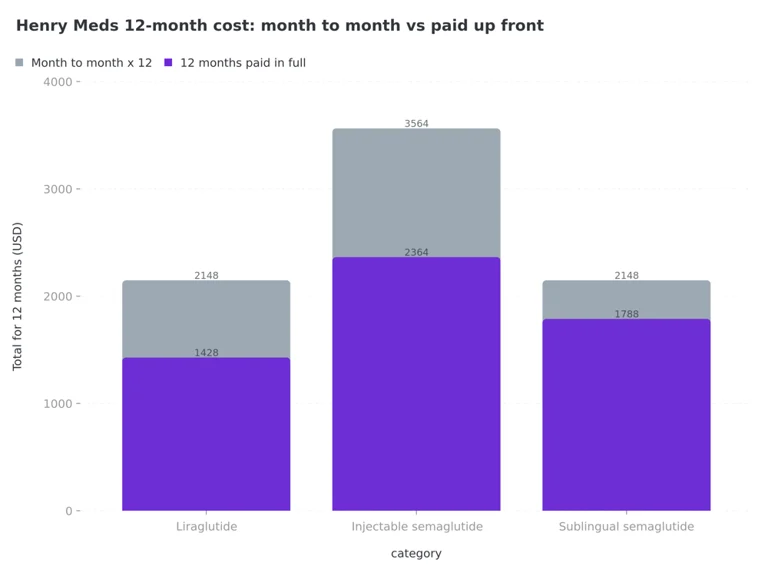 Figure 1: Paying 12 months up front saves $720 on liraglutide, $1,200 on injectable semaglutide and $360 on sublingual semaglutide. Source: Henry's programs page, my arithmetic.
Liraglutide at $1,428 is the lowest GLP-1 year on the programs page. Injectable semaglutide at $2,364 matches the $197 a month shown on the weight management page. The tradeoff is the exit. The FAQ says that on a multi-month plan "you may be required to pay out the rest of your balance" unless a healthcare provider says you cannot continue for medical reasons. A $1,428 or $2,364 payment up front is not returned if you stop at month four.
Cancellation, refunds and billing
Henry's refund rules sit in two places, and both are strict. The clause I promised is the medical discontinuation exception, in the list below.
- Before a prescription. If you are not approved after the free evaluation, you are not charged.
- Subscription fees. The refund policy says they "are billed under the terms accepted at enrollment and are generally non-refundable." A billing error such as a duplicate charge is corrected with a credit.
- Prescription products. They are "final sale upon shipment" and cannot be returned.
- The $30 consultation fee. It is non-refundable once a prescription is issued. The policy also lets Henry deduct a "reasonable processing fee" from any refund.
- The medical exception. If you are on a multi-month plan and must stop for medical reasons, Henry may give a prorated refund of the unused part. You need a letter from an MD, DO, NP or PA saying continuing therapy is medically contraindicated, and Henry's clinical team must approve it. Dispensed medication is not refunded.
- Wrong or damaged shipments. A pharmacy dispensing error gets a free replacement. For damage or a suspected temperature problem you must report within 48 hours of delivery, with photos if asked. Henry may limit reshipments to one in 90 days.
WARNING
I found no money-back guarantee on results. A prepaid 6 or 12 month term is not returned if you stop early, so pick a term you are sure you will finish.
On canceling, the FAQ says to use your patient portal account, email ask@henrymeds.com or call 909-787-2342. The terms say renewals are automatic unless you cancel "at least 48 hours before the end of your current subscription term." Cancellation takes effect at the end of the current billing period, and "No refunds are available for a partially used subscription period, except where required under applicable law." The terms say Henry may send renewal notices 3 to 7 days ahead on monthly plans and aims for 15 to 45 days ahead on multi-month plans.
The homepage FAQ also says "You can easily cancel any time." Read that next to the balance-payout line in the same answer. Canceling is easy. Getting money back for a prepaid term is not.
What the research says
The drugs behind these trials are branded products. None of the trials below tested Henry, and none tested a compounded drug.
- Semaglutide. In STEP 1, 1,961 adults without diabetes got semaglutide 2.4 mg or placebo, plus lifestyle intervention, for 68 weeks. Mean weight change was -14.9% against -2.4%, and 69.1% on the drug lost 10% or more against 12.0% (Wilding et al., 2021). Novo Nordisk funded the trial.
- Tirzepatide. In SURMOUNT-1, 2,539 adults got tirzepatide or placebo for 72 weeks. Mean weight change at the 15 mg dose was -20.9% against -3.1% on placebo (Jastreboff et al., 2022).
- Drug plus behavioral therapy. In STEP 3, 611 adults got semaglutide or placebo with intensive behavioral therapy over 68 weeks. Weight fell 16.0% against 5.7%, and 75.3% lost 10% or more against 27.0% (Wadden et al., 2021).
- After stopping. In the STEP 1 extension, 327 participants were analyzed after treatment stopped. They regained 11.6 percentage points of the lost weight by week 120 (Wilding et al., 2022). A paid year can end before your weight settles.
- Heart outcomes. In SELECT, 17,604 patients with overweight or obesity and established cardiovascular disease had a primary cardiovascular event in 6.5% on semaglutide against 8.0% on placebo, a hazard ratio of 0.80 (Lincoff et al., 2023).
On Henry's own results, the GLP-1 page says people taking injectable semaglutide with Henry "lost ~18% of their body weight in a year." Its footnote cites Rubio et al., 2025, a retrospective study of 1,200 adults who started compounded semaglutide between 2022 and 2024. The paper reports a mean loss of 18.39% at week 50 on doses up to 1 mg a week. I read the full text and found four things worth knowing. The authors work for Colchis Medical Services, and the correspondence address is a henrymeds.com email. There was no control group. Weight was patient-reported during virtual visits. And the text I extracted does not say how many of the 1,200 were still being measured at week 50, so the average may describe the people who stayed. The paper's abstract says loss "approaching 20%," while Henry's page says 18%. I did not find the study in PubMed, so I treat it as a company-linked report, not independent proof.
What members say in app reviews
Henry's app is small, so the review data is thin. The App Store listing, read October 23, 2026, shows "Henry Meds" from Adonis Health Inc., version 1.18.80 released October 7, free to download, with 2.3 stars from 9 ratings. The reviews feed returned only 4 written reviews, so I cannot report an average of the last 50. Their ratings were 1, 1, 4 and 1, an average of 1.75, and three of the four describe the app crashing or cutting off messages after an iOS update. The Google Play listing shows 3.0 from 6 ratings.
The most serious review, dated May 13, 2026, says the company stopped responding and stopped sending prescriptions at "$400/mo." I cannot verify any account, and one review is not a pattern. The pricing question for readers is different: the $400 figure does not match any plan on the programs page, which tops out at $297 a month for the GLP-1 plans. If you pay more than the listed price, ask for an itemized statement. Florida's weight-loss Bill of Rights, which Henry posts on its own legal pages, lists the right to an itemized statement of price, including extra products, exams and lab tests.
I did not read Trustpilot reviews. Henry links to them from its own pages, and the volume there is a better guide than these few app reviews.

Henry Meds compared with Noom Med
Henry and Noom Med both sell a subscription that wraps a prescription in a program, and they differ in what the wrapper is. Henry sells a compounded drug with provider access, and I found no coaching, lessons or food logging on its pages. Noom Med bundles behavior coaching. Our Noom Med pricing breakdown covers its tiers, our Noom Med worth-it review weighs cost against support, and our Noom pricing guide compares the weight and medication tracks.
One correction to our own writing. Our list of Noom Med alternatives says Henry publishes no price on any page it could reach. The programs page does list prices, and this post is the updated read. Our WeightWatchers pricing guide covers another paid option with a clinical arm. For a program that bills the drug separately from the membership, see our Mochi Health pricing guide.
Who Henry Meds fits, and who should look elsewhere
It may fit you if:
- You want one bundled monthly price with the drug, visits and shipping inside it.
- You pay cash and do not need insurance involved.
- You are comfortable with a compounded drug and its FDA status, and you will stay long enough to use a prepaid 6 or 12 month term.
You may want another option if:
- You want a branded, FDA-approved drug. I found none on Henry's pages.
- You are unsure you will stay. Prepaid terms are not returned, and subscription fees are generally non-refundable.
- You rely on Medicare, Medicaid or a plan that covers GLP-1 drugs. Henry accepts none of them.
- You are over 70, since the GLP-1 page says eligibility ends there.
How to price Henry Meds before you pay: 5 steps
- Pick the product first. Henry sells compounded liraglutide, semaglutide and tirzepatide tablets, plus phentermine. Month-to-month prices run $149 to $297, and the plan price includes the drug, visits and shipping.
- Choose the term. A 12-month plan paid up front cuts injectable semaglutide from $297 to $197 a month and liraglutide from $179 to $119. Month-to-month costs more but ends sooner.
- Plan for the extras. The free evaluation can lead to a $30 consultation fee when a prescription is written. Ask whether it is on top of the plan price, and whether any lab cost applies.
- Know the refund rules. Prescription products are final sale and subscription fees are generally non-refundable. A prorated refund needs a clinician letter saying therapy is medically contraindicated.
- Set a cancel reminder. Cancel at least 48 hours before your term ends, in the portal, by email or by phone, or the renewal goes through.
Tracking food on or off a GLP-1 drug
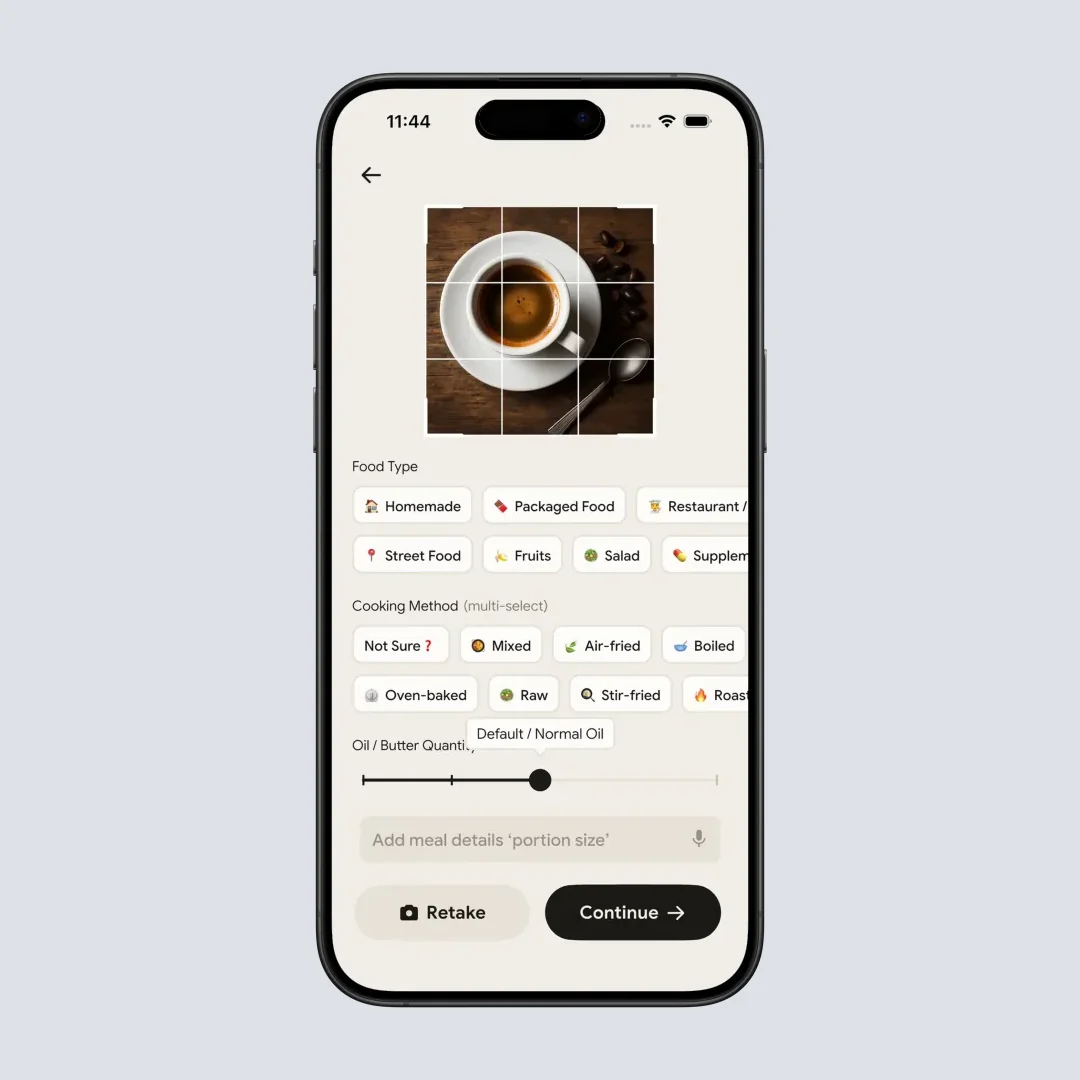
Whatever program you pick, a record of what you eat makes visits more useful, especially when appetite drops and protein falls behind. NutriScan, the app my team makes, estimates calories and macros from a photo of a meal, and it lets you log blood glucose readings by hand for free. It does not import data from a continuous glucose monitor. It has a Free plan with 5 AI food scans a week and a Premium plan at about $59 a year, described in our pricing breakdown. NutriScan has no clinicians, cannot prescribe, and does not replace Henry or your doctor. Our meal scan guide shows how photo logging works, and our Ozempic diet plan covers what to eat when appetite drops. Photo estimates can also miss hidden oil in mixed dishes. What the app gives you is a record to bring to an appointment.

TIP
Bring a week of meal photos or notes to your next provider message. It gives the clinician something concrete to adjust against.
Henry Meds pricing FAQ
Is Henry Meds free?
No. The evaluation is free and lasts up to 15 minutes, but a GLP-1 plan starts at $179 a month on Henry's GLP-1 page. A 12-month plan paid up front brings liraglutide to $119 a month and injectable semaglutide to $197 a month. The medication is included in the plan price.
How much does Henry Meds cost per month?
On the programs page, last updated December 3, 2025, month-to-month prices are $179 for compounded liraglutide, $297 for injectable semaglutide and $149 for phentermine. Paying 12 months up front lowers the monthly rate to $119, $197 and $149 for the first two products.
Does insurance cover Henry Meds?
No. Henry Meds is self-pay only and does not participate in insurance, Medicare or Medicaid. The terms say you agree not to submit claims. There is no prior authorization step either.
Can I get a refund from Henry Meds?
Rarely. Subscription fees are generally non-refundable, prescription products are final sale, and a $30 consultation fee is not refundable once a prescription is issued. A prorated refund is possible only if a clinician documents that continuing therapy is medically contraindicated.
Can I use my HSA or FSA for Henry Meds?
Maybe. Henry's terms say HSA and FSA use may be possible in some cases but is not guaranteed and depends on your plan administrator. Ask your administrator before you pay.
How do I cancel Henry Meds?
Cancel in your patient portal account, by emailing ask@henrymeds.com or by calling 909-787-2342. The terms say to cancel at least 48 hours before the end of your term, and cancellation takes effect at the end of the billing period. On a multi-month plan you may owe the remaining balance.