Is Omada Free? Omada Health Cost, Insurance and Refunds
 ChatGPT
 Claude
 AI Mode
 Perplexity
Omada costs $0 for members whose employer or health plan covers it, and Omada's help center says "Omada does not offer self-pay at this time," so there is no price to pay if you are not covered. If you leave the job or the plan, access ends. GLP-1 drugs are a separate bill, and Omada's own help center lists monthly cash prices from $149 to $449.
I work on the NutriScan team, which makes a food tracking app, so read this as an outsider's summary of Omada's public pages. I did not apply or enroll. I read every page below on October 30, 2026, and rechecked the coverage, terms, drug price and App Store pages on November 12. Omada's pages disagree with each other in a few places, and I flag each one where it shows up. There is no consumer pricing page: omadahealth.com/pricing and /cost both return a not-found error.
Prices and policies reflect Omada pages read October 30 and November 12, 2026. Omada's terms of use list an effective date of October 1, 2026, and say members who enroll on or after September 28, 2026 are bound right away. Coverage, fees and drug prices change, and nothing here is medical advice. Talk to a clinician before you change a diet or a diabetes medication.
IMPORTANT
Omada pricing at a glance (pages read November 12, 2026)
- Prevention and weight health, diabetes, hypertension: "offered at no cost to you" when your employer or health plan covers it, per the FAQ.
- Joint and muscle health (physical therapy): "subject to deductibles, copays and co-insurance" under your plan, per the same FAQ.
- No coverage: no self-pay option, per the help center.
- Devices: "yours to keep" per the diabetes page, but they stop syncing within two weeks after your account closes.
- Refund: the terms of use say fees paid for the Services are non-refundable unless Omada says otherwise in writing. Members on a covered benefit pay no program fee.
- Cancellation: email support@omadahealth.com, per the help center.
- App ratings: 4.66 stars from 94,825 ratings on the App Store.
IMPORTANT
Your Omada cost check, in order.
⏱️ Progress 0/4 • ~0 minutes in • Keep going
⏳ Step 1: Who pays, program by program
⏳ Step 2: What happens when coverage ends
⏳ Step 3: Devices, GLP-1 drug bills and refunds
🔍 The complaint that shows up most in 150 member reviews (revealed near the end)
Is Omada free? The quick answer
Free for most members, and not available to anyone else. Omada sells to employers and health plans, and those buyers pay. The FAQ says: "If you're signing up through your employer or health plan, our Prevention & Weight Health, Diabetes, and Hypertension programs are offered at no cost to you." Three things decide whether you get in:
- Who sponsors you. Omada tells you to "speak to your human resources department" to learn which conditions your plan covers. The eligibility check takes about a minute, per Omada's individuals page, and costs nothing.
- Your health profile. Coverage is not enough. The FAQ says you must also "meet the clinical enrollment criteria," and the help center says some people, such as someone who is pregnant or on dialysis, may not be clinically eligible.
- Which program. The physical therapy program works differently from the other three, as the table below shows.
 Your employer or health plan decides whether Omada costs $0 or is not available at all.
If you want a coach for a fixed fee that you pay yourself, Omada does not sell that. Our Nourish pricing guide covers a dietitian service that bills insurance; Dario sells a self-pay diabetes plan.
What Omada costs, program by program
| Program | What you pay | Source |
|---|---|---|
| Prevention and weight health | $0 with employer or plan coverage | FAQ |
| Diabetes | $0 with employer or plan coverage, "if eligible" | diabetes page |
| Hypertension | $0 with employer or plan coverage, "if eligible" | hypertension page |
| Joint and muscle health | Deductibles, copays and coinsurance under your plan | FAQ |
| GLP-1 support and prescribing | Program per employer; drug billed separately | terms of use |
| Self-pay for any program | Not offered | help center |
I found no dollar price for a member on any Omada page, apart from the drug prices covered below. The terms of use say Omada "reserve[s] the right to require payment of fees for the Services," and that you pay any portion "except where those fees have been covered by your employer, health insurance company, or other third-party sponsor."
Program length depends on your plan, and most members stay at least a year, per the FAQ. Omada's own estimate is 2 to 3 hours a week.
Does insurance cover Omada?
Insurance is how nearly everyone gets in. Omada's help center has dedicated sections for members who come through Cigna, CVS, Express Scripts and Amazon's health condition programs, which suggests those partners or your employer arrange the coverage, and you see no bill. Spouses and adult dependents (18 and older) can join if the plan covers them and they meet the clinical criteria, per the FAQ and the help center.
In 2016, Omada announced that Medicare would reimburse CDC-recognized providers such as itself for the Diabetes Prevention Program. Today the CMS page for the Medicare Diabetes Prevention Program says people with Medicare enroll through "MDPP Suppliers" in in-person or online formats, and that CMS added coverage of online delivery through December 31, 2029. No Omada member page says Omada is a current supplier for individual Medicare beneficiaries, so check the CMS supplier list or ask your plan.
IMPORTANT
Checkpoint: you know who pays.
⏱️ Progress 1/4 • ~2 minutes in • Keep going
✅ Step 1: Who pays, program by program
👉 Step 2: What happens when coverage ends
⏳ Step 3: Devices, GLP-1 drug bills and refunds
🧩 The top complaint in member reviews (coming soon)
What happens if you leave your employer or lose coverage
The help center answers this in a page titled Account Closure Due to Loss of Coverage:
- Your account closes or will close once the employer or benefit provider stops paying.
- You cannot continue out of pocket: "Omada does not offer self-pay at this time."
- You can check whether new coverage includes Omada through the coverage page, or ask HR.
- You can transfer your scale readings to Apple Health, Google Fit or Samsung Health before the account closes.
The terms of use say the same thing in legal language: access "may terminate when that third party's coverage for your participation ends," and Omada may end access "at any time, with or without cause, with or without notice," which "may result in the forfeiture and destruction of certain information associated with your account." Two App Store reviewers describe a version of this: one lost a three-year employer-paid membership after an insurance change and found out when login failed, and another came back from a trip to find a year of progress gone. I could not verify either, but both fit what the terms allow.
Export your readings before coverage ends
Once the account closes, your history can go with it. Move scale readings to Apple Health, Google Fit or Samsung Health while you still have access.
Devices: what you get and whether you keep them
Omada ships connected devices in a Welcome Kit. What is in yours depends on the program and your plan, and the pages do not match each other exactly.
| Program | Devices Omada lists | Source |
|---|---|---|
| Prevention and weight health | Connected smart scale | prediabetes page |
| Diabetes | Two continuous glucose monitors, blood glucose meter with test strips and lancets, smart scale | diabetes page |
| Hypertension | Blood pressure monitor, smart scale "if eligible" | hypertension page |
| Joint and muscle health | Exercise kit | MSK page |
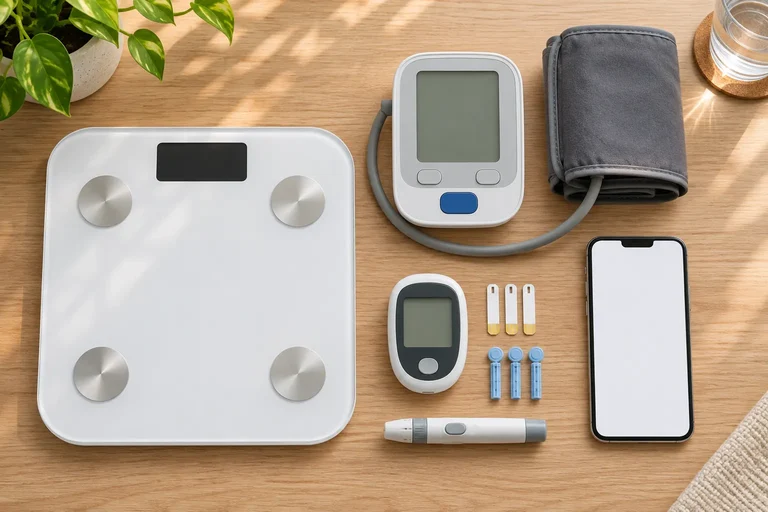 The kind of connected devices Omada ships, depending on your program and plan.
On keeping them: the FAQ says "all the tools that are provided by Omada during the program are meant for members to keep." The loss-of-coverage page adds a catch. You may keep and use the devices, but they "will be disconnected from your account within the two weeks of your account being closed and it will no longer transmit data to Omada," and the free test strips and lancets stop. After that you buy supplies from the device maker.
A help article says members with a BMI in the normal range may not receive a scale. For diabetes and hypertension, the FAQ tells you to ask HR "what devices are covered under your plan," so the CGMs on the diabetes page are not guaranteed. And the terms of use bar you from selling or transferring Omada-supplied devices, so "yours to keep" does not mean yours to resell.
IMPORTANT
Checkpoint: halfway there.
⏱️ Progress 2/4 • ~4 minutes in • Keep going
✅ Step 1: Who pays
✅ Step 2: When coverage ends
👉 Step 3: Devices, GLP-1 drug bills and refunds
⏳ The top complaint in member reviews (next)
What Omada's GLP-1 offering costs
Omada prescribes GLP-1 drugs now, through a partner. Its November 2025 announcement described prescribing and medication management in all 50 states, and its help center says "Wheel is Omada's third party prescribing partner." The terms of use add that joining a program "does not guarantee that a prescription will be written, renewed, approved for coverage, or filled," and that drug, lab and equipment charges are "separate from any fees paid to Omada."
How you pay depends on how your employer set it up:
- Insurance or pharmacy benefit. Employers on CVS Caremark or Express Scripts can require you to join Omada and stay active to keep your GLP-1 covered. Under the CVS Caremark rules, Omada checks the prior 31 days every day for app activity or scale weigh-ins, and "only one Omada activity per day counts."
- Member Cash Pay. Eligible members whose employer includes it can see a Wheel provider by video, with labs coordinated through the app. Omada's Member Cash Pay page says prescriptions are for weight management only. Its March 2026 announcement says members "purchase their medications independently through cash-pay channels."
- Manufacturer direct. Omada's May 2026 release says it joined Eli Lilly's Employer Connect as an independent program administrator.
Omada's help center prints example monthly cash prices for drugs filled at LillyDirect or NovoCare Pharmacy. These come from its GLP-1 cost article, which tells you to check the manufacturer's site for current numbers:
| Drug (form) | Example monthly price by dose |
|---|---|
| Zepbound (injection) | $299 at 2.5 mg, $399 at 5 mg, $449 at 7.5 mg and above |
| Foundayo (pill) | $149 at 0.8 mg, $199 at 2.5 mg, $299 at 5.5 mg and above |
| Wegovy (injection) | $349 from 0.25 mg to 2.4 mg, $399 at 7.2 mg |
| Wegovy (pill) | $149 at 1.5 mg, $199 at 4 mg, $299 at 9 mg and 25 mg |
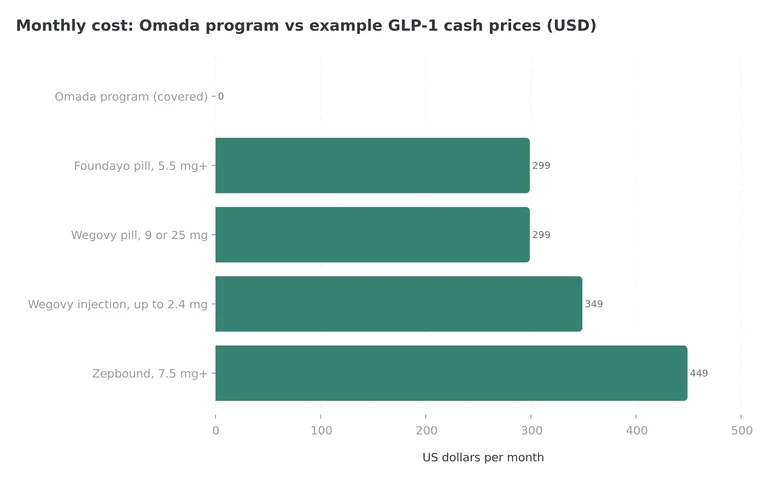 Figure 1: With coverage the program is $0, but the example drug cash prices run $299 to $449 a month at maintenance doses.
Zepbound and Foundayo carry a catch: refill within 45 days of your last delivery to keep those prices, or Zepbound at 7.5 mg rises to $499 and at 10 mg or higher to $699, and Foundayo rises to $349. By my arithmetic, a full year of Zepbound at the $449 maintenance price is $5,388, and the first few months cost less while the dose steps up.

For weight loss, the coaching may be covered while the drug is not. Omada's own 2026 survey of more than 3,000 GLP-1 patients outside its programs found that 44% paid over $250 a month. It was a company survey, though Omada says it was not run with or for Lilly.
HSA and FSA
Short answer
Omada's pages say nothing about HSA or FSA, and covered members owe nothing to reimburse.
I found no Omada page that mentions HSA or FSA. If your employer pays, there is nothing to reimburse. The cases where it could matter are the physical therapy program, where you owe plan cost-sharing, and prescription drugs you pay for yourself. Whether those costs qualify depends on your plan administrator and the plan's rules, so ask before you spend pre-tax money.
Where Omada's pages disagree
Here are the gaps between Omada's marketing site, terms and help center.
- "No cost" with and without conditions. The prevention page says "All at no cost to you" with no condition. The diabetes and hypertension pages add "if eligible." The FAQ ties all of it to your employer or plan. The accurate version is the FAQ's.
- Physical therapy kit. The MSK page promises a "free exercise kit" and "at no extra cost," while the FAQ says the program is "subject to deductibles, copays and co-insurance." The kit may be free while the visits are not. One one-star App Store review says the reviewer was billed more than quoted after an injury visit. I could not verify it.
- How to cancel. The FAQ says to email support. The terms say to follow "the instructions on the Site or in the Apps" or contact support. I found no in-app cancel button described anywhere, so email is the safe route.
- Keeping devices. "Yours to keep" appears on the product pages. The loss-of-coverage article says they go offline in two weeks.
Refunds, cancellation and billing
If you do pay a fee to Omada, the terms of use say: "Any fees paid for the Services are non-refundable except where otherwise indicated by us in writing." I found no refund window, no money-back guarantee and no form on any Omada page.

Cancelling is simple. Omada's help article says to email support@omadahealth.com and say whether you want the account closed now or in a few days "to review materials or send any final messages to your group or coach." The FAQ gives the same email and a phone number, (888) 409-8687.
Cancel in writing
Email support@omadahealth.com and keep the reply. If you only want fewer emails, change your notification settings instead.
Under the terms, pharmacy, lab and equipment charges may be billed to you "directly on a cash-pay basis," and Omada "does not set, collect, or control these third-party charges."
What the research says
Nearly all of Omada's outcomes data is company-funded or written by employees. Here is what each abstract says.
- Prediabetes, randomized. In a single-blind trial of 599 adults with prediabetes, the digital program group lost 5.5% of body weight at 12 months versus 2.1% in a one-session education class, and 43% versus 21% lost at least 5%. HbA1c fell 0.08 percentage points more with the program. The comparison group got one class, not another program. ClinicalTrials.gov lists Omada Health as the lead sponsor (Katula et al., 2022, American Journal of Preventive Medicine).
- Prediabetes, three years. In 220 people in a single-arm, non-randomized study, those who completed at least four lessons kept off 3.0% of their weight at three years, with an A1c drop of 0.31. Authors were Omada employees (Sepah et al., 2017, BMJ Open Diabetes Research and Care).
- Type 2 diabetes. In a retrospective cohort of 1,322 commercially insured members, those starting at A1C of 8% or higher fell from 9.48% to 7.47% at 12 months. Members under 8% held steady. The authors are Omada employees and a paid consultant (Berthoumieux et al., 2024, Science of Diabetes Self-Management and Care).
- Hypertension. In a retrospective cohort of 1,117 members, systolic blood pressure fell 4.8 mm Hg on average at 12 months, and 8.1 mm Hg for those who started uncontrolled. Employee authors (Wu et al., 2023, JMIR Cardio).
- GLP-1 companion. In a quasi-experimental study of 245 adults who had just started a GLP-1 drug, those in Omada's 12-week program lost 6.0% of body weight versus 3.3% in usual care. Omada Health funded it (Stanton et al., 2026, Diabetes, Obesity and Metabolism).
The 2017 and 2023 to 2024 cohorts have no control group, so they cannot separate Omada's effect from the fact that motivated people enroll. The randomized trial is the strongest, and its result is modest: about 3.4 percentage points more weight loss than a class. For context, an independent 2026 systematic review of 37 digital diabetes studies found that inadequate personalization was the most common barrier to engagement, in 15 of 37 studies (Thanthrige et al., 2026, JMIR Diabetes).
IMPORTANT
Checkpoint: one section left.
⏱️ Progress 3/4 • ~7 minutes in • Keep going
✅ Step 1: Who pays
✅ Step 2: When coverage ends
✅ Step 3: Devices, drug bills and refunds
✨ The top complaint in member reviews (about to reveal)
What members say in reviews
The App Store listing, read November 12, 2026, shows "Omada" from Omada Health, Inc., version 26.42.0 released November 9, free to download, with 4.66 stars from 94,825 ratings. The separate Joint and Muscle Health app shows 4.80 from 3,274. I could not find a Google Play listing, so I report the App Store only.
When I pulled it on October 30, Apple's review feed returned 150 written reviews dated July 10, 2025 to October 20, 2026. Fifty-seven are five-star and 57 are one or two stars, an average of 3.2 stars for this sample against 4.66 overall. The most common complaint is the food log, ahead of sign-in errors and mandatory enrollment. I read the low ones and counted by keyword, so treat the numbers as approximate:
- Mandatory enrollment for drug coverage. About 14 low reviews say their employer or pharmacy benefit made Omada a condition of keeping a GLP-1 prescription. They describe tracking that did not always sync with the pharmacy benefit.
- Food logging. About 19 complain about the food log: barcode scans returning wrong or zero nutrition data, no easy way to log a half portion, and no calorie counts.
- Sign-in and app errors. About 15 describe failed sign-up, password loops, or slow loading.
- Abrupt loss of access. About four describe an account closing without warning, including one who said they reapplied and were denied because they did not work at Costco, which has its own Omada program.
Of the 57 five-star reviews, 26 mention the coach. No review in the sample describes a billing surprise on the core program.
Who Omada fits, and who should look elsewhere
It may fit you if:
- Your employer or plan lists Omada, which makes the cost $0.
- You have prediabetes, type 2 diabetes or high blood pressure and want a coach, a scale or monitor, and a weekly lesson.
- You want to keep a GLP-1 covered and your plan requires an activity program.
- You prefer no meal plan. The FAQ says Omada "does not prescribe a meal plan."
You may want another option if:
- You have no coverage. There is no way to buy in.
- You may change jobs soon and want a program that follows you. Access ends with the sponsor.
- You need a food log with accurate calories, since many reviewers say Omada's log falls short.
- You want a clinician to prescribe and adjust diabetes medication. The diabetes program pairs you with a coach and a certified diabetes care and education specialist, and I found no page saying they prescribe diabetes drugs.
If you want a plan you can buy yourself, see how we priced Signos, Nutrisense, Lingo and Stelo, or read our roundup of apps for CGM users. For a GLP-1 program that bills directly, we wrote up Noom Med pricing.
IMPORTANT
Recap: what you now know about Omada's cost.
⏱️ Progress 4/4 • ~9 minutes in • Nicely done
✅ $0 with coverage, no self-pay without it
✅ Access and device syncing end with coverage
✅ GLP-1 drugs and third-party charges are billed separately
✅ Food logging is the top review complaint (revealed)
How to price Omada before you enroll: 5 steps
- Check for a benefit first. Ask HR or your health plan if Omada is covered, or run the eligibility check, which costs nothing.
- Ask which program and which devices. Get in writing whether your plan includes a scale, a blood pressure monitor, a glucose meter or CGMs, and who pays for test strips afterward.
- Ask about drug costs. If you want a GLP-1 prescription, ask whether it runs through your pharmacy benefit or Member Cash Pay, and what the monthly price is at your starting dose.
- Save your data. Learn how to export your scale readings to Apple Health or Google Fit, in case coverage ends.
- Plan how you will leave. Email support@omadahealth.com and say whether you want the account closed at once or in a few days.
Tracking food and blood sugar outside a program
A record of what you eat makes any appointment more useful. NutriScan, the app my team makes, estimates calories and macros from a photo of a meal. It lets you log blood glucose readings by hand on the Free plan, and it syncs with Apple Health and Health Connect. It does not import readings from continuous glucose monitor apps. The Free plan allows 5 scans a week, and Premium costs about $59 a year, described in our pricing breakdown. NutriScan has no clinicians, cannot adjust medication, and does not replace Omada or your doctor. Our carb tracking apps for diabetes roundup compares options for people who want to log carbs on their own.
Omada pricing FAQ
Is Omada free?
Only through coverage. Omada says its prevention, diabetes and hypertension programs are offered at no cost when your employer or health plan covers them. It does not offer self-pay, so without coverage you cannot buy in. Checking eligibility is free.
How much does Omada cost per month?
Omada lists no monthly price for members. With employer or plan coverage the program cost to you is $0, and the physical therapy program may involve deductibles and copays. GLP-1 drugs are billed separately, with example cash prices from $149 to $449 a month on Omada's help center.
Does insurance cover Omada?
Usually it is the insurer or employer who pays. Omada works with Cigna, CVS Caremark, Express Scripts, Amazon and many employers. I found no Omada page that says individual Medicare, Medicaid or marketplace coverage applies, so ask your plan.
Can I get a refund from Omada?
The terms say fees paid for the Services are non-refundable unless Omada says otherwise in writing. Members on a covered benefit pay no program fee. Pharmacy and lab charges come from third parties, who set their own refund rules.
Can I use my HSA or FSA for Omada?
I found no Omada page on this. If your employer pays, there is no cost to reimburse. For physical therapy cost-sharing or drugs you buy yourself, ask your plan administrator.
How do I cancel Omada, and do I keep the devices?
Email support@omadahealth.com and say when you want the account closed. You can keep the devices, but they disconnect from Omada within two weeks of closure, and free test strips stop.