No-Cook Meal Plan for a Week That Fills You Up
 ChatGPT
  Claude
  AI Mode
  Perplexity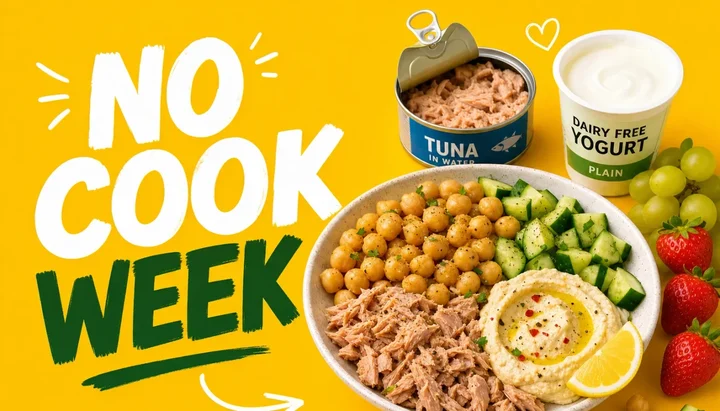
TL;DR - a week of meals with no stove
• The rule: every meal is one protein anchor, one or two produce items, one starch, one flavor source.
• The key number: five servings of fruit and vegetables a day, two fruit and three vegetables, sat at the lowest total mortality across 26 cohorts.
• The sizes: 1,000 to 2,000 calorie days are the same plan with different block counts, 4 to 6 protein anchors.
• The sequence: pick your calorie level ➡️ choose four anchors ➡️ shop once ➡️ assemble and review on day four.
• The catch: one pantry favorite that most no-cook plans treat as protein is nothing of the kind.
Around five servings of fruit and vegetables a day, two of fruit and three of vegetables, tracked with the lowest total mortality across two Harvard cohorts and a dose-response meta-analysis of 26 prospective studies, a hazard ratio of 0.87 against a two-serving reference (Wang et al., 2021). Not one of those servings requires a stove.
This guide is a meal plan for people whose kitchen is a shared hostel counter, a hotel room, a dorm fridge, or a stove they are too tired to face after work. It covers seven days, three calorie levels, one shopping list, and honest answers for the situations that send people searching at 11 p.m. NutriScan publishes this post and makes a calorie tracking app.
IMPORTANT
Your no-cook week at a glance.
A quick roadmap so you can shop today and eat tonight.
⏱️ Progress 0/4 • ~0 minutes in • Keep going
⏳ Step 1: Learn the four-part rule
⏳ Step 2: Size the day, 1,000 to 2,000 calories
⏳ Step 3: Shop once and assemble the week
🔍 The pantry favorite that is not a protein anchor (revealed near the end)
What a No-Cook Week Actually Looks Like 🥗
Three worked examples, all fictional, all built from the same four-part rule.
Take a 24 year old man in a hostel with no kitchen access. Every Sunday he buys canned tuna, Greek yogurt tubs, brown bread, peanut butter, bananas, tomatoes, cucumbers, roasted chana and almonds. Yogurt with banana and almonds for breakfast, two tuna and tomato sandwiches for lunch, peanut butter toast with cucumber salad for dinner, chana in the evening. Near 2,000 calories with roughly 110 g of protein, and he cooked nothing.
Take a 70 kg woman cooking for one. Her problem is waste, not skill: half a cabbage rots every week. She switches to single-serve formats. Canned beans, 170 g yogurt tubs, pre-washed salad bags, cherry tomatoes and small pots of hummus. Only the salad bag has a deadline, and she plans it into the first three days.
Take a family of four during a long power cut. Dinner becomes curd with poha soaked in milk for the kids, sprouted moong salad with lemon and onion for the adults, plus bananas, peanut brittle and cold milk. No gas, no long fridge time, no argument.

Assembly, not cooking: cold toppings out of tubs, laid on bread, in the time it takes a kettle to boil.
The Four-Part Rule That Makes Any No-Cook Meal Work 🧱
Every meal in this plan is the same equation.
- Protein anchor. Canned tuna or sardines, canned beans, plain Greek yogurt, cottage cheese, curd, hummus, ready-to-eat tofu, boiled eggs, nut butter, roasted chana.
- Produce. Two items, at least one raw vegetable. Tomato, cucumber, carrot, bell pepper, salad leaves, cabbage, onion, plus fruit.
- Starch. Bread, wraps, rice cakes, crackers, oats soaked overnight, pouched rice or quinoa, poha soaked in milk or curd.
- Flavor. Olive oil and lemon, chaat masala, hot sauce, pickle, mustard, salt and pepper, herbs.
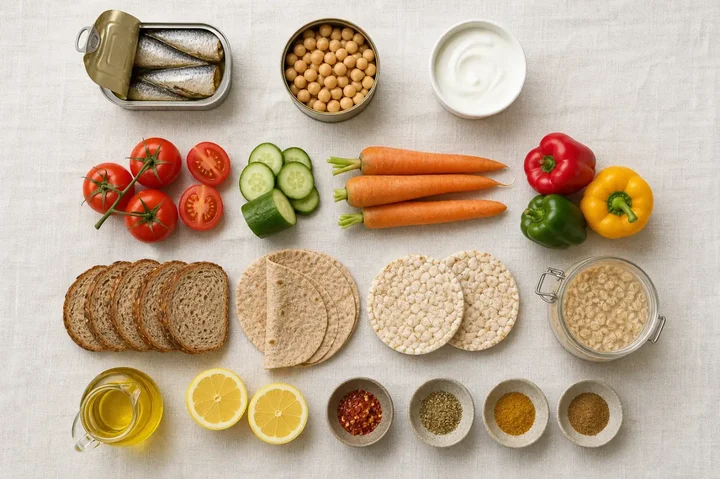
One shelf of each row covers every meal in the week.
Miss the protein anchor and the meal is a snack. Miss the flavor and you eat it twice and quit, which is the most common failure with no-cook plans. Here are common anchors, with numbers from our own food pages, plus the column that matters when calories are tight.
| No-cook protein anchor | Reference portion | Calories | Protein | Protein per 100 kcal |
|---|---|---|---|---|
| Canned tuna in water | 100 g drained | 132 kcal | 29 g | 22.0 g |
| Plain nonfat Greek yogurt | 170 g tub | 100 kcal | around 17 g | 17.0 g |
| Cottage cheese | 100 g | 98 kcal | 11 g | 11.2 g |
| Egg, sold hard boiled | 1 egg | 70 kcal | 6 g | 8.6 g |
| Chickpeas, cooked | 1 cup, 164 g | 269 kcal | 15 g | 5.6 g |
| Hummus | 100 g | 166 kcal | 7.9 g | 4.8 g |
| Almonds | 1 oz, 28 g | 164 kcal | 6 g | 3.7 g |
| Peanut butter | 2 tbsp | 188 kcal | 7 g | 3.7 g |
That last column is where the plan quietly falls apart. Hold that thought, the two bottom rows come back later.
IMPORTANT
Checkpoint: here's where you are right now.
Quick status update so you always know the next best move.
⏱️ Progress 1/4 • ~1 minute in • Keep going
✅ Step 1: The four-part rule (done)
👉 Step 2: Size the day (you're here)
⏳ Step 3: Shop once and assemble
🧩 The anchor that is not an anchor (coming soon)
The 7 Day No-Cook Meal Plan 📅
This is the free menu for a week. Portion it up or down using the calorie table in the next section, and read across the row for the day you are on. Every line is assembly only.
| Day | Breakfast | Lunch | Dinner | Snack |
|---|---|---|---|---|
| Monday | Overnight oats with milk, banana, almonds | Tuna, sweetcorn and tomato wrap, side salad | Chickpea, cucumber and onion bowl with hummus and pita | Apple and a small handful of nuts |
| Tuesday | Greek yogurt, berries, oats stirred in | Cottage cheese with crackers, carrot and pepper sticks | Bean and avocado salad, corn tortillas | Roasted chana or edamame |
| Wednesday | Peanut butter on whole grain toast, orange | Hummus and grated carrot sandwich, boiled egg | Sardines on rye with tomato and red onion | Yogurt tub |
| Thursday | Muesli with cold milk and grapes | Chicken or tofu ready-to-eat pack over salad bag | Tuna and white bean salad with olive oil and lemon | Banana with nut butter |
| Friday | Overnight oats with curd, mango, cardamom | Sprouted moong salad with lemon, onion, tomato | Wrap with cheese, salad and pickle | Cold milk and a date or two |
| Saturday | Fruit and yogurt bowl with seeds | Big shared board: crackers, cheese, hummus, olives, cut fruit | Cold pouched rice with canned beans, salsa, avocado | Popcorn, air popped |
| Sunday | Soaked poha with curd, peanuts, pomegranate | Leftover board plus a boiled egg | Cottage cheese, tomato, cucumber and toast | Fruit |
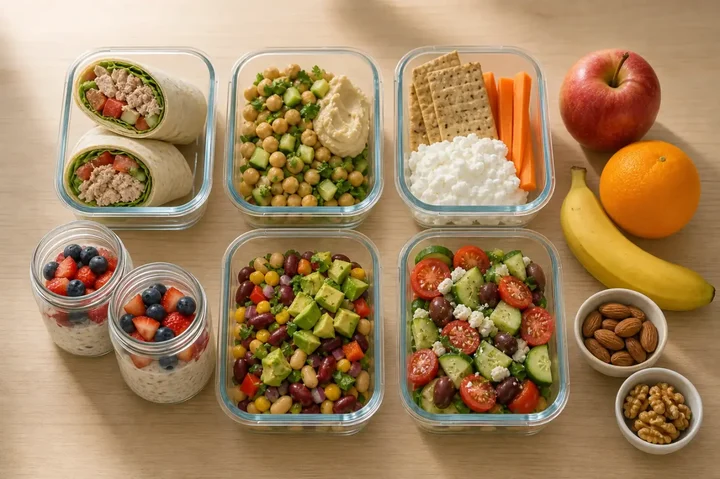
A whole week, assembled in one sitting. Nothing here saw heat.
Shopping list for one person for the week: 4 cans of tuna or sardines, 3 cans of beans, 7 yogurt tubs, cottage cheese, hummus, a dozen eggs, oats, muesli, bread and wraps, peanut butter, 2 L milk or a plant drink, salad bag, tomatoes, cucumbers, carrots, peppers, onions, avocado, 7 pieces of fruit, nuts, olive oil, lemon.
TIP
Buy fruit at two ripeness stages. Three ripe bananas for the first half of the week and four green ones for the second half means day six still has something edible in the bowl.
Building 1,000, 1,200, 1,500 and 2,000 Calorie Days 🔢
Same plan, four sizes. Count the blocks rather than the grams.
| Calorie day | Protein anchors | Produce servings | Starch servings | Added fat | Realistic protein total |
|---|---|---|---|---|---|
| 1,000 | 4 | 5 | 2 | 0 to 1 tsp | 75 to 85 g |
| 1,200 | 4 | 5 | 3 | 1 tsp | 85 to 95 g |
| 1,500 | 5 | 5 | 4 | 2 tsp | 100 to 110 g |
| 2,000 | 6 | 6 | 6 | 3 tsp | 120 to 135 g |
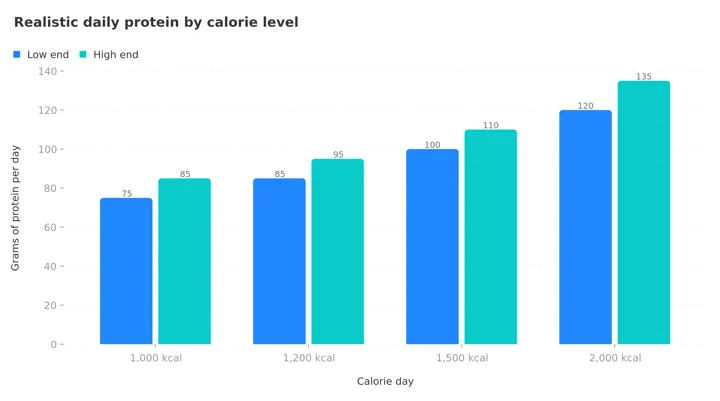
Figure 1: doubling calories from 1,000 to 2,000 raises protein by only about 60 percent, because the extra energy goes to starch and fat.
Figure 1 is the argument for counting anchors instead of calories. A 1,200 calorie day is a common floor for most adult women without medical supervision, and 1,000 only makes sense for smaller or older adults over a short stretch. A 500 calorie day is off this table on purpose: that number belongs to medically supervised very low energy diets and to clear liquid prep before procedures.
For a personal number, run your details through the TDEE calculator and take 15 to 20 percent off for weight loss. The protein intake calculator does the per-kilogram math.
If you would rather cook, the 1,500 calorie meal plan for a week lists calories and protein for every meal on a low carb, budget grocery list.
IMPORTANT
Checkpoint: midway progress update.
You're halfway, and the decisions get easier from here.
⏱️ Progress 2/4 • ~2 minutes in • Keep going
✅ Step 1: The four-part rule (done)
✅ Step 2: Size the day (done)
👉 Step 3: Shop once and assemble (current)
⏳ The anchor that is not an anchor (next)
Seven Tips That Keep a No-Cook Week Alive 💡
- Shop once, on the same day. The plan fails on Wednesday with an empty fridge, not on Monday with high motivation.
- Buy the format that matches your household. Cooking for one means single-serve tubs and cans. Family packs are why food gets thrown away.
- Watch the 2 hour rule. An insulated bag and an ice pack fix a desk lunch.
- Drain and rinse your cans. Rinsing chickpeas cuts the sodium meaningfully and costs 15 seconds.
- Keep one flavor kit. Olive oil, lemon, salt, pepper, chili flakes, chaat masala.
- Add fiber slowly. Fiber helps constipation, and flatulence rises in the fiber groups of the trials (van der Schoot et al., 2022). Ramp over two weeks.
- Log a few days, not every day. Three logged days tell you whether your anchors are landing. Seven burns you out.
WARNING
A no-cook plan lives or dies on the fridge. Bacteria multiply fastest between 40 and 140 degrees Fahrenheit, doubling in as little as 20 minutes, and food should never sit out of refrigeration for more than 2 hours, or 1 hour above 90 degrees (USDA FSIS). Opened cans, cut fruit and dairy are the items to watch. If you are pregnant, immunocompromised or over 65, throw out anything you are unsure about.
How to Set Up Your Week in Six Steps 🪜
- Pick your calorie day from the table above, or calculate it. Write the block counts on a sticky note.
- Choose four protein anchors you will genuinely eat. Not the aspirational ones.
- Fill the shopping list and buy for seven days at once, with fruit at two ripeness stages.
- Do the 20 minute prep that is not cooking: wash and cut vegetables into containers, portion nuts, mix three jars of overnight oats.
- Assemble the grid from the 7 day table, or build your own with the weekly meal planner so the shopping list writes itself.
- Review on day 4. Whatever you skipped twice gets swapped, not repeated. That single review is the difference between a week and a habit.
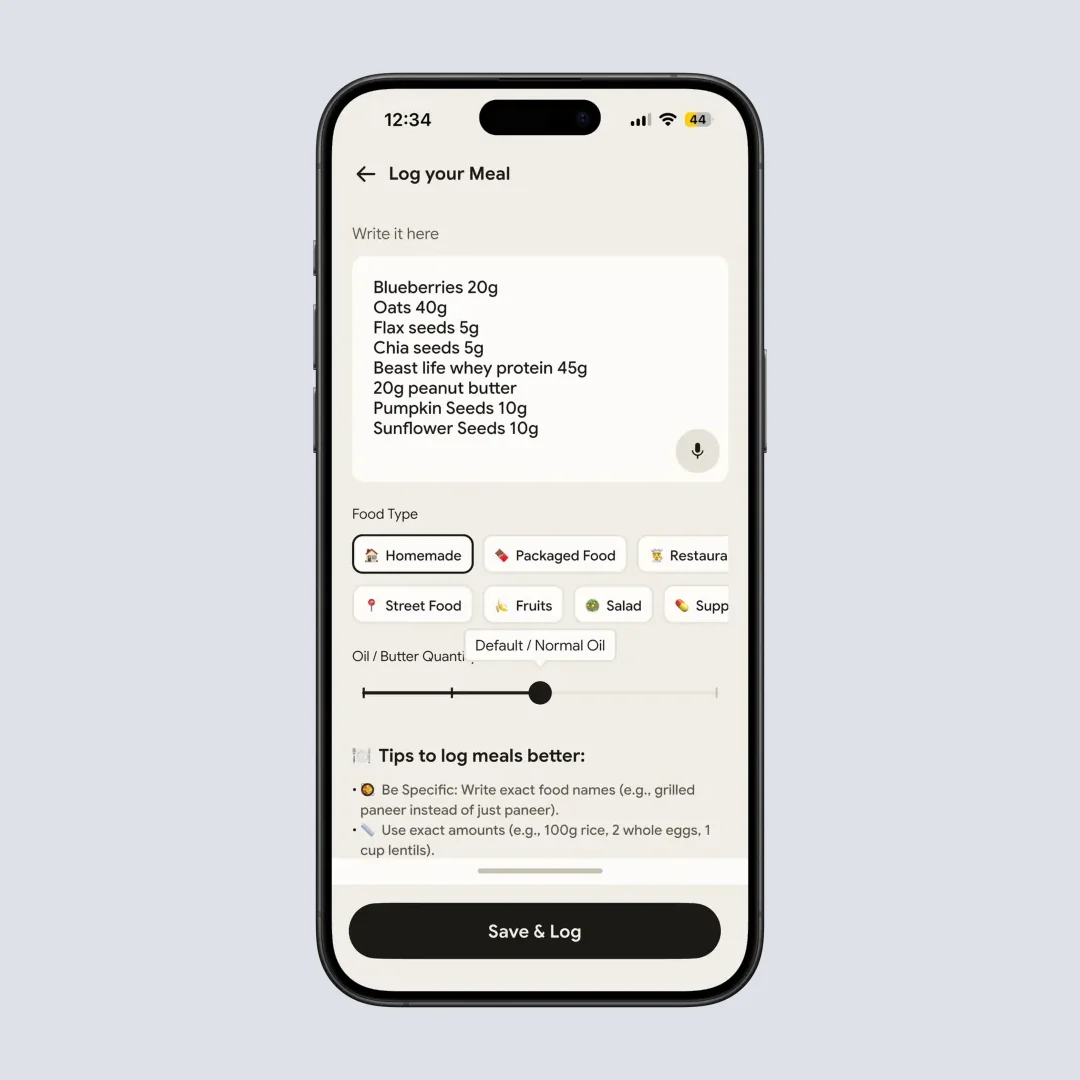
Typing a meal in plain words beats hunting a database. In-app path: Home > Pencil Icon > Write About Meal.
No-Cook Eating in Your Kitchen, Wherever It Is 🌍
The four-part rule survives translation. The ingredients change, the shape does not.
India, and hostel food without cooking. Curd, fresh paneer, sprouted moong, roasted chana, soaked poha, brown bread, bananas, guava, cucumber and tomato with chaat masala make a full day with no gas, covering protein, fiber and calcium. For portion numbers on Indian staples, our list of low calorie high protein foods in India is the one I send people to, and the Indian diet plan pages cover the cooked version.
On the trail, and out of the freezer. A resupply box is the extreme version: tortillas, peanut butter, tuna pouches, hard cheese, dried fruit, nuts and olive oil, with long-distance hikers often needing 3,500 to 4,500 calories a day, so the block table gets multiplied rather than redesigned. At home the freezer does a smaller version of the same job: frozen berries, edamame thawed in the fridge, sliced bread, all labeled with the date.
A keto week without cooking. Canned fish, cheese, boiled eggs, avocado, olives, nuts, full fat curd, paneer and salad vegetables cover a keto week with no stove. Drop the bread, oats and wraps, and watch the fruit.
The Special Situations People Actually Search For 🩺
These come up constantly, so here are straight answers rather than a food list for each.
Hemoglobin and periods. Adult women aged 19 to 50 need 18 mg of iron a day, adult men 8 mg, and vegetarians close to double because plant iron absorbs poorly (NIH Office of Dietary Supplements). Canned sardines, beans, fortified cereal and raisins cover it without heat, and vitamin C foods alongside improve absorption.
Dairy free, gluten free, braces and recovery. Most people with lactose intolerance tolerate some lactose, so hard cheese and lactose free milk usually work. For celiac disease the gluten-free diet is lifelong and cross contact is a real risk, so labels beat guesswork (NIDDK). With braces, or after surgery, the soft list is the same: yogurt, cottage cheese, hummus, applesauce, ripe bananas, soft bread.
Colonoscopy prep and GLP-1 medication. Colonoscopy prep is the one week to ignore this plan and follow the written instructions (NIDDK). On a GLP-1 medication appetite drops hard, so yogurt, cottage cheese, canned fish and soft fruit still go down.
IMPORTANT
Checkpoint: final stretch before the reveal.
One last nudge, the reveal is next.
⏱️ Progress 3/4 • ~3 minutes in • Keep going
✅ Step 1: The four-part rule
✅ Step 2: Size the day
✅ Step 3: Shop once and assemble
✨ The anchor that is not an anchor (about to reveal)
The Pantry Favorite That Is Not a Protein Anchor 🥜
It is peanut butter, and almonds are right beside it.
Look at the last column of the anchor table again, plotted below. Canned tuna carries 22.0 g of protein per 100 calories and plain nonfat Greek yogurt carries 17.0 g. Peanut butter carries 3.7 g, and so do almonds. That six-fold gap is why a no-cook day can hit 1,800 calories and still leave you 40 g of protein short.
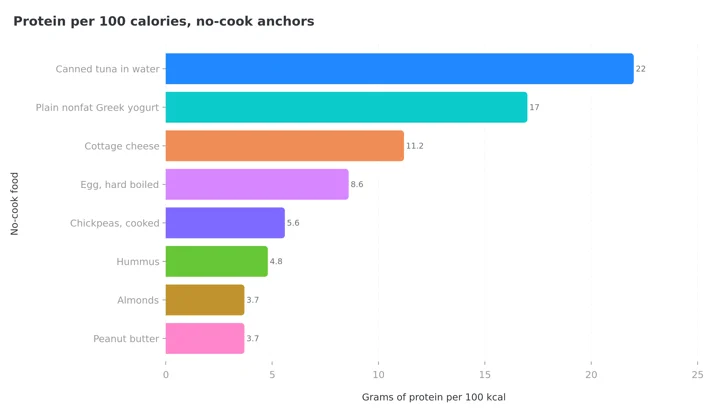
Figure 2: protein per 100 calories, from the table above. The two nut items sit at roughly one sixth of canned tuna.
Peanut butter is 76 percent fat by calories: 2 tablespoons give 16 g of fat and 7 g of protein in 188 calories. Excellent flavor source, poor anchor. A common failure looks like toast with peanut butter, a banana with nut butter, nuts in the afternoon, and a day that reads full but delivers under 60 g of protein.
The fix costs nothing. Keep the nut butter, move it to the flavor slot, and put a can, a tub or an egg in every one of the four anchor slots. That swap is worth 30 to 40 g of protein a day at the same calories.

A tuna sandwich, eaten with both hands. Roughly 29 g of protein and no pan involved.
What the Research Supports, and What It Does Not 🔬
The evidence behind a no-cook week is mostly evidence about food groups, not about heat.
Produce volume is the strongest signal. Five servings a day, split two fruit and three vegetables, sat at the lowest total mortality in the Harvard cohorts and the 26-cohort meta-analysis, and eating more than five added no further benefit (Wang et al., 2021). Raw produce is the easiest part of a no-cook plan to hit.
Protein targets come from exercise science, not meal-plan research. The International Society of Sports Nutrition position stand puts 1.4 to 2.0 g per kg per day as sufficient for most exercising people (Jäger et al., 2017). Hitting that from cans, tubs and bags takes planning, not cooking. What no trial supports: that raw food is inherently better, or that one week changes body composition much. For the money side, healthy eating on a budget covers the cheap swaps, and the high protein snack guide covers the gaps between meals.
IMPORTANT
Recap: everything you completed this round.
You finished the run, so save this page for next week.
⏱️ Progress 4/4 • ~4 minutes in • Nicely done
✅ Step 1: The four-part rule
✅ Step 2: Size the day, 1,000 to 2,000 calories
✅ Step 3: Shop once and assemble
✅ The anchor that is not an anchor (revealed: peanut butter, 3.7 g of protein per 100 calories)
Frequently Asked Questions ❓
What should I eat for breakfast, lunch and dinner if I am not cooking?
Breakfast: overnight oats made with milk or a plant drink, or plain Greek yogurt with fruit and nuts. Lunch: a wrap or bowl built on canned tuna, canned chickpeas, hummus or cottage cheese, with raw vegetables and a dressing. Dinner: the same shape, bigger, plus a starch such as bread, a wrap, pouched rice or crackers. All three need a can opener, a spoon and a fridge.
Is a 1,200 calorie no-cook day safe, and what about 1,000 or 500 calories?
A 1,200 calorie day is the lowest most adults should build a plan around without medical supervision, and it is easy to underfeed protein at that level. A 1,000 calorie day suits only smaller or older adults, briefly. A 500 calorie day is not a meal plan; that number belongs to medically supervised very low energy diets and to clear liquid preparation before a procedure.
What can I eat with no cooking if I am dairy free or gluten free?
Dairy free: swap yogurt and cottage cheese for canned fish, canned beans, hummus, nut butters, ready-to-eat tofu and fortified soy drink. Hard cheese and lactose free milk are often fine, since lactose intolerance is a dose problem for many people. Gluten free: skip wheat, barley and rye, and use corn tortillas, rice cakes and certified gluten free oats. For celiac disease the diet is lifelong and cross contact matters, so check labels.
What should I eat for protein and fiber on a plan with no cooking?
Protein: canned tuna at about 29 g per 100 g, plain nonfat Greek yogurt at about 10.2 g per 100 g, cottage cheese at about 11 g per 100 g, canned chickpeas, hummus and nuts. People who train regularly do well on 1.4 to 2.0 g of protein per kg of body weight a day. Fiber: canned beans, raw vegetables, fruit with the skin on, oats and nuts, and a cup of cooked chickpeas carries about 12.2 g. For constipation, psyllium above 10 g a day for at least four weeks has the best trial evidence.
Can food fix hair fall, acne, or bring on a period?
Not directly, and I would rather say so than sell you a list. Hair shedding and graying are mostly genetic, hormonal and age related, though iron deficiency and very low protein intake are testable contributors worth checking with a doctor. Acne responds mildly at best to diet changes, and no food brings on a period early.
Is there a free version of this meal plan?
Yes. Everything on this page is the plan, written so you can copy the day grid onto a note or a sheet of paper. A no-cook week also costs less than a cooked one in most countries, because canned fish, canned beans, eggs, oats and seasonal fruit are the cheap end of protein and produce.
Start With Sunday's Shopping List 🚀
A week without cooking is the version of eating well that survives a broken stove, a shared kitchen, a night shift, or a month where the energy is not there. The four-part rule is the method: protein anchor, produce, starch, flavor, repeated 21 times with the shopping done once.
Pick your calorie level, copy the day grid, buy the list, and review on Thursday. To see how close your assembled meals land to the numbers in the table, NutriScan reads a plate from a photo, faster than typing a wrap into a diary at your desk, and the free plan covers 5 scans a week. If you would rather not weigh the portions, how to count calories without weighing food shows the hand method with a worked day.