Best App for Voice Food Logging 2026 (Hands-Free, Ranked)
 ChatGPT
  Claude
  AI Mode
  Perplexity
TL;DR - Best Voice Food Logging Apps 2026
• Why voice: a 28-day pilot study found people who logged meals by speaking created more entries on more days than people who typed, and in a separate 502-person trial, higher self-monitoring adherence was associated with greater odds of losing at least 5 percent of body weight.
• Best for conversational logging: NutriScan, where Monika asks about the oil or portion your sentence left out, with 4 free voice calls per week.
• Fastest pure dictation: MacroFactor's Describe turns one spoken sentence into entries you review and edit before logging, but there is no free tier.
• Cheapest of the four with a single published annual price: NutriScan at about $59 a year, below MacroFactor at $71.99 and below Lose It and MyFitnessPal at $79.99 (Lose It membership tiers). SnapCalorie and Cal AI both run promo pricing that dips lower.
• The catch everywhere: transcription averages about 83 percent accuracy in research, so treat every voice log as a first draft and pick the app whose correction step you will actually do.
In a 2023 pilot study published in JMIR Formative Research, people who logged their meals by speaking created more food log entries and stayed active in their diary on more days across 28 days than people who logged the same way by typing (Chikwetu et al., 2023). The study was small, with 18 participants, but the direction matches what I see every week: the less effort a log takes, the longer people keep the habit. Speaking is less effort than typing for most meals, and for some moments it is the only method that works at all.
As a NutriScan nutritionist, I need to be upfront about two things before we start. First, NutriScan is our app, and it appears in this ranking, so read my reasoning and check my sources instead of taking my word for it. Second, voice logging is not magic. A systematic review of speech-based dietary assessment found that automated transcription reached an average accuracy of about 83 percent across the nine studies that measured it (Dodd et al., 2022). That means roughly one word in six can come out wrong before the app even starts counting calories. The best voice logging app is not the one with the most impressive demo. It is the one that understands normal food sentences, shows you what it heard as editable entries, and lets you fix mistakes in seconds.
This article ranks six apps on exactly that flow. Prices below are standard US prices as of mid 2026. They can change or vary by region, so check the store page before you pay.
IMPORTANT
Your voice logging plan at a glance.
A quick roadmap so you can pick the right app without paying for the wrong one.
⏱️ Progress 0/4 • ~0 minutes in • Keep going
⏳ Step 1: The 3 moments voice logging wins
⏳ Step 2: How voice logging breaks (and where)
⏳ Step 3: All 6 apps, ranked and priced
🔍 The 7-day test that decides your pick before you pay (revealed near the end)
Three Moments When Voice Logging Wins 🎙️
Voice logging is not a gimmick for people who dislike typing. There are specific moments in a normal day where it is clearly the best input method.
Cooking with messy hands. You just finished plating a curry. Your fingers have oil and turmeric on them. Nobody unlocks a phone, opens a search bar, and types "chicken curry one cup" in that state. Saying "one cup of chicken curry, two rotis, cooked with two spoons of oil" takes five seconds and keeps your phone clean.
 Both hands busy, dinner in progress: this is the moment a voice log takes five seconds and a typed log takes none, because it never happens.
Walking after a meal. You left the restaurant and you are walking to the car or the bus. Typing while walking is slow and unsafe. Speaking a quick summary of the meal while it is still fresh in your memory beats reconstructing it three hours later. Memory fades fast, and logs made long after a meal are less complete.
Holding a child, a leash, or a steering wheel. Parents eat one-handed. Dog owners eat mid-walk. Commuters eat before driving. In each case, one hand is permanently busy. A hands-free log is the difference between logging and skipping. Skipping matters: in a 12-month randomized trial of 502 adults, higher adherence to self-monitoring was associated with greater odds of losing at least 5 percent of body weight (Burke et al., 2025). That trial ran one app in two arms, so it says nothing about which input method is better, only that recording regularly tracks with the result.
IMPORTANT
Checkpoint: here's where you are right now.
Quick status update so you always know the next best move.
⏱️ Progress 1/4 • ~1 minute in • Keep going
✅ Step 1: The 3 moments voice logging wins (done)
👉 Step 2: How voice logging breaks (you're here)
⏳ Step 3: All 6 apps, ranked and priced
🧩 The 7-day test that decides your pick before you pay (coming soon)
What Voice Logging Actually Does (and What It Cannot) 🔬
Every voice logging feature runs the same three-step pipeline, and each step can fail in its own way.
Step 1: turn your speech into words. This is transcription, and it is the step with the 83 percent average accuracy figure from the review above (Dodd et al., 2022). Accents, background noise, and food names from outside the app's home market all lower it. An app that shows you the words it heard lets you catch these errors immediately.
Step 2: turn words into foods. "Two rotis and dal" has to map to real database entries. This is where apps differ most. Some parse quantities well. Some default every food to one generic serving. A food you named correctly but matched to the wrong database entry gives you a confident wrong number.
Step 3: turn foods into calories and macros. Even when the words and matches are right, the app has to assume a portion and a preparation if you did not say one. A 2025 validation study of a voice and image dietary assessment system, run with mothers and children under five in Siem Reap province, Cambodia, found it produced significantly lower estimates than a standard 24-hour recall for 80 percent of nutrients in the mothers, and for 32 percent in the children, even though most mothers rated the app easy or very easy to use (Rollo et al., 2025). Easy to use and accurate are different claims. Your spoken sentence rarely includes the cooking oil, the butter on the roti, or the sugar in the tea, and the app cannot count what nobody mentioned.
Treat every voice log as a first draft
No transcription step can recover words you never said. The nearest measurement comes from photo logging: O'Hara et al. tested ChatGPT-4 on 114 meal photographs and found a mean absolute percentage difference of 26.9 percent across 16 nutrients, with a statistically significant gap on 10 of the 16, though energy in kilocalories was the study's most accurate measure at 0.1 percent off (O'Hara et al., 2025). That study had no user-confirmation arm, so the argument that follows is ours and not a research finding: the ranking below rewards apps that make reviewing and fixing the draft fast, because a number nobody checks is a number nobody corrects.
How I Ranked These Apps 📋
I scored six popular apps on three jobs, in this order of weight:
- Understanding normal food sentences. Can you speak the way you actually talk about food, including quantities, mixed dishes, and non-Western foods, and get a sensible result?
- Editable output. Does the app show what it heard as separate line items you can fix in a few taps, before the wrong number enters your day?
- Availability. Can you use voice logging on the free plan, on both platforms, in your country, without hitting a paywall on day one?
I did not rank on database size, coaching, or photo scanning quality. Those matter, and I have compared them separately in our AI photo calorie counter ranking. Reminder of my bias: NutriScan is our product, and I have kept its weaknesses in plain view so you can judge fairly.
IMPORTANT
Checkpoint: midway progress update.
You're past the theory. The ranking starts now.
⏱️ Progress 2/4 • ~3 minutes in • Keep going
✅ Step 1: The 3 moments voice logging wins (done)
✅ Step 2: How voice logging breaks (done)
👉 Step 3: All 6 apps, ranked and priced (current)
🧩 The 7-day test that decides your pick before you pay (next)
1. NutriScan: Best for Conversational Voice Logging 🥇
NutriScan's voice logging runs through Monika, an AI nutritionist you reach from the call button on the home screen. You speak a normal sentence like "I had two rotis, a bowl of dal, and a glass of buttermilk," and Monika builds the log from it. The difference from simple dictation is that Monika can ask back. If your sentence leaves out the thing that changes the calorie count most, like how much oil went into the dal or how big the bowl was, the conversation surfaces it instead of silently guessing. No published study has tested whether asking back beats guessing, so that is our design bet rather than a proven one. It rests on the plain fact that an app cannot count an ingredient nobody mentioned.
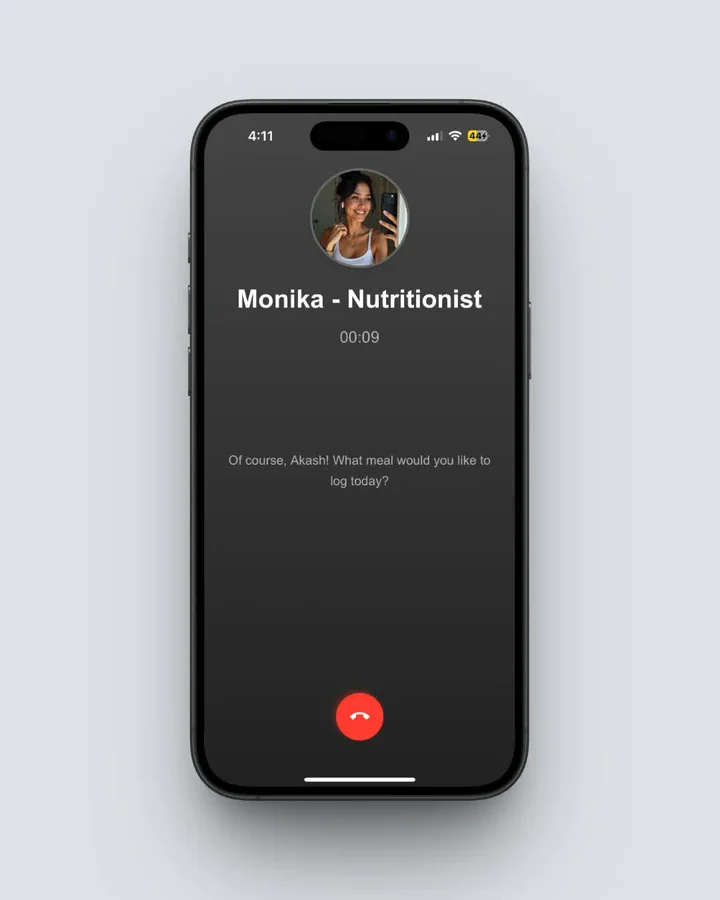 Home > Click Call Button: Monika answers, you say the meal, and the log lands on your home screen.
Voice is also not locked behind the paywall. The free plan includes 4 Monika calls a week alongside 5 photo meal scans a week, and Premium at about $59 a year removes both caps, as covered in our NutriScan pricing guide. Because Monika was trained with Indian and other non-Western foods as core inputs, sentences like "one plate of poha" or "two idlis with sambar" resolve without the workarounds you need in US-centric databases.
The honest trade-offs. A conversation takes longer than a one-shot dictation. If you want to speak for four seconds and be done, MacroFactor's flow below is faster. Four free calls a week is a real cap for someone who wants to voice log every meal without paying, and five free scans a week is enough to test the scanner on the meals that break a food database, not to run your whole week on. And if your diet is mostly packaged food, NutriScan has no barcode scanner, so packaged items go in through the Packaged Food tag with manual or voice entry.
Choose NutriScan if: you eat home-cooked, mixed, or restaurant meals, and you want the app to ask about what your sentence left out instead of guessing.
2. MacroFactor: Best Pure Dictation to Editable Entries ⚡
MacroFactor's Describe feature is the cleanest implementation of speak-and-done on this list. You speak or type the contents of a meal, and the app interprets the ingredients and quantities and logs them without you searching for each item, as described in its own Describe documentation. The output is the key part. Describe returns the foods and quantities it picked and you review them before anything lands in your diary: add or remove foods, edit the quantities, then tap Log Items. That is exactly the editable-output job this ranking weights second. One caveat on the "voice" part: MacroFactor's own instructions route dictation through the microphone button on your keyboard, so this is speech typed into a text field rather than a dedicated voice mode.
The catch is the same one I noted in our mixed-dish photo comparison. MacroFactor's documented flow is describe, review, log, with no step where the app asks you a question back. Its own guidance puts the fix on you, warning that if you say "one slice of multigrain bread with oats, spelt, pumpkin seeds, and sunflower seeds", it may not understand that those are components of the bread and will pull each one up as a separate food with a default quantity. If you never mention the cooking oil, spotting the missing calories is entirely your job. There is also no free tier at all, only a 7-day trial before the $71.99 per year subscription, which we break down in our MacroFactor cost guide. That rules it out for anyone who wants to test voice logging casually before paying.
Choose MacroFactor if: you know your ingredients well, you want the fastest speak-to-log flow available, and you are already paying for its adaptive macro coaching.
3. Lose It: Simple Dictation, Now at the Top of the Price Range 💰
Lose It added voice logging as part of its Premium bundle. Premium is $79.99 per year, roughly $6.67 per month, with no monthly plan and a lifetime option at $299.99 for free accounts or $229.99 if you are already a Premium member (Lose It membership tiers and pricing). That is the same annual price as MyFitnessPal, so the old "cheap voice logging" case for Lose It no longer holds. We cover what the bundle includes in our Lose It Premium review. The flow is simple dictation: speak your meal, review the matched foods, save. Users seem genuinely happy with it. One user posted a PSA telling others not to overlook the voice log feature, noting that being specific when you speak gets better matches (r/loseit).
The limits come from the design. Lose It's own tier page puts "smart photo and voice logging features" on the Premium side of the line, so you cannot try voice on the free plan before the trial. Parsing quality by cuisine is our read rather than a tested finding, but it sits alongside a measured pattern: across 16 manual logging apps, energy was overestimated for Western diets by about 1040 kJ and underestimated for Asian diets by about 1520 kJ (Li et al., 2024). And like MacroFactor, the documented flow is speak, review the matched foods, save. There is no prompt back for the oil or the portion you left out, so the review step is on you.
Choose Lose It if: your meals are mostly common, single-item foods, you want the rest of the Lose It Premium bundle too, and the $79.99 a year is worth it to you.
4. MyFitnessPal: Big Database, Gated Voice 🗄️
MyFitnessPal launched Voice Log with a dedicated button behind the plus menu, and the feature itself is fine: speak, review the matched foods, confirm. But it is available only to Premium subscribers, and only with your app language set to English on iOS or Android, running app version 24.35.0 or higher, per the company's own Voice Logging support page. The gate is language, not country. Premium costs $79.99 per year, tied with Lose It at the top of the price range here, and the free trial is 7 days (MyFitnessPal Premium). We break the tiers down in our MyFitnessPal pricing guide.
The deeper issue is what your spoken words match against. MyFitnessPal's database is one of the largest in the category, over 20 million foods by its own account, though Lose It publishes a bigger number at 50M+. A 2024 evaluation in Nutrients found MyFitnessPal had the highest food recognition accuracy of the AI-supported apps tested, at 97 percent (Li et al., 2024). The same paper also recorded a 35 percent underestimation on an "Eggs on toast with butter" image, because the app omitted the butter. And a separate 2025 validation study found poor validity for six measures, total energy, carbohydrates, protein, cholesterol, sugar and fiber, against reference measures (Morello et al., 2025). Those authors point at "the copious options for each food entry, including non-verified consumer entries". Right name, wrong number is the specific risk: your sentence matches instantly, to whichever of several entries the app picked. Review the numbers, not just the names.
Choose MyFitnessPal if: you already pay for Premium, run the app in English, and want voice added to one of the largest databases in the category.
Four apps down, two to go. Still ahead: the 7-day test that tells you whether any of these deserves your money.
5. SnapCalorie: Voice Notes with Portion Focus 📸
SnapCalorie is a smaller app with a strong focus on portion estimation. Its listing describes the core flow directly: snap a photo of your meal or dictate a voice note, and the AI analyzes the food and measures portions (App Store). The voice note is a main input, not a hidden extra, and pairing a spoken description with a photo of the same plate is a genuinely good pattern, because each input covers what the other misses. The words carry the invisible items, and the image carries the visible portions. A semi-automated image-plus-voice design is the same combination dietary researchers chose for their own assessment systems (Rollo et al., 2025).
The trade-offs come from size. SnapCalorie's own listing puts its database at 500k+ foods verified against USDA data, far smaller than MyFitnessPal's 20M+ or Lose It's 50M+, and it is built by a small team, Perception Labs, Inc., which is a real consideration for a multi-year tracking habit. Pricing moves constantly: the App Store listing carried ten live Premium SKUs at once in August 2026, from $9.99 to $149.00, so check the store page before you assume a number.
Choose SnapCalorie if: you like the photo-plus-voice-note combination and are comfortable with a smaller app.
6. Cal AI: Voice as a Fix Tool, Not a Logger 🔧
Cal AI is a photo-first scanner, and we ranked it well for speed in our photo comparison. Voice appears as part of the correction step rather than the capture step. The photo-first flow lets you photograph the meal or the label, describe it in voice or text, and refine it with natural-language correction until the entry matches what you ate (Fuel Nutrition review). As a correction tool that works. As a primary hands-free logger it does not, because the flow still starts with pointing a camera at the plate.
Pricing is dynamic and shown only after onboarding. As of August 2026 the App Store listing ran nine concurrent Unlimited subscription SKUs bracketing $2.99 to $29.99 (App Store), a pattern we explain in our Cal AI pricing guide. The app is free to download, though the same listing states that food scanning analysis results require a subscription, so there is not much to test for free. If voice is the feature you are shopping for, this is the weakest match on the list.
Choose Cal AI if: you mainly want fast photo scanning and treat voice as an occasional correction method.
Voice Logging Compared: The Quick Table 📊
| App | Voice input style | Editable line items | Voice on free plan | Yearly price |
|---|---|---|---|---|
| NutriScan | Conversation with follow-up questions | Yes | 4 calls per week | about $59 |
| MacroFactor | One-shot dictation (Describe) | Yes, review before logging | No free plan, 7-day trial | $71.99 |
| Lose It | One-shot dictation | Yes | No | $79.99 |
| MyFitnessPal | One-shot dictation | Yes | No, Premium only and English only | $79.99 |
| SnapCalorie | Voice note, pairs with photo | Basic | Limited | Promo SKUs $9.99 to $149.00 |
| Cal AI | Describe-to-fix after photo scan | Partial | Limited | Dynamic, $2.99 to $29.99 |
Prices are standard US prices as of mid 2026 and change by region. SnapCalorie and Cal AI both run many concurrent promo SKUs, so the store page is the only reliable figure for those two.
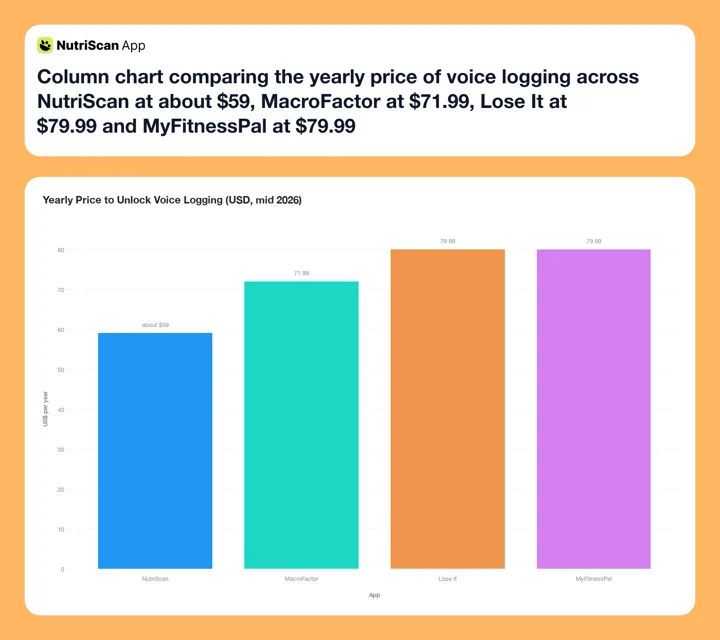 Figure 1: The yearly cost of voice logging runs from about $59 to $79.99 across these four, and of those four only NutriScan lets you use voice weekly without paying at all. SnapCalorie sits outside this chart because its pricing is promo-variable.
The spread is narrower than it used to be. Lose It's price increase put it level with MyFitnessPal at $79.99, so the two one-shot dictation apps now cost the same, and availability and parsing quality decide this ranking rather than price.
7 Tips to Make Voice Logs Accurate 💡
- Say the quantity for every item. "Rice" becomes a default serving chosen by the app. "One and a half cups of cooked rice" becomes your actual lunch. The quantity is the highest-value word in the sentence.
- Name the cooking method and fat. "Paneer curry cooked with two spoons of oil" and "grilled paneer" are hundreds of calories apart, and no transcription step can recover words you never said. Standard reference values put one tablespoon of cooking oil around 120 calories (USDA FoodData Central record 171413).
- Review every line before saving. Transcription averages about 83 percent accuracy in the research (Dodd et al., 2022). Assume one item per meal needs a correction and spend the ten seconds checking.
- Speak right after eating, not at night. A quick voice note while the meal is fresh beats a detailed reconstruction at 10 pm. In a 12-month trial of 502 adults, higher self-monitoring adherence was associated with greater odds of losing at least 5 percent of body weight (Burke et al., 2025).
- Save your repeated meals. If Tuesday dinner is always the same dal and rice, correct it once, save it, and reuse it. A saved corrected meal is more accurate than the best AI parse of a new sentence.
- Use voice for cooked meals, the pack label for packaged food. The panel on the box is exact. A spoken description of the same protein bar is a guess. Match the input method to the food.
- Re-check your habit at month three. A 2025 systematic review and meta-analysis found app-based interventions produce modest weight and BMI reductions over 4 to 6 months, with effectiveness limited beyond 6 months and a tendency to regain, which the authors put down to apps lacking the personalized support needed to sustain the loss (Pujia et al., 2025). If voice logging is drifting, switching input methods for a week often restarts the habit.
The one habit that outranks every app choice
Whichever app wins for you, the tip that pays off most is number 1: speak the quantity. That one is our view rather than a tested finding, but it follows from what the research does show, that apps are good at hearing food names and have to assume any amount you never said.
IMPORTANT
Checkpoint: final stretch before the reveal.
One last nudge. The 7-day test is next.
⏱️ Progress 3/4 • ~5 minutes in • Keep going
✅ Step 1: The 3 moments voice logging wins
✅ Step 2: How voice logging breaks
✅ Step 3: All 6 apps, ranked and priced
✨ The 7-day test that decides your pick before you pay (about to reveal)
How to Test a Voice Logging App in One Week 🗓️
You've been patient. This is the part that saves you a wasted year of subscription. Run these seven days on any app in the ranking before you enter a card number, because a demo can't fail in your kitchen, but a test can.
- Day 1: speak three real meals. Not test phrases. Your actual breakfast, lunch, and dinner, with quantities, in your normal accent and kitchen noise. Note how many items each parse got right.
- Day 2: try your hardest dish. Give it the mixed curry, the casserole, or the street food you actually eat. This is where apps separate. Count the taps needed to fix the result.
- Day 3: log hands-free for real. While cooking or walking. If the flow needs you to look at the screen mid-sentence, it is not truly hands-free.
- Day 4 and 5: compare against a known meal. Log one packaged food by voice, then read the nutrition panel on the pack. The gap between the two numbers is your app's real-world error for that food type.
- Day 6 and 7: check the habit signal. Did you log more meals this week than last? The pilot evidence says voice should increase your logging days, not just feel novel (Chikwetu et al., 2023). If your log count did not rise, the feature is not helping you, whatever the demo looked like.
Every meal you speak lands in the same place: your daily log. In NutriScan that is the home screen, where each voice-logged meal joins your calorie and macro breakdown for the day, so the week-long test above has a scoreboard you can actually read. If you have not set targets yet, our free macro calculator gives you the numbers that scoreboard tracks against.
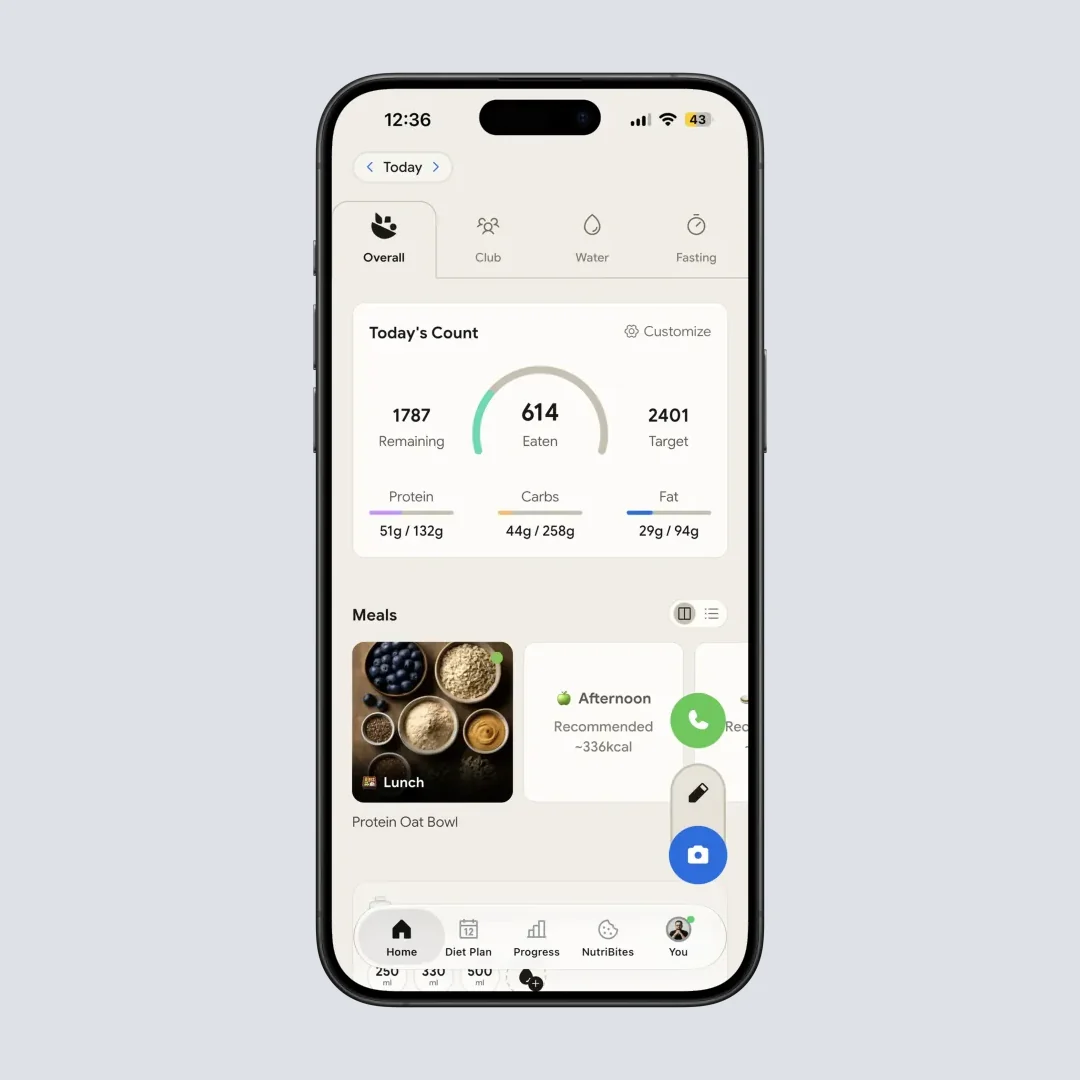
The home screen scoreboard: meals logged through Monika land here next to photo scans and manual entries, with the day's calories and macros in one view.
What the Research Actually Says About Voice Logging 📚
The evidence base for voice-first dietary tracking is younger than for photo logging, but the findings point the same way. One caveat on independence: the speech-recording review and the household validation study below share three authors, so they are not two separate research groups agreeing.
On engagement, the strongest signal is the 2023 base2Diet pilot: over 28 days, voice-based logging produced more distinct logging events and more active days than text-based logging in the same study design, and participants preferred the voice alerts (Chikwetu et al., 2023). Eighteen participants is a pilot, not a verdict, but engagement is exactly where logging interventions usually fail, so a method that increases logging days matters. It lines up with the broader self-monitoring literature, where higher adherence to recording is associated with greater odds of hitting a 5 percent weight loss (Burke et al., 2025).
On accuracy, the picture is more cautious. The speech-recording review reports transcription accuracy averaging 83 percent across studies (Dodd et al., 2022). Downstream of transcription, food detection accuracy across published AI systems ranges from 74 to 99.85 percent, a spread the authors attribute to disparity between studies rather than to the food itself (Zheng et al., 2024). And in Cambodian households, a combined voice and image system read lower than standard recalls for most nutrients while still being rated easy to use (Rollo et al., 2025).
Even the best-case photo test lands short on most measures: 26.9 percent mean absolute difference across 16 nutrients, significant on 10 of them, with calories the one measure that came out nearly exact (O'Hara et al., 2025). The pattern I keep seeing in every input method we test is that capture is getting easy and the numbers are still hard. Nobody has published a test of whether correcting the draft fixes it, so this is my read and not a finding: pick the app whose correction step you will actually do.
The Verdict: Buy the Understanding, Not the Microphone ✅
Every app here has a microphone button. The differences are what happens after you stop talking. NutriScan is my pick when your meals are cooked, mixed, or regional, because the conversation catches what your sentence left out, and because you can test voice free. MacroFactor is the pick for the fastest dictation with a clean review step, if you accept no free tier. Lose It is a clean, simple dictation app that now costs $79.99 a year, so buy it for the whole Premium bundle rather than for voice alone. MyFitnessPal makes sense only if you already pay for Premium and run the app in English. SnapCalorie is a promising smaller option with the cheapest way into voice logging if you catch the right promo, and Cal AI treats voice as an accessory.
 When the app hears "two rotis, dal with two spoons of oil, and buttermilk" and every line item comes back right.
Whichever you choose, run the one-week test above before paying for a year. And if you want to feel the difference a follow-up question makes, say tonight's dinner to NutriScan and let Monika ask about the oil. The answer usually changes the number more than the microphone ever will. Download NutriScan free and your first Monika call takes one tap from the home screen.
IMPORTANT
Recap: everything you completed this round.
You finished the run. Save this for the week you test your pick.
⏱️ Progress 4/4 • ~7 minutes in • Nicely done
✅ Step 1: The 3 moments voice logging wins
✅ Step 2: How voice logging breaks
✅ Step 3: All 6 apps, ranked and priced
✅ The 7-day test that decides your pick before you pay (revealed)
Frequently Asked Questions ❓
Is voice logging more accurate than typing your food?
Not by itself. The words arrive with about 83 percent average transcription accuracy in published research (Dodd et al., 2022), and the app still guesses portions you did not state. Voice wins on consistency, not precision: a 2023 pilot found voice loggers recorded more entries on more days than text loggers (Chikwetu et al., 2023). More logged days with small errors beats fewer logged days with perfect ones.
Which apps let you log food by voice for free?
NutriScan includes 4 Monika voice calls per week on its free plan (NutriScan pricing). Lose It and MyFitnessPal keep voice logging inside their paid plans, and MacroFactor has no free tier at all, only a 7-day trial. SnapCalorie and Cal AI offer limited free use with paid upgrades.
Do voice logging apps understand Indian and other non-Western foods?
Unevenly. Apps built on US-centric databases often match "poha" or "sambar" to a generic nearest entry, which changes the calories. Research on nutrition apps found manual apps underestimated Asian-style meals by roughly 360 calories on average while overestimating Western-style meals (Li et al., 2024). If you eat regional food daily, test the app on your five most common dishes before paying.
Should I say the portion size out loud?
Yes, always. The quantity is the single most valuable part of the sentence. An app that hears "rice" logs a default serving. No published study has tested whether stating the portion improves the final number, so take this as our own view: the app has to assume any amount you leave out, and saying it up front costs less than fixing it later.
Is voice logging private enough to use in public?
Treat spoken logs like any dictation: the audio is processed by the app's speech systems, and you are saying your meals out loud where people can hear. Practical middle ground: use voice at home and in the car, and use photo or typed input in the office. Every app in this ranking offers at least one silent input method alongside voice.
Can voice logging replace photo scanning?
They cover different failures, and the strongest pattern is using both. The photo shows portions you would misjudge in words, and your words carry the invisible items like oil and sugar that no camera sees. That is why researchers building assessment tools combine image and voice in one system, and named theirs the Voice-Image Solution for Individual Dietary Assessment (Rollo et al., 2025). It is also why our own meal scan flow asks you to set the cooking method, from 11 options, and the oil level, from 4, before it commits a number to your day.
Related: best app for photo logging of mixed dishes and Lifesum vs Lose It on photo and voice logging.