Iron in Food: How Much You Need and Which Foods Have It
 ChatGPT
 Claude
 AI Mode
 Perplexity
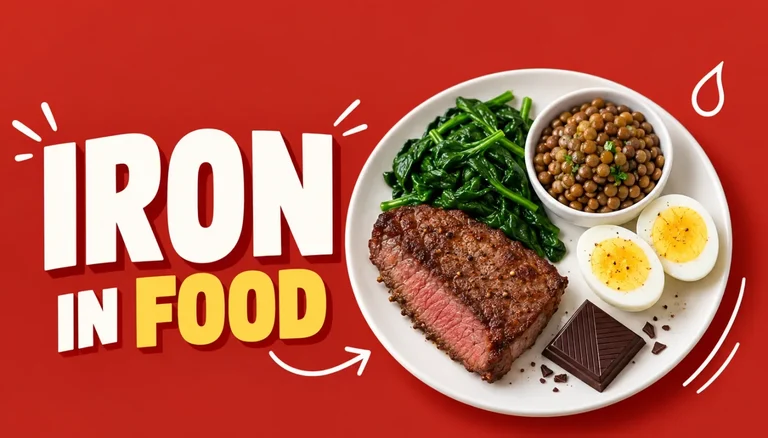
Iron carries oxygen in your blood, and most adults need 8 mg a day, with 18 mg for women aged 19 to 50. Beef, mutton, lentils and spinach all contain it. Eggs have about 1 mg each, and Guinness Zero has almost none.
Figures checked on October 14, 2026 against the NIH Office of Dietary Supplements iron fact sheet (which draws on USDA FoodData Central and the National Academies) and the NutriScan food pages linked below. Servings and percentages follow the NIH table unless a row says otherwise.
Summary
- Daily need: the US Recommended Dietary Allowance (RDA) is 8 mg for men over 18, 18 mg for women aged 19 to 50, 8 mg for women over 50, 27 mg in pregnancy and 9 mg while breastfeeding at ages 19 to 50.
- Eggs: one large hard-boiled egg has about 1 mg, 6% of the Daily Value (DV).
- Mutton: 3.73 mg per 100 g cooked goat meat, 21% of the 18 mg DV, per USDA FoodData Central.
- Roast beef: 2 mg in 3 ounces of braised bottom round, 11% of the DV.
- Guinness Zero: 0.1 mg per 440 ml can, under 1% of the DV.
- Vegetarians need 1.8 times the RDA, because plant iron is absorbed less well than iron from meat.
How much iron do you need per day?
The Food and Nutrition Board at the National Academies of Sciences, Engineering, and Medicine sets the RDA for iron. The NIH Office of Dietary Supplements publishes the values in its iron fact sheet.
| Age | Male | Female | Pregnancy | Breastfeeding |
|---|---|---|---|---|
| 7 to 12 months | 11 mg | 11 mg | ||
| 1 to 3 years | 7 mg | 7 mg | ||
| 4 to 8 years | 10 mg | 10 mg | ||
| 9 to 13 years | 8 mg | 8 mg | ||
| 14 to 18 years | 11 mg | 15 mg | 27 mg | 10 mg |
| 19 to 50 years | 8 mg | 18 mg | 27 mg | 9 mg |
| 51 years and over | 8 mg | 8 mg |
Babies from birth to 6 months have an Adequate Intake of 0.27 mg a day, not an RDA.
How much iron per day does a woman need?
Women aged 19 to 50 need 18 mg a day, more than twice the 8 mg men need. The need drops to 8 mg after age 50. Teenage girls aged 14 to 18 need 15 mg, and pregnancy raises the figure to 27 mg.
The NIH fact sheet also lists teenage girls, premenopausal women and pregnant women among the groups in the United States at risk of getting too little. The 18 mg figure is also the Daily Value printed on US food labels, so a food with 9 mg lists 50%.
If you eat no meat, the National Academies set the requirement 1.8 times higher than for people who eat meat. The cause is bioavailability: the NIH puts absorption at 14% to 18% from mixed diets that include meat, seafood and vitamin C, and 5% to 12% from vegetarian diets.
Which foods have the most iron?
The NIH table below lists iron per serving from USDA FoodData Central. "Percent DV" is against 18 mg.
| Food | Serving | Iron | % DV |
|---|---|---|---|
| Breakfast cereal fortified with 100% DV | 1 serving | 18 mg | 100% |
| Oysters, eastern, cooked | 3 oz | 8 mg | 44% |
| White beans, canned | 1 cup | 8 mg | 44% |
| Beef liver, pan fried | 3 oz | 5 mg | 28% |
| Lentils, boiled | 1/2 cup | 3 mg | 17% |
| Spinach, boiled | 1/2 cup | 3 mg | 17% |
| Tofu, firm | 1/2 cup | 3 mg | 17% |
| Dark chocolate, 45% to 69% cacao | 1 oz | 2 mg | 11% |
| Chickpeas, boiled | 1/2 cup | 2 mg | 11% |
| Sardines, canned in oil | 3 oz | 2 mg | 11% |
| Beef, braised bottom round | 3 oz | 2 mg | 11% |
| Cashews, oil roasted | 1 oz | 2 mg | 11% |
| Chicken, roasted | 3 oz | 1 mg | 6% |
| Turkey breast, roasted | 3 oz | 1 mg | 6% |
| Tuna, light, canned in water | 3 oz | 1 mg | 6% |
| Egg, hard boiled | 1 large | 1 mg | 6% |
| Milk | 1 cup | 0 mg | 0% |
The NIH notes that lean meat and seafood are the richest sources of heme iron, while nuts, beans and vegetables supply non-heme iron. About half of the iron in the US diet comes from bread, cereal and other grain products, because wheat flour is fortified.
Our own lentils page lists 3.3 mg for half a cup (99 g) cooked, which matches the NIH figure of 3 mg after rounding.
How much iron is in eggs?
One large hard-boiled egg has about 1 mg of iron, or 6% of the DV, in the NIH table. Two eggs at breakfast give about 2 mg. That is the same as a 3 ounce serving of braised beef bottom round and less than half a cup of boiled lentils at 3 mg.
Eggs are better known for protein and choline. Treat them as a small contributor to iron, not the main one. Our boiled egg page has the calories and protein per egg.
How much iron is in mutton?
USDA FoodData Central lists roasted goat meat at 3.73 mg of iron per 100 g cooked, which is 21% of the 18 mg DV. We use that entry on our mutton page because mutton means goat meat across much of India. A 3 ounce (85 g) serving works out to about 3.2 mg, our arithmetic from the same figure.
Mutton from mature sheep is a different USDA entry from goat, so a mutton curry made with sheep meat will not match this number exactly. Curries also change the portion of meat per bowl. A bowl with 100 g of cooked meat is the unit to compare.
Does roast beef have iron?
Yes. The NIH table gives 2 mg for 3 ounces (85 g) of braised bottom round with the fat trimmed, 11% of the DV. Beef iron is mostly heme iron, which the body absorbs better than the iron in plants. The NIH says other food components change heme iron absorption less than they change non-heme iron absorption.
The number moves with the cut and how it is cooked. Deli roast beef is sliced from different cuts and differs by brand, so use the label. Our beef roast page has calories and protein for a cooked roast.
Does Guinness Zero have iron?
Barely. Our Guinness Zero page lists 0.1 mg of iron per 440 ml can. Against the 18 mg DV that is about 0.6%. You would need to drink around 180 cans to reach a woman's daily 18 mg, so it does not count toward your iron.
Heme and non-heme iron: why plant sources count for less
Meat, poultry and seafood supply heme iron. Beans, nuts, vegetables and fortified grains supply non-heme iron. The NIH says heme iron has better bioavailability and that other foods affect non-heme iron absorption more.
Two practical points come from the NIH fact sheet:
- Vitamin C helps. Ascorbic acid improves absorption of non-heme iron, so lentils with tomatoes or peppers beat lentils on their own.
- Some plant foods block it. Spinach has a lot of iron on paper, but it contains polyphenols that inhibit absorption, and the NIH gives it as an example of a food with low iron bioavailability.
Meat, poultry and seafood also raise the absorption of non-heme iron eaten in the same meal.
What happens if you get too little iron?
Iron deficiency anemia develops when the body's iron stores run out and hemoglobin falls. The NIH lists weakness, fatigue, difficulty concentrating and stomach upset as symptoms, and says it can affect immune function and body temperature regulation. The World Health Organization estimated in 2008 that about half of the 1.62 billion cases of anemia worldwide are due to iron deficiency.
Tiredness has many causes. A blood test measuring hemoglobin and ferritin is how iron deficiency is confirmed, and a doctor decides the treatment.
Do not start iron tablets on a guess
The Tolerable Upper Intake Level for iron from food and supplements is 45 mg a day for ages 14 and up. The NIH reports that doses of 45 mg a day or more can cause stomach and bowel side effects. People with hereditary hemochromatosis absorb too much iron and should not add more. Iron can also interfere with levothyroxine and levodopa, so take supplements only on medical advice.
How do you keep track of your iron?
Iron is one of the nutrients NutriScan tracks. The Progress page has a Vitamins & Minerals target with cards for Iron and 11 other nutrients, each with a progress bar. The "Why?" button on a card opens deficiency effects, top food sources per 100 g and tips. You can also pin Iron to the Home screen from a list of 18 nutrients.
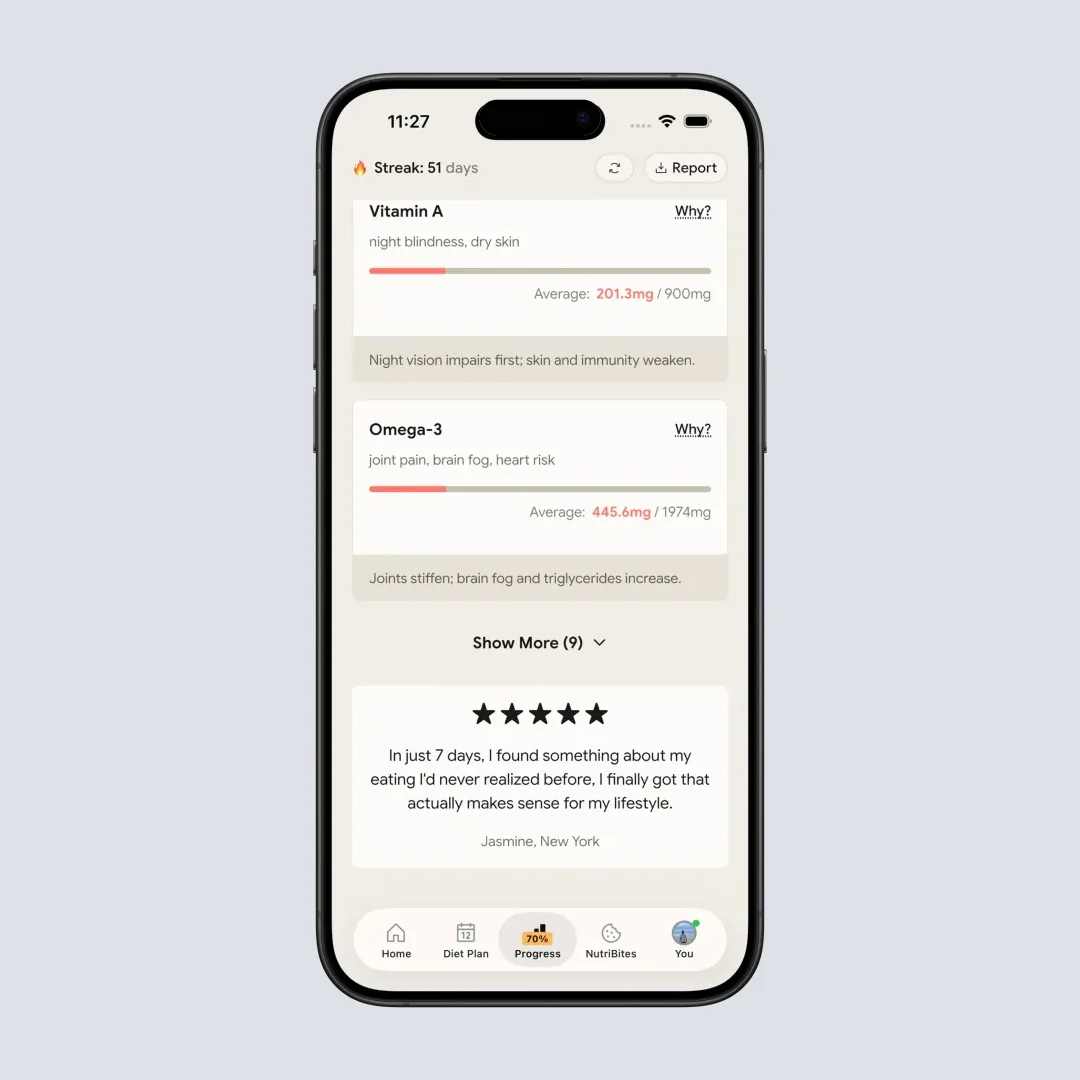
The Vitamins & Minerals target on the Progress page.
Scan a plate and the app logs its nutrients, iron included. The free plan includes 5 scans a week. If you are pregnant, a teenager aged 14 to 18 or a vegetarian, your RDA is higher than the 8 mg most adults need, so check the table above.
For the other minerals, see how much potassium and sodium you need, or the best apps for micronutrient tracking.