How Much Water Do You Need a Day? Official Numbers
 ChatGPT
 Claude
 AI Mode
 Perplexity
Healthy adults need about 2.0 to 3.7 liters of total water a day, depending on whose reference you use. "Total water" means drinking water, every other drink and the moisture in food. Food supplies roughly a fifth of it, so the amount you need to pour into a glass is smaller than the headline figure.
Reference values checked on October 14, 2026 against the National Academies' Dietary Reference Intakes for Water, Potassium, Sodium, Chloride, and Sulfate (2005), EFSA's 2010 Scientific Opinion on Dietary Reference Values for water, and the CDC's 2009 to 2012 NHANES data brief. Food figures come from the linked NutriScan food pages unless a line names another source.
Summary
- United States (National Academies): adequate intake of total water is 3.7 L a day for men and 2.7 L for women. That is about 3.0 L (13 cups) and 2.2 L (9 cups) from drinks, with the rest from food.
- Europe (EFSA): 2.5 L a day for men and 2.0 L for women, total water from drinks and food.
- Pregnancy: the National Academies give 3.0 L of total water, about 2.3 L (10 cups) from drinks. EFSA adds 300 mL a day to the non-pregnant figure.
- Food counts. Cucumber is 95% water and watermelon juice is 92%. Even Sprite is 89.5% water by USDA data, though it carries 38 g of sugar a can.
- These are intake levels for healthy people, not a target to force. Heat, exercise, illness and body size move your own number. In NutriScan the Water tab suggests 35 mL per kg of body weight and lets you change it.
How much water do you need per day?
The two reference sets most people meet are the US one and the European one. Both state an adequate intake (AI), which is the level that healthy people were observed to drink, not a minimum requirement.
| Group | National Academies (US), total water | Of which from drinks | EFSA (Europe), total water |
|---|---|---|---|
| Men, 19 and over | 3.7 L (125 fl oz) | about 3.0 L (13 cups) | 2.5 L |
| Women, 19 and over | 2.7 L (91 fl oz) | about 2.2 L (9 cups) | 2.0 L |
| Pregnancy | 3.0 L | about 2.3 L (10 cups) | non-pregnant AI plus 300 mL |
| Breastfeeding | 3.8 L | about 3.1 L (13 cups) | non-lactating AI plus about 700 mL |
The National Academies report based its figures on what women who appear adequately hydrated actually drink, which it put at about 2.7 L a day, and about 3.7 L for men. EFSA's opinion lands lower, at 2.0 L for women (95th percentile of intake 3.1 L) and 2.5 L for men (95th percentile 4.0 L).
The CDC's NHANES data brief shows what people in the US actually take in. In 2009 to 2012 men averaged 3.46 L (117 fl oz) from all foods and liquids a day and women averaged 2.75 L.

How much of your water comes from food?
The National Academies report that water from food supplied about 19% of total water intake in the US survey it used (NHANES III), which works out to 0.7 L a day for men and 0.5 L for women. Fluids made up the other 81%, or 3.0 L for men and 2.2 L for women.
That split is why the glass target is lower than the total. A woman who meets the 2.7 L adequate intake by the National Academies' split drinks about 2.2 L and eats the other 0.5 L.
Some foods carry far more water than the 19% average suggests:
| Food | Water content | Source |
|---|---|---|
| Cucumber | 95% | NutriScan food page |
| Watermelon juice | 92% | NutriScan food page |
| Watercress, raw | about 95% | USDA FoodData Central |
| Lemon-lime soda such as Sprite | 89.5 g per 100 g | USDA FoodData Central, SR Legacy |
How much water intake per day for women?
Use 2.7 L of total water (the National Academies figure) or 2.0 L (EFSA) as the two ends of the range. In US terms that is about 9 cups, or 74 fl oz, from drinks and the remainder from food.
Neither figure adjusts for your body. A taller person, a person who trains, and anyone spending time in heat will sit above it. If you track in the NutriScan app, the Water tab suggests a goal of 35 mL per kg of the weight in your profile, rounded to 50 mL and kept between 1,500 and 4,000 mL. For a 70 kg person that comes to 2,450 mL of logged drinks, which sits close to the National Academies' drinks figure for women plus a little extra. You can edit the goal from 500 to 10,000 mL.
How much water intake during pregnancy?
The National Academies set the adequate intake in pregnancy at 3.0 L of total water a day, about 2.3 L (10 cups) of it as drinks. That is 0.3 L above the figure for women who are not pregnant.
EFSA reaches a similar total by a different route. It keeps its non-pregnant 2.0 L and adds 300 mL a day to match the rise in energy intake, giving 2.3 L. For breastfeeding it recommends about 700 mL a day above the non-lactating figure, to replace the water in breast milk. The National Academies sets the lactation AI at 3.8 L a day of total water, with about 3.1 L from beverages.
Both bodies describe levels for healthy people. If you have vomiting, swelling, a kidney condition or a pregnancy complication, your own clinician's number replaces these.
How much water is in Sprite and other drinks?
Everything you drink counts toward the fluid total, including soda. USDA lists lemon-lime soda at 89.5 g of water per 100 g. A 355 mL can of Sprite is about 320 g of water at that rate (our arithmetic, treating 1 mL as 1 g).
The same can has 140 calories and 38 g of added sugar on our Sprite page. You get the water and a drink that is mostly sugar alongside it, which is why water, unsweetened tea or sparkling water are the better way to reach your number. Our coffee page covers why a normal amount of coffee also counts toward fluid.
How much watercress should I eat daily?
Our watercress page suggests 1 to 2 cups (34 to 68 g) of raw watercress a day. USDA lists raw watercress at about 95% water, so that portion adds only about 32 to 65 mL of water.
Watercress is a vitamin and mineral food at 11 calories per 100 g. Count its water as a small bonus and keep your drinks as the main source.
How much watermelon juice should I drink a day?
The watermelon juice page recommends 200 to 250 mL a day for most people and no more than 100 mL a day with diabetes or PCOS. At 92% water, 250 mL gives about 230 mL of water. At 46 calories per 100 mL it also gives about 115 calories, mostly sugar.
Treat it as a fruit serving. It can cover part of a fluid goal, though plain water does the job without the sugar.
Can you drink too much water?
Yes, though it takes a lot over a short time. The National Academies did not set an upper level for water. Their report notes that people with normal kidney function can excrete about 0.7 L an hour, so steady sipping across the day is not a concern for most healthy adults. Drinking several liters in an hour is the situation to avoid.
If you have a medical condition
This article is general information. If you have kidney disease, heart failure, take diuretics or were told to restrict fluids, follow your care team's limit instead of these figures.
How do you know you are drinking enough?
The reference values are population averages. The National Academies note that differences in intake come partly from body size, physical activity and climate, so a hot week or a hard training day puts your need above the table.
A practical way to cover it:
- Drink with every meal and snack. Seven or eight small drinks spread over the day beat one large drink late at night.
- Eat water-rich food. A cucumber salad or a few slices of watermelon adds water and takes some pressure off the glass.
- Set your own target from your weight. The 35 mL per kg rule in NutriScan is a starting point, not a prescription.
- Raise it for sweat. Add a glass or two on hot or training days.
How do you track water in NutriScan?
The Water tab is on the free plan. The first time you open it, a two-step intro sets a daily goal from your weight, in ml or oz. After that, one tap on 250 ml or 500 ml (8 or 16 oz) logs a drink, a custom chip takes any amount up to 3,000 ml, and an Undo icon removes the last one.
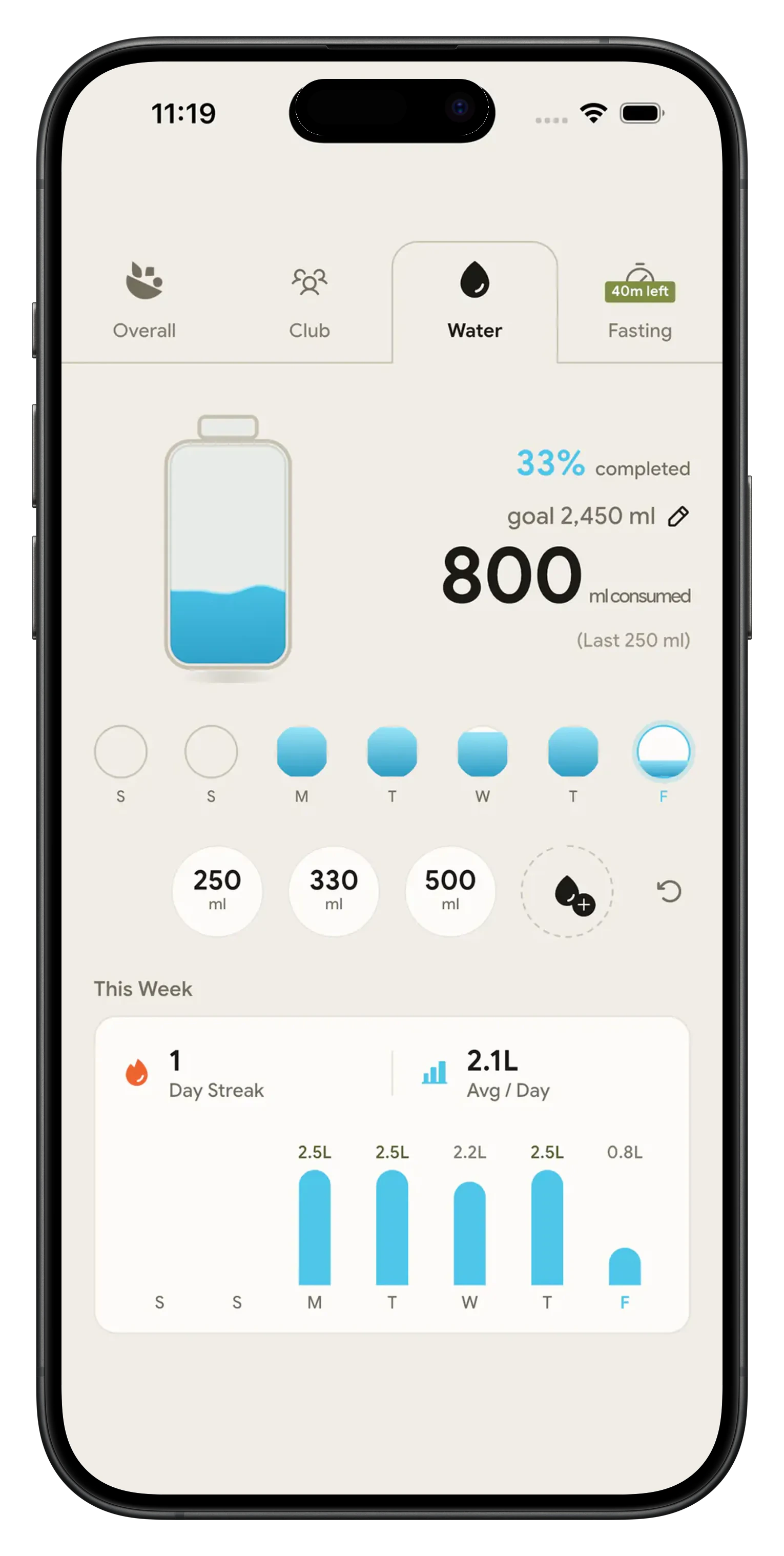
The Water tab on Home. The bottle fills toward the day's goal and the strip shows the last seven days.
The This Week card shows your day streak and average per day. You can set reminders from Profile, Set Reminders, at an interval from every 15 minutes to every 3 hours between a start and end time. When you allow hydration access on the Health screen, water syncs with Apple Health or Health Connect. Scanning your plate logs the calories and nutrients of what you eat. The free plan includes 5 scans a week.
If you want a daily protein, fiber or sodium target alongside water, see our guides to protein per day, fiber per day and sodium per day.
What else do people ask about water intake?
How much water should I drink per day?
The National Academies set an adequate intake of 3.7 liters of total water a day for men and 2.7 liters for women, counting all beverages and food. About 19% of that comes from food, so drinks supply roughly 3.0 liters (13 cups) for men and 2.2 liters (9 cups) for women. EFSA is lower, at 2.5 liters for men and 2.0 liters for women.
How much water intake per day is right for women?
The National Academies' adequate intake for women aged 19 and over is 2.7 liters of total water a day, about 2.2 liters (9 cups) from drinks and the rest from food. EFSA sets 2.0 liters of total water for women. CDC survey data from 2009 to 2012 found US women averaged 2.75 liters from all foods and drinks.
How much water intake during pregnancy?
The National Academies' adequate intake in pregnancy is 3.0 liters of total water a day, about 2.3 liters (10 cups) from drinks. EFSA suggests the non-pregnant figure of 2.0 liters plus 300 mL a day, so 2.3 liters in total. Your own number depends on heat, activity and your clinician's advice.
How much water is in Sprite?
USDA lists lemon-lime soda at 89.5 g of water per 100 g. A 355 mL can of Sprite therefore holds roughly 320 g of water, which counts toward fluid intake. The same can has 140 calories and 38 g of sugar on our Sprite page, so water or an unsweetened drink is the better way to cover your fluid.
How much watercress should I eat daily?
Our watercress page suggests 1 to 2 cups (34 to 68 g) of raw watercress a day. Watercress is about 95% water per USDA, so that amount adds only about 32 to 65 mL of water. Eat it for the vitamins and the 11 calories per 100 g, and count it as a small extra rather than a way to meet your fluid goal.
How much watermelon juice should I drink a day?
Our watermelon juice page recommends 200 to 250 mL a day for most people, and 100 mL at most with diabetes or PCOS. The juice is 92% water, so 250 mL gives about 230 mL of water along with 115 calories at 46 calories per 100 mL. Drink it as a fruit serving and keep plain water as your main fluid.