Is Culina Health Free? Dietitian Cost, Insurance and Fees
 ChatGPT
 Claude
 AI Mode
 Perplexity

Culina Health says 93% of its patients use insurance for their dietitian visits, so the visit itself often costs a copay of about $30 to $60 and sometimes nothing. If you skip insurance, its membership page lists three self-pay plans at $99, $169 and $229 a month. The catch is the late-cancel rule: patients who bill insurance can be charged a fee of up to $100 for a late cancel or a no-show.
I work on the NutriScan team, which makes an AI nutrition coach app, so read this as an outsider's summary of public documents. I read Culina Health's pricing, insurance, FAQ and cancellation pages live on November 4, 2026, and compared them with copies in the Internet Archive's Wayback Machine going back to April. The prices and fees below matched in both. Each source is linked so you can open the live page and check whether it has changed.
Prices and policies were checked on November 4, 2026. Culina Health serves patients in the United States. Plans, session limits and fees change, so confirm them with Culina Health and your insurer before you book.
IMPORTANT
Culina Health pricing at a glance
- With insurance: Culina Health says 93% of patients do this. Common copays are $30 to $60 per session.
- Without insurance: membership plans at $99, $169 or $229 a month.
- Extra membership sessions: $75 for 30 minutes, $100 for 45 minutes.
- Late cancel or no-show: up to $100 for insurance patients, a forfeited session for members.
- Medicare: accepted for diabetes, kidney disease and the 36 months after a kidney transplant, with a doctor's referral.
- The app: free to download, but you get access after you book a first session.
IMPORTANT
Your Culina Health cost plan at a glance.
Three money questions, then the routine that ties them together.
⏱️ Progress 0/4 • ~0 minutes in • Keep going
⏳ Step 1: What you pay with insurance
⏳ Step 2: What you pay without it
⏳ Step 3: The fees and Medicare rules
🔍 The 5-step booking routine that prevents a surprise bill (revealed near the end)
Is Culina Health free? The quick answer
No. Culina Health is a clinic staffed by registered dietitians, and it charges for sessions either through your insurance or through a monthly membership. The FAQ says "93% of our patients receive insurance coverage for their visits" and adds that "if you're not covered by insurance," memberships and support are available.
Here is how the cost splits by how you pay:
- Insurance in network: you pay whatever your plan assigns, which can be $0 under a preventive benefit, a copay, or the full rate until your deductible is met.
- Out-of-network insurance: Culina Health gives you a superbill, an itemized receipt, so you can ask your insurer for reimbursement. Whether you get money back depends on your plan.
- Self-pay membership: $99, $169 or $229 a month, billed automatically.
- Medicare: covered for a short list of conditions, explained below.
 The honest answer depends on one thing: whether your insurer pays.
I found no free tier and no free consultation on any page I read. The app is free to download, though, and I cover that in its own section.
What Culina Health is and who runs it
Culina Health is a virtual nutrition practice. Its About page says registered dietitians Vanessa Rissetto and Tamar Samuels started it in 2020 after running separate private practices. The home page claims more than 10,000 patients served, a patient NPS of 95, service in 50 states and over 2,000 referring physicians. These are the company's own numbers and I could not check them elsewhere.
The legal name differs from the brand. The App Store lists the seller as Fig Health, Inc., and Crunchbase lists Fig Health, Inc. as doing business as Culina Health. I searched for news of an acquisition or merger on November 4, 2026 and found none. The footer on Culina Health's own pages gives a Hoboken, New Jersey address.
 Photo by Vitaly Gariev on Unsplash
The service has three parts:
- One-on-one visits. Video sessions with a registered dietitian matched to your state and your health goals. The home page describes a 60-minute first session and 45-minute follow-ups. Insurance sessions can differ, and the membership plans below use 30 and 45 minute follow-ups.
- Group sessions. The FAQ says group programs give "6 hours of care from a registered dietitian for a fraction of the cost of 1:1 sessions," with at most 12 people, and it is built for people who skip insurance. I found no group price on any page I read.
- The app. Meal logging, recipes and a chat with your dietitian, described below.
Culina Health cost with insurance
Most patients go this route. The insurance page lists these in-network plans: Aetna, Anthem Blue Cross Blue Shield, AmeriHealth, BCBS PPO, BCBS HMO in select states, CareFirst Blue Cross Blue Shield, Cigna, Empire Plan, Harvard Pilgrim Health Care in Massachusetts, Horizon BCBS, Mass General Brigham Health Plan, Meritain, Oxford, UMR and United Healthcare.
The same page publishes session estimates by insurer, and it tells you to confirm them with your plan:
| Insurer | Sessions Culina Health says are covered |
|---|---|
| Aetna | 10 to 26 per policy year |
| CareFirst Blue Cross Blue Shield | 12 or more per policy year |
| Horizon Blue Cross Blue Shield | 3 per policy year |
| Cigna | Typically 3 per policy year, some plans unlimited |
| Blue Cross Blue Shield, UMR, United Healthcare | Some plans unlimited with no cost-sharing |
Copays are the part that decides your bill. The page says the most common copays it sees range from $30 to $60 per session. The FAQ suggests sessions every 1 to 2 weeks for the first 1 to 3 months. At one visit every other week for three months, that is about six visits, so $180 to $360 in copays if your plan covers all six. If your plan stops at three sessions, as the Horizon estimate does, the next visits are not covered, and the pages do not say what the price is then. Ask before the fourth visit.
Two other points from the insurance page. First, Culina Health says its dietitians accept insurance "for all conditions." Second, you can use HSA and FSA money for copays, coinsurance and other out-of-pocket costs. Whether a specific purchase qualifies is your plan administrator's decision, so ask them before you rely on it.
Finally, the deductible. If you have not met a high deductible, in-network insurance can charge you the full negotiated rate per visit until you do. The FAQ names this case: membership suits patients "who have high deductibles that have not been met."
IMPORTANT
Checkpoint: insurance math done.
Next, the self-pay plans and their exit rules.
⏱️ Progress 1/4 • ~3 minutes in • Keep going
✅ Step 1: What you pay with insurance (done)
👉 Step 2: What you pay without it (you're here)
⏳ Step 3: The fees and Medicare rules
🧩 The 5-step booking routine that prevents a surprise bill (coming soon)
Questions to ask your insurer
Ask for the CPT codes 97802 and 97803, which cover medical nutrition therapy visits, and ask whether your plan pays for them with a Z71.3 (dietary counseling) diagnosis. A yes on both, plus the copay and yearly visit cap, tells you almost everything about your Culina Health bill.

Culina Health cost without insurance
The self-pay route is the membership program. The page lists:
| Plan | Price | First month | Ongoing |
|---|---|---|---|
| Essentials | $99 a month | 60-minute intake | 1 session of 30 minutes a month |
| Core | $169 a month | 60-minute intake and a 30-minute follow-up | 2 sessions of 30 minutes a month |
| Enhanced | $229 a month | 60-minute intake and a 45-minute follow-up | 2 sessions of 45 minutes a month |
Members can buy extra sessions at "discounted rates": $75 for 30 minutes and $100 for 45 minutes. The page lists what every plan includes: messaging your dietitian between sessions, a personalized nutrition, lifestyle and supplement plan, the mobile app, and lab recommendations.
Here is what each plan adds up to, using my own arithmetic on those prices:
| Plan | 3 months | 12 months |
|---|---|---|
| Essentials | $297 | $1,188 |
| Core | $507 | $2,028 |
| Enhanced | $687 | $2,748 |
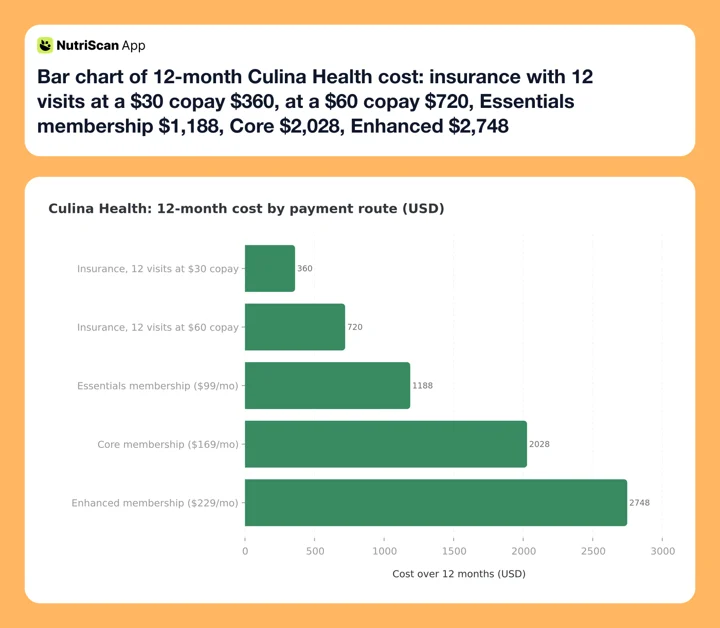 Figure 1: Over a year, monthly visits on a $30 to $60 copay cost $360 to $720, while membership runs $1,188 to $2,748. Insurance figures assume all 12 visits are covered.
As Figure 1 shows, covered visits beat every membership plan when your insurer pays for a full year of sessions. The rules around membership are strict, according to the FAQ:
- Billing is automatic. Culina Health charges you on the same date each month, before services are delivered.
- Unused sessions expire. They do not carry over, and there are no refunds for unused sessions.
- You can cancel or pause any time before the next billing cycle, and you can still use that month's sessions.
- Early exit costs more. If you cancel before you finish the intro month plus one full month of follow-ups, you pay a standalone rate of $225 for the first session and $100 for each follow-up, and your membership payment counts toward that. By my reading, a Core member who leaves after month one would owe $325 in total, which is $156 more than the $169 already paid. Confirm this with Culina Health before you sign up.
- Insurance does not apply later to those sessions. Culina Health cannot "retroactively apply" insurance to membership sessions, and you "cannot submit" membership fees to your insurer for reimbursement.
The membership page also invites you to "pay with HSA/FSA." That is a tax-advantaged account, not an insurance claim, and your plan administrator decides whether a membership fee qualifies.
WARNING
Check your session cap before you pick membership. If your insurer covers 10 or more sessions, a $30 to $60 copay per visit usually costs less than a $99 to $229 monthly fee. If your plan covers 3 sessions and you have a high deductible, membership may cost less over a year.
IMPORTANT
Checkpoint: halfway, and the costly part is next.
The late-cancel rule is where most surprise charges come from.
⏱️ Progress 2/4 • ~6 minutes in • Keep going
✅ Step 1: What you pay with insurance (done)
✅ Step 2: What you pay without it (done)
👉 Step 3: The fees and Medicare rules (current)
⏳ The 5-step booking routine that prevents a surprise bill (next)
Late cancel and no-show fees
This is the fee that surprises people. The cancellation policy says:
- You must cancel or reschedule at least 24 hours before the session.
- You are a no-show if you do not enter the session within 15 minutes of the start time.
- Not confirming a session "does not constitute as cancelling your appointment."
- If you are driving, in another meeting or somewhere you cannot talk privately, or you cannot stay for the whole session, the dietitian can end it, and that counts as a late cancellation.
- Insurance patients: "your card on file will be automatically charged a fee of up to $100."
- Members: you forfeit the session, with no refund or reschedule.
- Group sessions: you forfeit the session but still receive the materials.
 Check the clock 24 hours out, not 24 minutes.
The page does not say when the fee is lower than $100 or how you can dispute a charge.
One October 2026 App Store reviewer, rating the app one star, said they joined about 40 minutes late after getting no appointment notification, messaged the dietitian, and was still charged a missed-appointment fee. Under the policy as written, a person who is more than 15 minutes late is a no-show. That is one reviewer's account, and I cannot check the other side of it.
Does Culina Health take Medicare or Medicaid?
Medicare: yes, in a narrow way. The FAQ says Culina Health accepts Original Medicare Parts A and B and "some Medicare Advantage" plans, and that Medicare covers virtual dietitian visits only for diabetes, kidney disease, or a kidney transplant in the last 36 months, with a referral from an MD or DO.
That matches the federal rule. 42 CFR 410.132 says Medicare Part B pays for medical nutrition therapy when a physician refers you, and it limits referrals to people diagnosed with diabetes or renal disease. 42 CFR 410.130 defines renal disease to include the 36 months after a kidney transplant.
The number of hours is not in those two sections. Culina Health's Medicare article says Medicare covers up to 3 hours of medical nutrition therapy in the first calendar year and up to 2 hours in later years, that referrals last one year, and that Part B covers 100% for eligible services with a Medicare-approved dietitian. It says Medicare's telehealth flexibilities for dietitians are scheduled to end on December 31, 2027. If you have Original Medicare and none of the three qualifying conditions, the FAQ says to contact Culina Health about "out-of-pocket options."
Medicaid: I found no statement either way. Neither the FAQ nor the insurance page lists Medicaid or a state Medicaid plan. If you are on Medicaid, call (917) 647-1665 or email [email protected] before you book.
Where Culina Health works
The home page says 50 states. The FAQ is more specific: most patients live in New York, New Jersey, Texas, California, Massachusetts and the Washington, DC area, and dietitians serve other states too. Each dietitian must be licensed where the patient lives, because "the patient's state is considered the practice location" even for video visits. You enter your state when you book, and Culina Health matches you with a licensed dietitian.
The same FAQ says Culina Health dietitians speak 14 languages and that most patients get a first session within 7 to 10 days of first contact, sometimes in 1 to 2 days. Telehealth appointments run weekdays, evenings and weekends. The insurance page lists support hours of Monday to Friday, 8 am to 8 pm Eastern.
Is the Culina Health app free?
The download is free, but the app belongs to patients. The FAQ says that once you schedule your first session, "you'll gain access to the Culina Health app," which has meal tracking, recipes, healthy eating tips and a real-time chat with your dietitian. Memberships list the mobile app among their included features. I found no standalone app subscription and no way to use the dietitian chat without being a patient.
On November 4, 2026, the App Store listing showed:
- Seller: Fig Health, Inc.
- Version 2.11.0, released October 12, 2026
- Price: free
- Rating: 3.5 stars from 19 ratings
The App Store's reviews feed returned 7 written reviews, from November 2024 to October 2026. They average 2.0 stars, which is below the 3.5 average across all 19 ratings, because written reviews skew negative. With 7 reviews I would not call this a pattern, but the topics repeat:
- Forms and onboarding. An April 2026 reviewer could not scroll down to submit required forms, and said other parts of the app stayed locked until they did.
- Food journal. One 2025 reviewer called logging slow and the calorie values sometimes wrong. A November 2024 reviewer said the journal had many near-duplicate entries with no photos, and that the app does not support landscape mode on iPad.
- Missing views. A September 2025 reviewer asked how to chart calories and macros over time or export data, and found only weight charted.
- Positive notes. Two November 2024 reviewers rated 4 stars. One said the app helps them talk to their dietitian and review the materials sent to them.
- Billing. The October 2026 review above is the only one that mentions a fee.
IMPORTANT
Checkpoint: final stretch before the routine.
You know the prices. The next sections turn them into a booking plan.
⏱️ Progress 3/4 • ~9 minutes in • Keep going
✅ Step 1: What you pay with insurance
✅ Step 2: What you pay without it
✅ Step 3: The fees and Medicare rules
✨ The 5-step booking routine that prevents a surprise bill (about to reveal)
What the research says about dietitian care
Culina Health publishes outcome numbers on its home page, such as an average 5% weight loss over 6 to 12 months. I found no peer-reviewed study of its patients, so I treat those as marketing figures. The evidence for working with a dietitian in general is stronger, and it comes from trials of dietitians in many settings, not from Culina Health.
- Weight. A systematic review and meta-analysis of 62 randomized trials found dietitian-led weight management improved percent weight loss by a mean difference of 4.01% against control conditions (95% CI 2.75% to 5.26%), with high certainty of evidence (Morgan-Bathke et al., 2023).
- Type 2 diabetes. Fourteen studies with 3,338 participants found HbA1c fell 0.47 percentage points more with dietitian nutrition therapy than with advice from other professionals. The authors rated the evidence as limited by heterogeneity and bias (Siopis et al., 2021).
- Prediabetes. Thirteen randomized trials showed medical nutrition therapy lowered HbA1c by 0.30% and fasting glucose by 4.97 mg/dL against standard care, with low to moderate certainty (Dudzik et al., 2023).
- Blood pressure. In 31 trials, therapy from a dietitian lowered systolic pressure by 3.63 mmHg and diastolic by 2.02 mmHg (Senkus et al., 2024).
Two limits apply. The Morgan-Bathke, Dudzik and Senkus reviews include authors who work for the Academy of Nutrition and Dietetics, the profession's trade body. And none of these trials tested Culina Health. They support seeing a dietitian. They do not show that Culina Health produces a given result for you.

Who Culina Health suits, and who should look elsewhere
It may suit you if:
- Your insurer is on its in-network list and covers enough sessions that your cost is a copay.
- You have diabetes, kidney disease or a transplant and a doctor's referral under Medicare.
- You want one dietitian over weeks, with messaging in between.
- You can protect an appointment slot and cancel more than 24 hours ahead when plans change.
You may want another option if:
- Your insurer covers only 3 sessions and you have a high deductible. Compare the membership against the per-session rates.
- Your schedule moves a lot. Late cancels cost up to $100 or a forfeited member session.
- You have Original Medicare without diabetes or kidney disease.
- You are on Medicaid, since I found no confirmation.
If you are comparing paid programs, see how Noom and its alternatives price their coaching, what Nutrisense charges to pair a dietitian with a glucose sensor, and our guide to budget meal planning apps. Other insurance-billed dietitian services: Fay, Berry Street and Season Health. For diabetes, a diabetic grocery list is a free place to start, and our diabetes macro calculator gives you daily carb, protein and fat targets to discuss with a dietitian.
How to book Culina Health without a surprise bill: 5 steps
Here is the routine. Each step takes one call, one email or one calendar entry.
 Photo by Alexa Williams on Unsplash
- Get your benefits in writing. Call the number on your insurance card and ask about dietitian or nutrition counseling visits: copay, deductible, session cap per year, and whether you need a referral. Culina Health publishes a verification guide on its insurance page.
- Check your plan against the in-network list. Compare your plan name with the insurance page, then email [email protected] if it is not listed.
- Ask what happens after your cap. If your plan covers 3 sessions, ask what a fourth costs, and compare that with the membership rate.
- Put reminders in your calendar for 24 hours before each visit. Reminders come by email and text, but not confirming does not cancel a session.
- If you choose membership, ask for the early-cancel math. Using the $225 and $100 standalone rates, ask Culina Health to write down what leaving after month one would cost on your plan.
IMPORTANT
Recap: everything you checked.
Save this before you call your insurer.
⏱️ Progress 4/4 • ~12 minutes in • Nicely done
✅ Step 1: What you pay with insurance
✅ Step 2: What you pay without it
✅ Step 3: The fees and Medicare rules
✅ The 5-step booking routine that prevents a surprise bill (revealed)
Tracking food between dietitian visits
Whoever you see, the days between visits decide most of the result. A dietitian works from what you ate, and a few weeks of honest records make the next session more useful.
NutriScan, the app my team makes, is an AI nutrition coach. You log meals by photo, voice or text, and it estimates calories and macros, builds a 28-day diet plan with grocery lists, and shows blood glucose readings next to your meals. Monika, its voice AI nutritionist, answers questions on a call, and NutriBites lets you ask about your own meal history. It has a Free plan with 5 scans a week and a Premium plan at about $59 a year, covered in our pricing breakdown.
NutriScan has no human dietitians, cannot bill insurance and does not replace Culina Health. Photo estimates can also miss hidden oil in mixed dishes. What it gives you is a record of what you ate to bring to each visit, which is the part a dietitian cannot see between sessions.
Culina Health pricing FAQ
Is Culina Health free?
No. Culina Health charges for sessions through your insurance or a monthly membership. It says 93% of patients use insurance, with common copays of $30 to $60 per session. Without insurance, membership plans cost $99, $169 or $229 a month.
How much does Culina Health cost without insurance?
Its membership page lists Essentials at $99 a month, Core at $169 a month and Enhanced at $229 a month. Extra sessions cost $75 for 30 minutes or $100 for 45 minutes. Billing is automatic and unused sessions do not carry over.
Does Culina Health take insurance?
Yes. Its insurance page lists Aetna, Anthem Blue Cross Blue Shield, Cigna, Horizon BCBS, Oxford, UMR, United Healthcare and others as in network. Session limits vary from 3 to more than 20 per year by plan, so check your own benefits.
Does Culina Health charge a cancellation fee?
Yes. Patients who bill insurance can be charged up to $100 for a late cancel, late reschedule or no-show, according to its cancellation policy. Members forfeit the session. Cancel more than 24 hours ahead to avoid it.
Does Culina Health take Medicare?
Yes, for Original Medicare Parts A and B and some Medicare Advantage plans. Medicare covers dietitian visits only for diabetes, kidney disease and the 36 months after a kidney transplant, with a referral from a doctor. I found no statement about Medicaid.