Lean Muscle Diet Plan: 70 kg Lifter, 6 Days a Week
 ChatGPT
 Claude
 AI Mode
 Perplexity
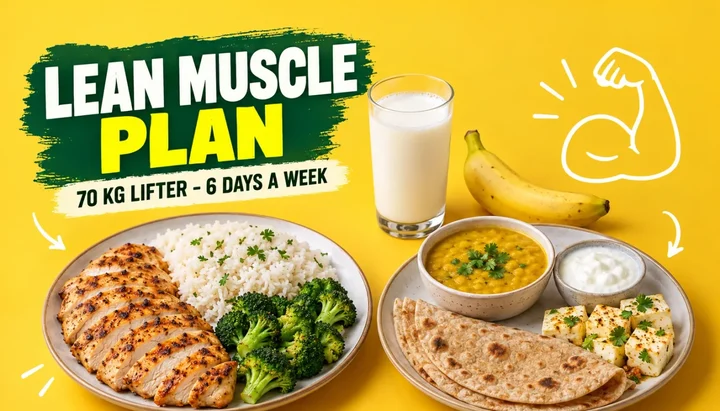
A 19-year-old lifter at 70 kg (154 lb) and 178 cm (5 ft 10) who trains six days a week needs about 3,100 calories a day and 140 to 155 g of protein to add lean muscle. That is roughly 250 calories above an estimated maintenance of 2,850, aiming for a gain of 175 to 350 g (0.4 to 0.8 lb) a week. Below are the numbers worked out, then a full sample day twice: once in everyday gym foods and once in Indian food, both landing near 3,100 calories.
TL;DR
- The target: about 3,100 calories a day and 140 to 155 g of protein for a 70 kg lifter who trains six days a week.
- The surplus: roughly 250 calories above an estimated maintenance of 2,850.
- The pace: a gain of 175 to 350 g (0.4 to 0.8 lb) a week.
- The check: weigh in for two weeks, then add or cut calories based on the trend.
Put your own numbers in first. Your height, age and training load will move the target away from the example.
Your daily bulking calories
3,056calories a day+500
2,556 maintenance calories plus a 500 calorie surplus.
- Maintenance 2,556
- Surplus +500
Your timeline
Protein while bulking
112 - 154g protein a day
1.6 to 2.2 g per kg of body weight. Muscle gain flattens out near 1.6 g per kg in the 2018 Morton meta-analysis, so the top of the band is a cushion rather than a requirement.
Lean vs standard pace
| Pace | Surplus | Weeks | Goal date |
|---|---|---|---|
| Lean 0.25 kg | +250 | 20 | Mar 10, 2027 |
| Standard 0.5 kg | +500 | 10 | Dec 30, 2026 |
Lean adds about a quarter kilo a week and keeps fat gain low. Standard is twice as fast and brings more fat with it. Switch the pace above to change the plan.
An estimate from the Mifflin-St Jeor equation. Weigh yourself weekly, and if the scale has not moved in two weeks, add 150 to 200 calories a day.
Here is what you will get from this guide:
- The calorie target and how it is calculated
- The protein target, and why more is not better
- A sample day in general foods
- The same day in Indian foods
- Swaps for vegetarian, budget and no-powder versions
- The two-week check that tells you whether to add or cut calories (revealed near the end)
Your numbers at a glance
| Item | 70 kg, 178 cm, 19 years, 6 sessions a week |
|---|---|
| Estimated maintenance | About 2,850 kcal |
| Daily target | About 3,100 kcal (+250) |
| Protein | 140 to 155 g (2.0 to 2.2 g per kg) |
| Target weight gain | 175 to 350 g (0.4 to 0.8 lb) a week |
| Meals | 4 to 5, with 25 to 45 g of protein in each main meal |
| Check-in | 7-day average weight, every 2 weeks |
Every figure here is an estimate. Treat 3,100 as the first guess and let the scale correct it.

Six training days a week is what pushes the maintenance estimate up to 2,850 calories.
How to set the calorie surplus
Start with maintenance. The Mifflin-St Jeor equation estimates resting energy use from weight, height and age (Mifflin et al., 1990). For a 19-year-old man it is 10 x 70 kg + 6.25 x 178 cm - 5 x 19 + 5 = 1,722 calories a day at rest.
Multiply by an activity factor. Six weight sessions a week plus a normal day of walking and studying or working sits around 1.65, which gives 1,722 x 1.65 = about 2,840, rounded to 2,850. A factor of 1.55 gives 2,670 and 1.725 gives 2,970, so the honest range is 2,700 to 3,000. The TDEE calculator shows the same sum for every activity level.
Then add the surplus. A review of off-season nutrition for natural lifters recommends eating about 10 to 20 percent above maintenance and aiming for 0.25 to 0.5 percent of body weight per week for novice and intermediate lifters (Iraki et al., 2019). At 2,850 that is 285 to 570 extra calories. Because the goal is lean muscle, this plan starts just under the low end at +250, which gives 3,100.
The review also says advanced lifters should gain slowly, since they add muscle slowly and a big surplus mostly adds fat. A review of energy surplus and muscle growth adds a caveat: the size of surplus that maximizes hypertrophy has never been validated in people who lift (Slater et al., 2019). So 3,100 is a starting hypothesis, not a law.
The weight target follows from the same review: 0.25 to 0.5 percent of 70 kg is 175 to 350 g a week. In 12 weeks that is 2 to 4 kg (4.5 to 9 lb), and not all of it will be muscle. For a longer look at how surpluses work, see the hard gainer diet guide.
How much protein you need
Past a certain point, extra protein stops adding muscle. A meta-analysis of 49 trials found that protein supplementation during resistance training added muscle mass up to about 1.6 g per kg a day, with the upper end of the confidence interval at 2.2 g per kg (Morton et al., 2018). The International Society of Sports Nutrition puts the general working range for people who train at 1.4 to 2.0 g per kg (Jäger et al., 2017).
For 70 kg, that is:
| Per kg of body weight | Daily protein |
|---|---|
| 1.6 g (where gains level off) | 112 g |
| 2.0 g (a clean target) | 140 g |
| 2.2 g (top of the range) | 154 g |
Aim for 140 g and treat 154 g as the ceiling. The sample days below land at 142 and 152 g.
Split it across the day. A review of per-meal protein suggests 0.4 g per kg per meal across at least four meals, which is 28 g at 70 kg (Schoenfeld and Aragon, 2018). The protein intake calculator gives the per-meal split for your weight.
WARNING
If you have kidney disease or any other medical condition, talk to your doctor before eating at the top of this range.
Fat and carbohydrate fill the rest. The general sample day has roughly 108 g of fat (1.5 g per kg) and about 380 g of carbohydrate (5.4 g per kg). Carbohydrate is the fuel for six training days, so it is the macro to protect.

Sample day, general version
This is a 3,100 calorie day for a 70 kg lifter who trains in the late afternoon. Calories and protein come from USDA FoodData Central values and from NutriScan's food pages for eggs, chicken breast, oats and Greek yogurt. Rice, chicken and salmon are cooked weights.
| Meal | Food | kcal | Protein (g) |
|---|---|---|---|
| Breakfast | 2 eggs scrambled in 1 tsp olive oil, 90 g (1 cup) rolled oats cooked in 1 cup (244 ml) whole milk, 1 banana | 786 | 37 |
| Lunch | 100 g (3.5 oz) chicken breast, 300 g (about 2 cups) cooked rice, 150 g broccoli, 1 tbsp olive oil | 726 | 43 |
| Pre-workout snack | 2 slices whole wheat bread with 2 tbsp peanut butter, 1 banana | 453 | 16 |
| Dinner (after training) | 100 g (3.5 oz) cooked salmon, 350 g cooked rice, 150 g mixed vegetables, 1 tbsp olive oil | 830 | 35 |
| Bedtime | 150 g nonfat Greek yogurt, 28 g (1 oz) almonds, 1 tbsp honey | 317 | 21 |
| Total | 3,112 | 152 |
A few notes on the table. The two tablespoons of olive oil are 238 calories with no bulk, which is the easiest way to raise calories when appetite is the limit. The peanut butter sandwich is the pre-workout carbohydrate, and the rice at dinner refills glycogen after training. Peanut butter itself is mostly fat, with 7 g of protein per 188 calorie serving, per NutriScan's peanut butter page.
TIP
Log the oil. The two tablespoons of olive oil are 238 calories with no bulk, which is the easiest way to raise calories when appetite is the limit.

Batch-cooked containers make hitting 3,100 calories a matter of reheating, not deciding.
Sample day, Indian-food version
The same targets with a dal, roti, paneer and curd plate. It runs on eggs, milk and curd, so it suits a lacto-vegetarian diet if you drop the eggs for extra paneer. Values come from NutriScan's pages for chapati, dal tadka, paneer and soya chunks, with USDA values for milk, curd, peanuts and almonds.
| Meal | Food | kcal | Protein (g) |
|---|---|---|---|
| Breakfast | 3-egg bhurji in 1 tsp oil, 2 chapati, 1 cup whole milk, 1 banana | 747 | 34 |
| Lunch | 1 cup dal tadka, 300 g (about 2 cups) cooked rice, 80 g paneer pan-tossed, 100 g curd | 877 | 37 |
| Pre-workout snack | 28 g (1 oz) roasted peanuts, 1 banana, 1 cup whole milk | 420 | 16 |
| Dinner | Soya chunk curry (50 g dry chunks, 1 tbsp oil), 3 chapati, 150 g curd | 743 | 41 |
| Bedtime | 1 cup whole milk, 28 g (1 oz) almonds | 313 | 14 |
| Total | 3,100 | 142 |
This plate leans on three Indian staples. Dal tadka gives 9.8 g of protein per cup for 182 calories, paneer gives 18.9 g per 100 g (with 24.8 g of fat, so portion it), and 50 g of dry soya chunks gives 26 g of protein for 172 calories. Soya chunks swell when soaked, so weigh them dry. The soya chunks page has the soaking maths.
Want a chicken day instead? Swap the 80 g of paneer at lunch for 100 g of cooked chicken breast (165 calories, 31 g of protein) and add a tablespoon of oil to the lunch dal. The day lands near 3,140 calories and 157 g of protein. For a plan built around Indian staples and local food costs, see the Indian weight gain diet plan.
The two days side by side
| General day | Indian-food day | |
|---|---|---|
| Calories | 3,112 | 3,100 |
| Protein | 152 g | 142 g |
| Main carbohydrate | Rice, oats, bread | Rice, chapati, banana |
| Main protein | Eggs, chicken, salmon, Greek yogurt | Eggs, dal, paneer, curd, soya chunks, milk |
| Fat source | Olive oil, almonds, peanut butter | Cooking oil, paneer, milk, almonds, peanuts |
| Meals | 5 | 5 |
Both days are the same plan with different groceries. The Indian day has less protein because it has no chicken or fish. To bring it closer to 150 g, raise the soya chunks from 50 g to 65 g dry or add a fourth egg at breakfast.
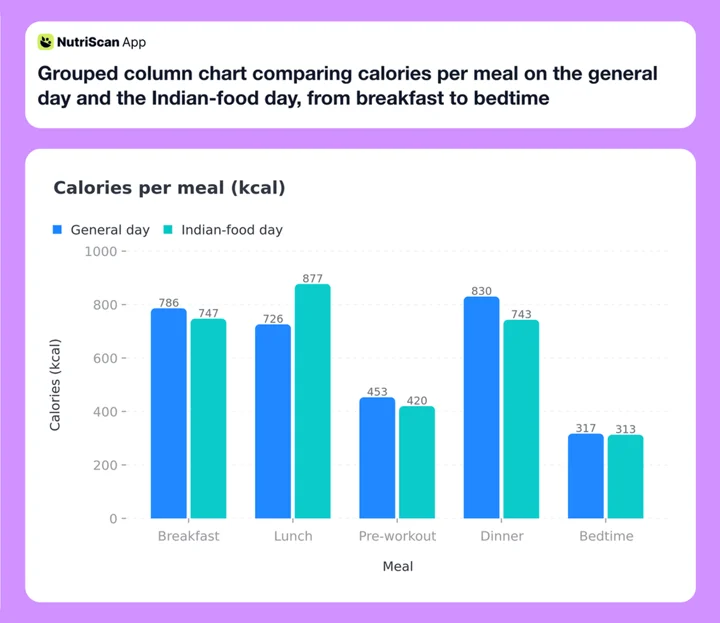
Figure 1: Calories per meal on the general day and the Indian-food day.
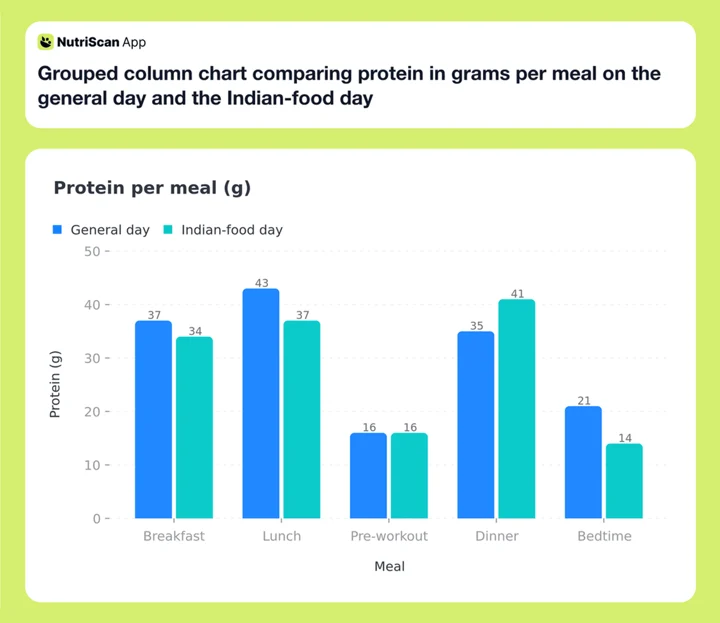
Figure 2: Protein per meal on the general day and the Indian-food day.
Swaps that keep the numbers
You do not need these exact foods. Swap within a category and the day holds.
- Chicken or fish: 100 g cooked chicken breast gives 31 g of protein. Tuna, turkey, lean beef or tofu fit the same slot.
- Rice: 300 g of cooked rice is about 390 calories. Pasta, potatoes or 3 chapati do the same job.
- Oats and milk: 90 g oats with a cup of whole milk is 499 calories and 23 g of protein. Poha, upma or two slices of toast with peanut butter work if oats bore you.
- Whey: One scoop is 120 calories and 24 g of protein. It is a gap-filler, not a requirement, and neither sample day uses it.
- Budget: Eggs, milk, curd, dal, rice and peanuts are low-cost staples in most markets, and all of them are on one list or the other.
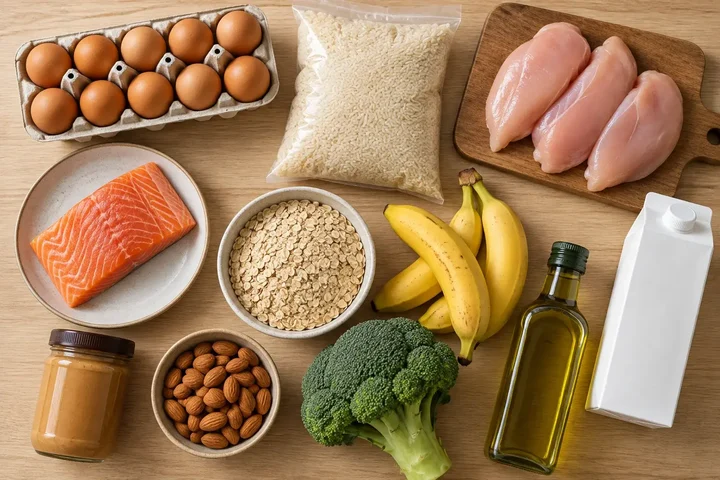
Most swaps come from one grocery list: eggs, rice, chicken, oats, milk, peanut butter and olive oil.
The two-week check
The calorie target is a guess, so test it.
Weigh yourself first thing in the morning, before food, three or four mornings a week. Average the week. Compare this week's average with last week's.
- Gaining 175 to 350 g a week: keep eating the same.
- Gaining less than 175 g for two weeks in a row: add 150 to 200 calories a day, one extra banana and a tablespoon of peanut butter is about right.
- Gaining more than 350 g a week: remove 150 to 200 calories. A bigger share of the extra is likely to be fat.
Recalculate maintenance every 4 to 5 kg of gain. The surplus that works at 70 kg is smaller at 76 kg.
How to log it without a food scale
Weighing every plate gets old by week three. NutriScan reads a photo of the meal and returns calories and protein, so a bowl of dal and rice takes a few seconds. NutriScan reports about 95 percent accuracy on calories; that is its own figure, not an independent study. The Free plan includes 5 photo scans a week, and Premium costs about $59 a year with unlimited scans.

The scan screen lets you tag the food type, the cooking method and how much oil went in.
For a takeout meal where you cannot see the oil, scan it anyway and compare the calories with the portion you expected. The best macro tracker for bulking compares the options if you want to see the alternatives.

Common mistakes on a lean muscle plan
- Eating 3,100 on paper and 2,600 in practice. Cooking oil, drinks and weekend meals get missed. A week of honest logs fixes this.
- Chasing protein past 2.2 g per kg. The research above shows no extra gain, and every extra gram of protein is calories not spent on carbohydrate.
- Skipping breakfast on busy days. A 750 calorie meal missed five days a week is 3,750 calories a week, enough to stall the whole surplus.
- Judging the plan after four days. Water and glycogen move the scale by a kilogram when you add carbohydrate, so only the two-week average counts.
- Cutting rest-day food too hard. Keep protein the same on the seventh day and trim at most 100 to 200 calories of carbohydrate.
Your first week
- Day 1: Weigh yourself and measure your waist at the navel. Save both.
- Days 1 to 7: Eat one of the two sample days, or a swap of it, six days out of seven.
- Day 7: Average the morning weights.
- Day 14: Run the two-week check and adjust.
- Week 12: Compare waist and weight. If the waist grew much faster than the scale, run a smaller surplus next block.

Train hard in week one and let the scale average, not a single morning, tell you how it is going.
Frequently asked questions
How many calories should a 19-year-old 70 kg lifter eat to build lean muscle?
About 3,100 a day if the training is six hard sessions a week. That is a maintenance estimate of 2,850 plus a 250 calorie surplus. Weigh yourself for two weeks and adjust by 150 to 200 calories if the weekly gain is outside 175 to 350 g.
How much protein does a 70 kg lifter need for lean muscle?
140 g a day is a clean target (2 g per kg), inside the 1.6 to 2.2 g per kg range used for lifters who are adding size. Spread it over four or five meals of 25 to 45 g each.
Can I build lean muscle on a vegetarian Indian diet?
Yes. Eggs, milk, curd, paneer, dal and soya chunks cover 140 g of protein at 3,100 calories, as the Indian sample day shows. Vegans can lean on soya chunks, tofu and lentils and may need more total food to reach the same protein.
Do I need whey protein to build lean muscle?
No. Neither sample day uses powder. A scoop (24 g of protein, 120 calories) is a convenient way to close a gap on a busy day, and nothing more.
How fast should I gain weight on a lean muscle diet?
0.25 to 0.5 percent of body weight a week, which is 175 to 350 g for a 70 kg lifter. Faster than that and more of the gain is fat.
Should I eat less on my rest day?
Keep protein the same. Trimming 100 to 200 calories of carbohydrate on a rest day is fine, but the weekly average is what decides whether you gain.
Related tools and guides
- Weight gain calculator for a daily target and a projected date
- TDEE calculator for maintenance calories
- Protein intake calculator for daily grams and a per-meal split
- Muscle gain with NutriScan for tracking a surplus