Hard Gainer Diet: Calorie Surplus Meal Plan to Gain Muscle
 ChatGPT
  Claude
  AI Mode
  Perplexity
TL;DR - Hard Gainer Diet and Calorie Surplus
• Who it's for: Anyone who trains, eats what feels like a lot, and watches the scale sit still
• Key number: A surplus of 10 to 20 percent above maintenance, gaining 0.25 to 0.5 percent of body weight a week
• Steps: Log two weeks to find maintenance ➡️ add 10 to 20 percent ➡️ fill six slots with calorie-dense food ➡️ recheck the seven-day average every two weeks
• Reality check: A 70 kg lifter should expect about 2.5 kg in twelve weeks, not in three
NutriScan publishes this post and makes a calorie tracking app. The hard gainer complaint has real physiology under it: when 16 lean volunteers were fed 1,000 calories a day above maintenance for eight weeks, two-thirds of the increase in their daily energy expenditure came from fidgeting, posture and other unplanned movement, and fat storage varied 10-fold between people eating the same surplus (Levine et al., 1999). Some bodies burn off a surplus almost as fast as it arrives.
That is the honest version of a hard gainer: an appetite that stops you eating enough, next to a body that quietly spends extra energy the moment you do. Both have one fix, a planned surplus you can actually eat every day, built from calorie-dense foods, on top of resistance training.
IMPORTANT
Your hard gainer plan at a glance.
A quick roadmap so you can start today.
⏱️ Progress 0/4 • ~0 minutes in • Keep going
⏳ Step 1: Set the surplus
⏳ Step 2: Pick calorie-dense foods
⏳ Step 3: Run the week, check the scale
🔍 The gain rate where every added kilo was muscle (revealed near the end)
What a Calorie Surplus Is, and What a Hard Gainer Really Is 🔍
A calorie surplus means you take in more energy than you spend. Burn 2,600 calories a day and eat 3,000, and the extra 400 is the raw material for new tissue. Without it, training still makes you stronger, but the muscle you can lay down is limited.
A hard gainer is the person for whom that surplus is hard to reach and hold. The label gets attached to a body type, the ectomorph: long limbs, narrow frame, low body fat. Body typing is not a scientific system, and no evidence says a narrow frame blocks muscle growth. What the frame predicts is appetite.
The second half of the explanation is movement you never counted. In the overfeeding study above, changes in non-exercise activity predicted who resisted fat gain, correlation 0.77 (Levine et al., 1999). Given extra food, some people pace more and sit less still, so their surplus on paper is not the one their body experiences.
A hard gainer diet is therefore a normal muscle gain diet with two adjustments: the calorie target sits higher than your appetite would choose, and the foods are picked to fit a stomach that fills quickly.
 The weekly weigh-in is the only test that settles whether your surplus is real.
How Many Calories You Need for a Surplus 🔢
A review of the off-season literature for natural bodybuilders recommends roughly 10 to 20 percent above maintenance, with a target gain of 0.25 to 0.5 percent of body weight per week for novice and intermediate lifters, and less for advanced lifters, who build muscle slowly enough that a large surplus buys them fat (Iraki et al., 2019).
Start with maintenance. Estimate it with a TDEE calculator, or better, by logging two weeks of normal eating while your weight holds steady. Then add the percentage.
| Body weight | Example maintenance | Surplus at 10% | Surplus at 20% | Target weekly gain |
|---|---|---|---|---|
| 50 kg (110 lb) | 2,000 kcal | 2,200 kcal | 2,400 kcal | 125 to 250 g |
| 60 kg (132 lb) | 2,300 kcal | 2,530 kcal | 2,760 kcal | 150 to 300 g |
| 70 kg (154 lb) | 2,600 kcal | 2,860 kcal | 3,120 kcal | 175 to 350 g |
| 80 kg (176 lb) | 2,900 kcal | 3,190 kcal | 3,480 kcal | 200 to 400 g |
| 90 kg (198 lb) | 3,200 kcal | 3,520 kcal | 3,840 kcal | 225 to 450 g |
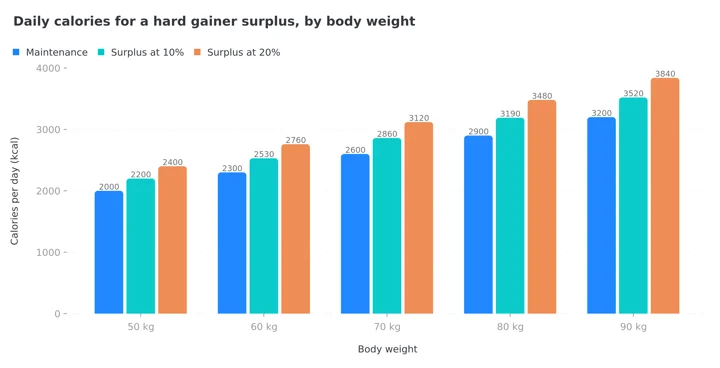 Figure 1: The gap between the bars is the whole diet. At 70 kg it is 260 to 520 extra calories a day, one shake.
The maintenance column holds example figures for a moderately active adult, and a hard gainer's real number usually runs higher, so check yours with a weight gain calculator. Then treat the calorie target as a hypothesis and the scale as the test: if weight has not moved after two weeks, add 200 calories a day.
Macros sit inside the total: protein at 1.6 to 2.2 g per kg, fat at 0.5 to 1.5 g per kg, the rest from carbohydrate at 3 to 5 g per kg or more (Iraki et al., 2019). At 70 kg that is 112 to 154 g of protein a day, and a protein intake calculator does the same sum for your weight.
Worked through on one person: a 70 kg man stuck at 70 kg after a year of training maintains at about 2,750, so a 15 percent surplus is 3,160 with 126 g of protein across four meals. He skips breakfast on workdays and loses 700 calories he never makes up, so one 700-calorie breakfast is the whole intervention.
IMPORTANT
Checkpoint: here's where you are right now.
You have a calorie target. Next comes the food.
⏱️ Progress 1/4 • ~1 minute in • Keep going
✅ Step 1: Set the surplus (done)
👉 Step 2: Pick calorie-dense foods (you're here)
⏳ Step 3: Run the week, check the scale
🧩 The gain rate where every added kilo was muscle (coming soon)

What the Research Says About Surpluses and Muscle Gain 📚
Two findings shape everything in this guide.
A surplus helps, but nobody has pinned down the ideal size. A review of energy surplus and hypertrophy found clear evidence of an anabolic stimulus from an energy surplus, while the surplus needed to maximize muscle growth has never been validated in a resistance training population (Slater et al., 2019). The 10 to 20 percent figure is a practice guideline, not a measured optimum.
Protein has a ceiling. A meta-analysis of 49 studies with 1,863 participants found protein supplementation raised fat-free mass by 0.30 kg during prolonged resistance training, with no further gains beyond roughly 1.62 g per kg per day (Morton et al., 2018). The International Society of Sports Nutrition puts the working range at 1.4 to 2.0 g per kg, 20 to 40 g per serving, every three to four hours (Jäger et al., 2017).
Hard Gainer Foods: What to Eat to Build Muscle 🥜
Calorie density is the property that matters: more energy per bite, so the daily total fits inside your appetite.
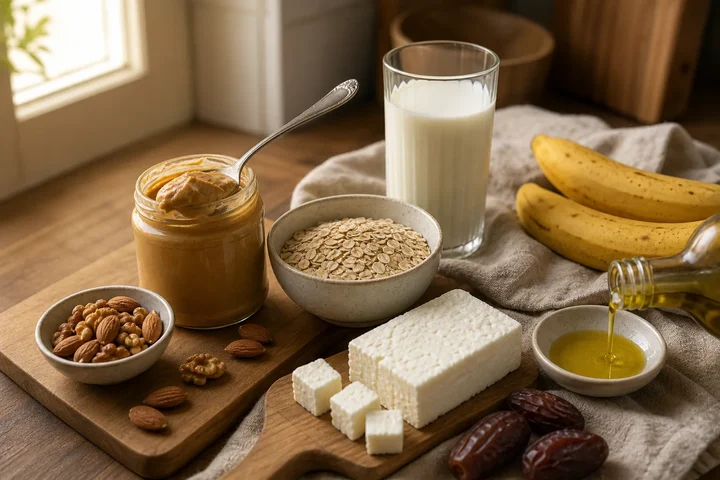 Every food here carries more calories per mouthful than its low-fat version.
| Food | Serving | Calories | Why it works |
|---|---|---|---|
| Peanut butter | 2 tbsp | 188 kcal | 76% fat, spreads on anything |
| Oats | 100 g dry | 389 kcal, 16.9 g protein | Cook in milk |
| Whole milk | 100 ml | 61 kcal | Liquid calories bypass fullness |
| Olive oil | 1 tbsp | 120 kcal | Any dish, no extra volume |
| Almonds | 1 oz (28 g) | 164 kcal | Pocket snack |
| Banana | 1 medium | 105 kcal | Blends into any shake |
| Dates | 1 date | 66 kcal | Five is 330 kcal |
| White rice | 100 g cooked | 130 kcal | Low fiber, easy in quantity |
| Chicken breast | 100 g cooked | 165 kcal, 31 g protein | Cheapest protein |
| Eggs | 1 egg | 70 kcal, 6 g protein | Whole eggs, not whites |
| Greek yogurt | 100 g full fat | 97 kcal | Full fat, not low fat |
| Paneer | 100 g | 296 kcal, 18 g protein | Vegetarian protein plus fat |
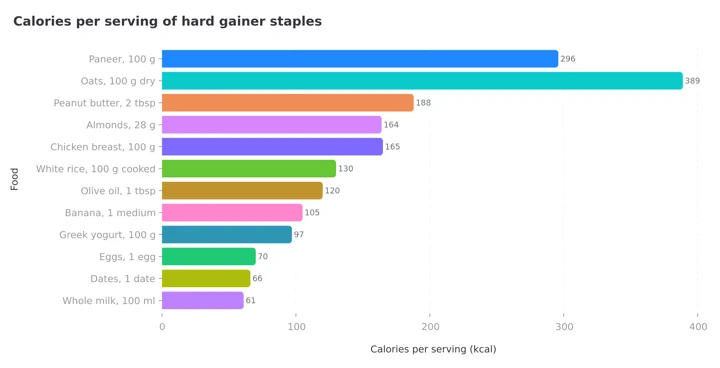 Figure 2: 100 g of dry oats carries 389 calories, six times the 61 calories in 100 ml of whole milk.
Two rules run through that table. Drink some of your calories: a shake of milk, oats, peanut butter and a banana carries 700 to 800 calories in two minutes, where the same energy as chicken and broccoli takes half an hour and leaves you too full for the next meal. And do not fear fat, which at 9 calories a gram raises a total fastest. What to avoid is high-fiber, high-volume food at every meal, because large salads and soups fill the stomach and leave no room.
Cook your carbs in something
Rice simmered in milk instead of water, oats cooked in milk, potatoes mashed with butter. Same volume on the plate, 150 to 250 more calories.
For the recovery side, muscle recovery nutrition covers what to prioritize after hard sessions.
IMPORTANT
Checkpoint: midway progress update.
You know the number and the foods. Now they become a week.
⏱️ Progress 2/4 • ~3 minutes in • Keep going
✅ Step 1: Set the surplus (done)
✅ Step 2: Pick calorie-dense foods (done)
👉 Step 3: Run the week, check the scale (current)
⏳ The gain rate where every added kilo was muscle (next)
A Free 7-Day Hard Gainer Meal Plan 🍚
Two versions follow, one around 3,100 calories and one around 2,350. Pick the closer one and scale portions. Both run the same six slots all week, matching the off-season advice of three to six meals a day, one within two hours of training (Iraki et al., 2019).
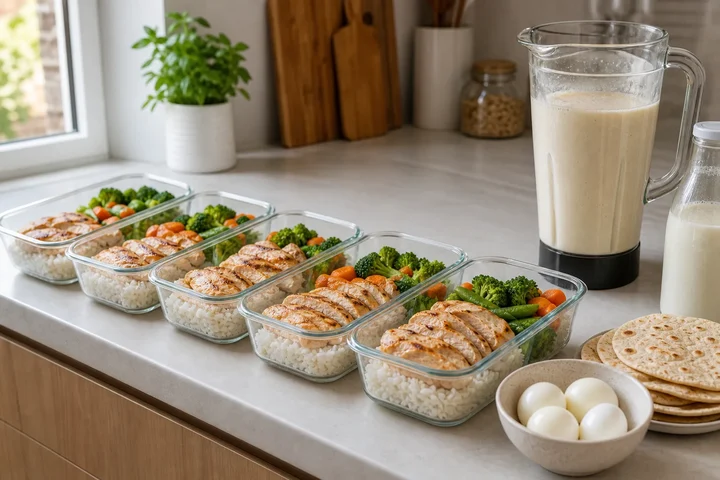 One Sunday cook-up removes the decision that costs hard gainers 700 calories on a busy Tuesday.
Meal Plan to Gain Muscle for Men, About 3,100 Calories
| Meal | What to eat |
|---|---|
| Breakfast | 100 g oats in 400 ml whole milk, banana, 2 tbsp peanut butter |
| Mid-morning | Shake: 300 ml milk, whey, banana, 1 tbsp peanut butter |
| Lunch | 200 g cooked rice, 150 g chicken breast, veg in 1 tbsp olive oil |
| Pre-training | 2 slices bread with peanut butter, 3 dates |
| Dinner | 180 g salmon or 200 g chicken thigh, 200 g potato, salad with olive oil |
| Before bed | 200 g full-fat Greek yogurt, 30 g walnuts, honey |
Meal Plan to Gain Muscle for Women, About 2,350 Calories
| Meal | What to eat |
|---|---|
| Breakfast | 60 g oats in 300 ml whole milk, 1 tbsp peanut butter, berries |
| Mid-morning | 150 g full-fat Greek yogurt, 20 g almonds, honey |
| Lunch | 150 g cooked rice, 120 g chicken or 150 g paneer, veg in olive oil |
| Pre-training | 1 banana with 1 tbsp peanut butter |
| Dinner | 130 g fish or chicken, 150 g potato, salad with olive oil |
| Before bed | 250 ml milk or a small casein shake |
The rules are identical to the men's plan. Nothing about muscle physiology differs by sex in a way that changes the protein target or the surplus percentage; only the totals differ, because they track body weight and activity. A pre-sleep feed of 30 to 40 g of protein raises overnight muscle protein synthesis, so both plans end with dairy (Jäger et al., 2017).
To generate the week against your own numbers, an app that builds a muscle gain meal plan does the portion arithmetic, and macro tracking for a bulk covers how to check you hit the target.
Lean Muscle Gain on an Indian Plate 🍛
The math does not change with the cuisine, only the ingredients. Indian kitchens already run on high-calorie staples: ghee, paneer at 296 calories per 100 g and full-fat dairy do the same job as olive oil and Greek yogurt. The gap in a typical vegetarian plate is protein density, because rice and roti carry the energy while dal alone rarely gets a lifter to 1.6 g per kg. A full sample day in both general and Indian foods is in the lean muscle diet plan for a 70 kg lifter.
Three fixes: put paneer, eggs or soya chunks into two meals a day rather than one, add a glass of milk at breakfast and one before bed, and cook with ghee rather than trimming fat out of curries. A lean gain day of paneer paratha with curd, a milk and banana shake, dal with rice and sabzi, roasted chana, rajma with two rotis, and milk before bed reaches 2,800 to 3,000 calories with 120 g of protein. A weight gain plan built around Indian foods keeps the portions honest.
Five Tips That Decide Whether the Surplus Turns Into Muscle 💡
1. Weigh yourself the same way every time. Same day, first thing, before food. Compare weekly averages, never single days, since weight swings by a kilogram on water alone.
2. Add calories to existing meals rather than adding meals. Oil in the curry, an extra slice of bread, whole milk instead of skim, peanut butter in the oats. Four small additions is 400 calories with no new meal to schedule.
3. Drink one of your meals. Liquid calories do not register as fullness the way solid food does.
4. Keep training hard and progressive. The surplus decides how much material is available; training decides where it goes. In 39 elite athletes, a planned surplus without a matched stimulus raised fat mass 15 percent against 3 percent, with no extra lean mass (Garthe et al., 2013).
5. Eat the same breakfast every day. A fixed 700-calorie breakfast removes one decision every morning.
 Overhead press in a commercial gym: the surplus supplies the material, the bar decides where it goes.
Your Step-by-Step Start, Day 1 to Week 12 🪜
- Measure your baseline. Weigh yourself on three consecutive mornings and average them.
- Find your maintenance. Log everything you eat for seven to fourteen days without changing anything. If weight is stable, that average is your maintenance. It beats any formula and most people skip it.
- Set the target. Add 10 to 20 percent. Novices and intermediates take the upper end, advanced lifters the lower.
- Set the macros, then the slots. Protein 1.6 to 2.2 g per kg and fat 0.5 to 1.5 g per kg first, remaining calories to carbohydrate, spread over six eating slots.
- Train and check in every two weeks. Three to four resistance sessions a week, compound lifts first. Compare the seven-day average weight to the one before: below 0.25 percent of body weight per week, add 200 calories a day; above 0.5 percent, take 150 away.
- Run it for twelve weeks, then reassess. Take photos and a waist measurement at week 0 and week 12. If the waist grew faster than everything else, run a smaller surplus next block.
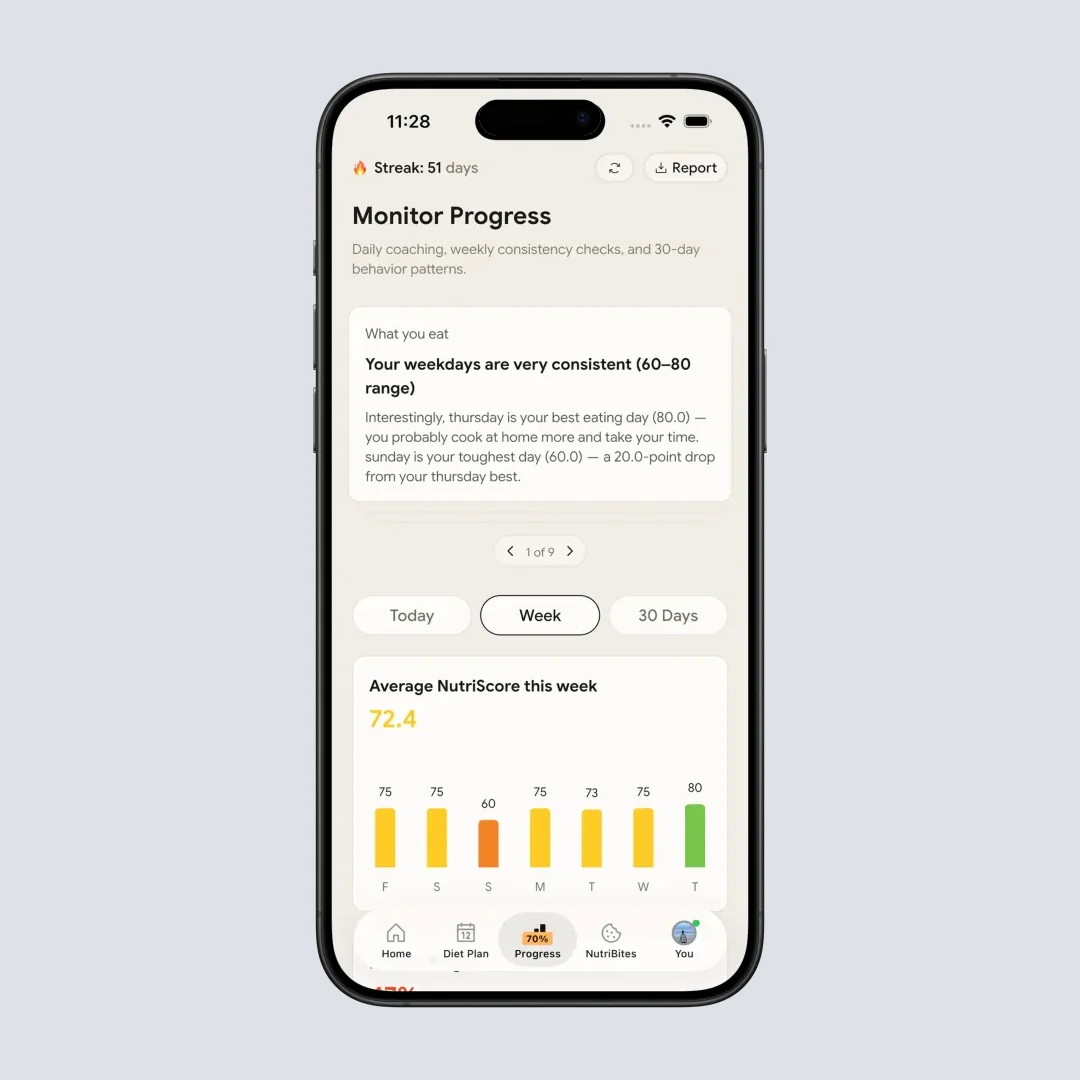
Step 5 needs a weekly view, because a single morning tells you nothing.
When a flat scale is not a hard gainer problem
Six weeks of a genuine surplus with no weight change at all is worth a doctor's visit, not another 200 calories. Unintentional weight loss can point to thyroid disease, celiac disease or diabetes.
IMPORTANT
Checkpoint: final stretch before the reveal.
One last nudge, the number is next.
⏱️ Progress 3/4 • ~5 minutes in • Keep going
✅ Step 1: Set the surplus
✅ Step 2: Pick calorie-dense foods
✅ Step 3: Run the week, check the scale
✨ The gain rate where every added kilo was muscle (about to reveal)

The Gain Rate Where Every Added Kilo Was Muscle 🏋️
The number is faster than most bulking advice suggests. Twenty-eight resistance-trained men did six weeks of supervised training plus a high-calorie supplement, targeting at least 0.45 kg of gain per week. Fat-free mass rose 4.8 percent, and a gain of about 0.55 percent of body mass per week corresponded, on average, to all of the added weight being fat-free mass (Smith et al., 2021).
For a 70 kg lifter, 0.55 percent is 385 g a week, just above the 0.25 to 0.5 percent band the off-season reviews recommend. The cautious rate people run to stay lean was not, in this group, the rate that maximized muscle. Two caveats: six weeks of supervised, supplemented trained men is a snapshot, not a rule for a year-long bulk, and the average hides real variation. Your own two-week check-in is the only version of this number that applies to you.
Can You Lose Belly Fat and Gain Muscle at the Same Time? ⚖️
This is the question behind every search for a free diet plan to lose weight and gain muscle. The straight answer: sometimes, depending who you are.
Recomposition happens most reliably in three groups: people new to resistance training, people returning after a break, and people carrying enough body fat to fuel muscle building from their own stores. For a lean, trained lifter it is much harder, because the evidence for a surplus assisting growth is clear even if the ideal size is unknown (Slater et al., 2019).
Recomposition's best chance: calories at maintenance or 10 percent below, protein at 2.0 to 2.4 g per kg, three to four sessions a week, and patience measured in months. The better path for a hard gainer who also wants a flatter stomach is to gain first, twelve to sixteen weeks of a modest surplus, then six to eight weeks at a small deficit. Tracking during a gaining phase is covered in the guide to protein tracking apps.
Start With One Extra Meal 🚀
The hard gainer problem is almost never metabolism. It is a daily total that falls a few hundred calories short, repeated for years, next to a body that spends extra energy the moment it arrives. Pick the smallest change that closes the gap: one 700-calorie breakfast, one shake, one tablespoon of oil per cooked meal. Then weigh weekly and adjust until the scale climbs at a quarter to half a percent of body weight per week.
What you cannot skip is knowing what you actually ate, and hard gainers tend to overestimate what they ate. If logging by hand stopped you before, NutriScan reads a meal from a photo in a few seconds, with 5 free scans a week and unlimited scans on Premium at about $59 a year. Twelve weeks of honest numbers beats any body-type label.
IMPORTANT
Recap: everything you completed this round.
Save this for your next twelve weeks.
⏱️ Progress 4/4 • ~8 minutes in • Nicely done
✅ Step 1: Surplus set at 10 to 20 percent above maintenance
✅ Step 2: Calorie-dense foods, one meal drunk
✅ Step 3: Run the week and check the seven-day average every two weeks
✅ The gain rate where every added kilo was muscle: about 0.55 percent (revealed)
Frequently Asked Questions ❓
What is a hard gainer?
Someone whose weight stays flat even though they eat what feels like a lot. It is a description, not a diagnosis. Two things explain it: an appetite that caps intake, and a rise in unplanned movement when calories go up (Levine et al., 1999).
Can I follow a free diet plan to lose belly fat and gain muscle at the same time?
Possible, and most likely if you are new to lifting, returning after a break, or carrying more body fat. It needs high protein, two to four hard sessions a week and calories at or slightly below maintenance. Lean trained lifters usually pick one goal at a time.
How much protein do I need to put on muscle?
Between 1.4 and 2.0 g per kg a day covers most people who train (Jäger et al., 2017), and 1.6 to 2.2 g per kg is the range for bodybuilders adding size. A meta-analysis of 49 trials found no further gains in fat-free mass above about 1.62 g per kg (Morton et al., 2018).
Do I need a mass gainer supplement?
No. Mass gainer powders sold under hard gainer and applied nutrition branding are mostly maltodextrin and whey, which milk, oats, peanut butter and a banana match for less. A shake helps when appetite is the limit, not because the powder beats food.
How fast should I gain weight on a hard gainer diet?
0.25 to 0.5 percent of body weight a week for novice and intermediate lifters, 175 to 350 g for a 70 kg person (Iraki et al., 2019). Advanced lifters sit at the low end.