MyNetDiary vs MyFitnessPal 2026: No-Ads Tracking Compared
 ChatGPT
  Claude
  AI Mode
  Perplexity
Both apps launched in 2005. Both are still actively developed in 2026. And both come up whenever someone asks which calorie tracker to use without getting sold ads, wrong data, or a $79.99/year bill for a barcode scanner.
The difference is real. MyFitnessPal built one of the largest crowdsourced food databases in the world. MyNetDiary built a smaller one, verified every entry by hand, and kept third-party ads out of every tier. For users who want to log consistently, that gap plays out in every session - not just on a features page.
Payne et al., writing in Obesity Science and Practice in 2022, found that consistent and frequent app-based dietary self-monitoring was associated with short-term weight loss (Payne et al., 2022). An app that interrupts logging with ads, paywalls the barcode scanner, or serves wrong entries is harder to use consistently. That friction compounds across hundreds of daily sessions.
This comparison runs four tests - ads, free tier features, pricing and database - and then reveals the one number most people overlook that predicts whether you will actually stick with tracking.
TL;DR - MyNetDiary vs MyFitnessPal 2026
- Ads: MyNetDiary runs no third-party ads in any tier. MyFitnessPal serves ads in the free food log.
- Free barcode scan: MyNetDiary includes it for free. MyFitnessPal charges $79.99/yr for it.
- Nutrients tracked: MyNetDiary tracks 108 free. MyFitnessPal tracks 18 free.
- Pricing: MyNetDiary mid-tier is $59.99/yr vs $79.99/yr for MyFitnessPal.
- Database: MyNetDiary has 2M+ verified entries. MyFitnessPal has 20M+ crowdsourced entries.
- Best for: MyNetDiary for clean free experience and health tracking. MyFitnessPal for database coverage and integrations.
IMPORTANT
Your MyNetDiary vs MyFitnessPal comparison at a glance.
Four tests. One clear verdict. Follow top to bottom or jump to what matters most.
⏱️ Progress 0/4 - ~0 minutes in - Keep going
⏳ Test 1: Ads and privacy gap
⏳ Test 2: Free tier features
⏳ Test 3: Pricing and database accuracy
🔍 The one number that predicts whether you will actually stick with tracking (revealed near the end)
What Each App Is 📱
MyFitnessPal is now owned by Francisco Partners after being acquired from Under Armour. It offers three tiers: Free, Premium at $79.99/year ($19.99/month), and Premium+ at $99.99/year (MyFitnessPal Premium). Prices here are standard US prices as of mid 2026 and change by region. The app supports 20 languages and holds 4.7 stars from 2.3 million App Store ratings (App Store, checked 7 August 2026) and 4.4 from 2.91 million Google Play reviews (Play listing, checked 7 August 2026). It is the name most people associate with calorie tracking, and that recognition has kept it the category leader for two decades.
MyNetDiary has stayed independent since 2005. It offers Free, Premium at $59.99/year ($8.99/month), Premium Plus at $99.99/year, and a Lifetime plan at $179.99 one-time (MyNetDiary pricing FAQ). The App Store runs discounted annual SKUs alongside the $59.99 one, so check the price in-app before you commit. MyNetDiary holds 4.8 stars from 161K App Store ratings and says 32 million people have tracked with it (App Store, checked 7 August 2026). It sits first in Forbes Health's Best Weight Loss Apps at 5.0 against MyFitnessPal's 4.8, on a rolling list rather than a dated award (Forbes Health).
Both run on iOS, Android, and the web. Both support Apple Watch and Wear OS.
Test 1: Ads and Privacy 👀
MyFitnessPal's free tier is ad-supported. That alone is not unusual. What stands out is where the ads appear - directly in the food log feed, the same screen you open three to five times per day as part of your health routine. For an app that is supposed to help you build a consistent habit, the conflict between the screen's purpose and its advertising creates real daily friction.
Beyond visible ads, MyFitnessPal's free tier includes ad-tracking SDKs. Your logging frequency, food choices, and in-app behavior are shared with advertising partners. For health-related data, some users find that arrangement uncomfortable.
MyNetDiary shows no third-party ads in any tier, free or paid (App Store listing). The free interface looks the same as the paid interface in layout. Nothing interrupts logging. Ads and tracking are separate questions though: Apple's privacy label on that same listing declares purchases, identifiers and usage data as used to track you across other companies' apps.
After MyFitnessPal's March 2026 redesign, its user rating in the April 2026 Diet App Scorecard dropped by 0.77 stars in a single month, the sharpest single-month decline that tracker has recorded (Diet App Scorecard). The scorecard is published by MyNetDiary, which discloses a commercial interest in the comparison. Review complaints cited the redesigned layout and ad placement.
TIP
If ads matter to your daily habit, MyNetDiary answers that question at the free tier. If you are paying $79.99/year for MyFitnessPal Premium mainly to remove ads, you are paying for something MyNetDiary gives you at no charge.
 Opening your food log 3-5 times a day - interruptions add up fast
IMPORTANT
Checkpoint: here's where you are right now.
Ads and privacy covered. On to the free tier features gap.
⏱️ Progress 1/4 - ~1 minute in - Keep going
✅ Test 1: Ads and privacy (done)
👉 Test 2: Free tier features (you're here)
⏳ Test 3: Pricing and database accuracy
🧩 The one number (coming soon)

Test 2: Free Tier Features 📊
The free tier is where the two apps diverge most sharply. Both handle the basics: daily food log, calorie and macro totals, weight tracking. The difference is in which features you get before paying anything.
| Feature | MyNetDiary Free | MyFitnessPal Free |
|---|---|---|
| Barcode scanner | Included | Premium only ($79.99/yr) |
| Nutrients tracked | 108 | 18 |
| Voice logging | Included | Premium only |
| Ads | None | Yes, with ad-tracking SDKs |
| Account required to start | No | Yes, email required |
| Food database | 2M+ staff-verified | 20M+ crowdsourced |
The barcode scanner gap is the most immediate for day-to-day use. MyNetDiary includes it in every tier (App Store listing). MyFitnessPal marks "Barcode Scan & Meal Scan" as not included with a free account and puts it behind Premium at $79.99/year (MyFitnessPal Premium). On the free tier, MFP users searching packaged foods by name take longer per entry and have more chances to select a wrong or outdated result.
The nutrient gap matters more as goals get specific. MyNetDiary tracks up to 108 nutrients free, the full spectrum of vitamins, minerals, amino acids, and fatty acid profiles (App Store listing). MyFitnessPal tracks 18. One caveat before you pick on that number: MyNetDiary lists detailed nutrient analysis among its Premium features, so check the free view carries the readouts you care about. For general calorie counting, 18 nutrients is enough. For anyone managing diabetes, heart health, or a micronutrient deficiency, 18 nutrients is not enough.
The account requirement is a smaller friction point. MyNetDiary allows anonymous use with no email sign-up. Your data is stored locally until you choose to create an account. MyFitnessPal requires email registration before you can log anything. For users who want to genuinely test an app before sharing personal information, MyNetDiary removes one barrier.
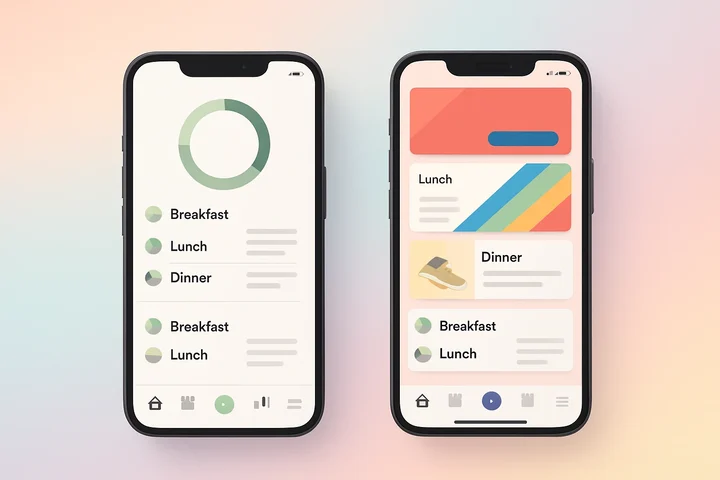 Clean free tier vs ad-supported: what your daily log screen looks like matters for habit-building
IMPORTANT
Checkpoint: midway progress update.
You're halfway - pricing and database next.
⏱️ Progress 2/4 - ~2 minutes in - Keep going
✅ Test 1: Ads and privacy (done)
✅ Test 2: Free tier features (done)
👉 Test 3: Pricing and database accuracy (current)
⏳ The one number (next)
Test 3: Pricing and Database Accuracy 💰
Pricing: Which Costs Less?
Here is the full pricing picture as of mid-2026:
| Plan | MyNetDiary | MyFitnessPal |
|---|---|---|
| Free tier | Ad-free, barcode included | Ads, no barcode |
| Mid-tier annual | $59.99/yr | $79.99/yr |
| Top-tier annual | $99.99/yr | $99.99/yr |
| Monthly mid-tier | $8.99/mo | $19.99/mo |
| Lifetime option | $179.99 one-time | Not available |
Prices are standard US prices as of mid 2026 and change by region (MyFitnessPal Premium, MyNetDiary pricing FAQ).
MyNetDiary's mid-tier Premium costs $20 less per year than MyFitnessPal's Premium. On monthly billing, the gap is $11 per month - or $132 per year. Over five years on monthly billing, the difference is $660.
MyNetDiary added the Lifetime plan in December 2025 (App Store release notes, v9.99). At $179.99 it pays off against MyNetDiary's own annual Premium in three years, and against MyFitnessPal's monthly Premium in a little over nine months, since nine months of MFP monthly comes to $179.91.
At the top tier, both apps reach $99.99/year but with different features. MyFitnessPal Premium+ adds the Meal Planner with grocery-app syncing. MyNetDiary Premium Plus adds an AI Coach, AI restaurant menu scanning, AI Suggest Meals, and a GLP-1 Companion for users on Ozempic or Wegovy with medication tracking. Blood glucose logging sits one tier down, in Premium.
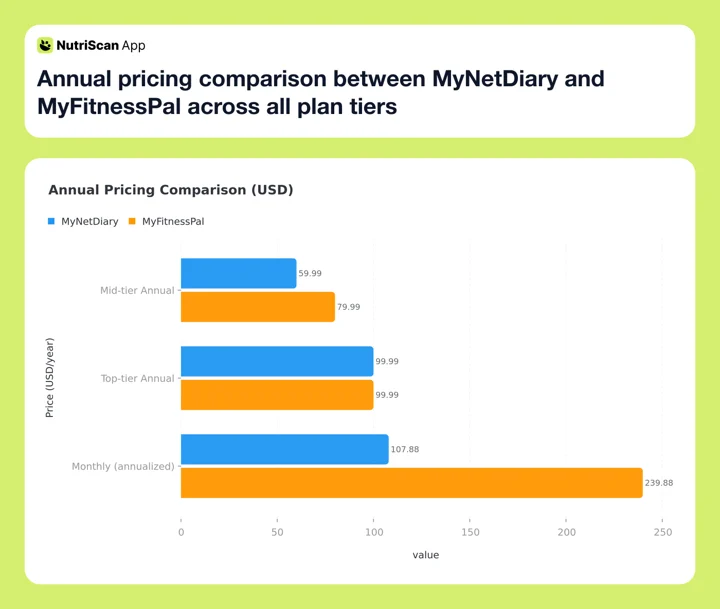 Figure 1: MyNetDiary consistently costs less at the mid-tier - the gap reaches $132/year on monthly billing
Database: Big vs. Verified 🔬
MyFitnessPal holds 20+ million items, one of the largest food databases in the world by its own description (MyFitnessPal). For obscure imported products, regional restaurant chains, or specialty foods, the coverage advantage is real. Crowdsourcing at that scale is genuinely useful.
The trade-off is accuracy variance. Because entries are user-submitted, duplicates for the same product with different macro values are common. A 2020 validation study in the Journal of Medical Internet Research found MyFitnessPal correlated strongly with a reference database on energy, macronutrients, sugar and fiber, but not on cholesterol and sodium (JMIR 2020). For tracking only calories and protein, this matters less. If you are watching sodium for blood pressure, it matters more.
MyNetDiary holds 2+ million items, each staff-reviewed against USDA FoodData Central and NCC research-grade sources, and it says its team reviews and updates 2,500 to 3,500 foods every day through user photo submissions (App Store listing). MyNetDiary also says the database has been licensed to power 30+ other nutrition apps and used as the data foundation in 5 academic research trials.
MyNetDiary says it scored highest of the 30 apps coded in an American Journal of Preventive Medicine analysis of Diabetes Prevention Program behavioral strategies. The paper itself, Pagoto et al. 2013, names no apps: it reports that the 30 apps carried 18.83% of the 20 strategies on average, with the best in the set reaching 65% (PubMed 24139770). Read it with the date attached: the app versions it coded were collected in January 2012, fourteen years ago, so it says little about either app today.
For most users who eat standard branded products in major markets, both databases cover the same foods adequately. The database gap becomes real for users with highly varied, niche, or internationally sourced diets where MyFitnessPal's coverage advantage matters.
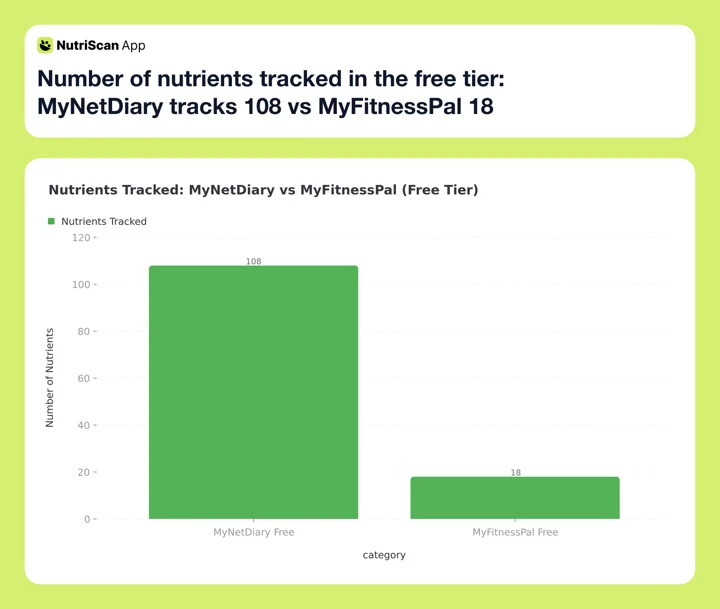 Figure 2: 108 vs 18 nutrients in the free tier - a 6x difference that matters for anyone tracking beyond calories and macros
IMPORTANT
Checkpoint: final stretch before the reveal.
Pricing and database covered. The deciding number is next.
⏱️ Progress 3/4 - ~3 minutes in - Keep going
✅ Test 1: Ads and privacy
✅ Test 2: Free tier features
✅ Test 3: Pricing and database accuracy
✨ The one number that predicts whether you will stick with tracking (about to reveal)
The One Number That Predicts Your Success 🎯
You have been patient. Here it is.
In January 2026, MyNetDiary ran a 7-day speed test logging 127 identical food entries on iOS. By its own count, MyNetDiary needed 711 total actions against 1,035 for MyFitnessPal, 46% more effort for the same task (MyNetDiary). Nobody has replicated it, and the page discloses MyNetDiary's commercial interest, so treat it as the vendor's measurement.
The gap has a simple cause. MyNetDiary includes free barcode scanning - a 1-second scan instead of a 15-to-20-second manual search. Voice logging is also free, turning typed entries into spoken ones for common meals. These two features together account for most of the speed difference in real-world daily use.
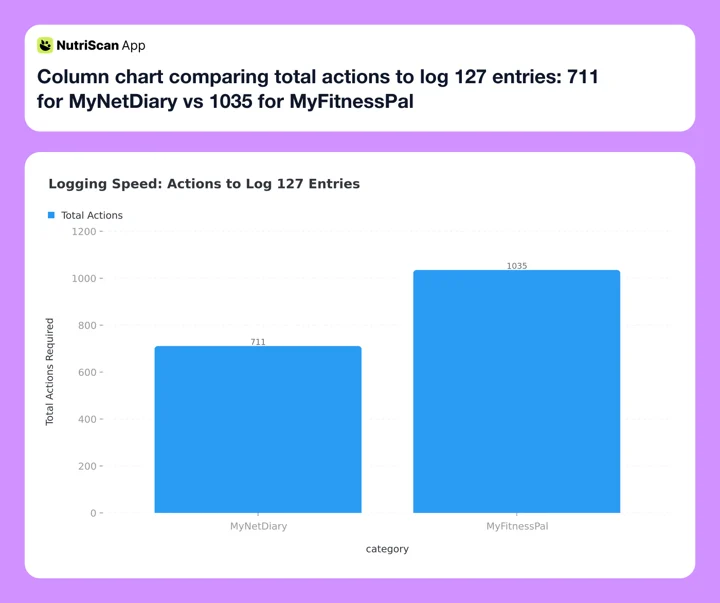 Figure 3: 46% more effort per session on MyFitnessPal's free tier - compounded across months of daily logging
Why does this number matter? Burke et al. 2025 found that higher adherence to dietary self-monitoring was associated with significantly greater odds of achieving 5% or more weight loss across 502 participants (Burke et al., 2025). The study tracked not just whether participants logged, but how consistently they did it. An app that takes 46% more effort per session creates a real barrier to the consistency that predicts results.
Payne et al. (Payne et al., 2022) measured frequency and consistency, not how precisely people logged, and still found both tied to short-term weight loss. A free barcode scanner helps on exactly those two counts: fewer taps per entry, and no typed guesswork to correct later. An app without ads removes the daily interruption that makes logging feel like a chore rather than a habit.
INFO
This is the deciding number for most free-tier users. If your daily logging involves packaged foods, the 46% extra effort in MyFitnessPal compounds into the reason most people quit within the first few weeks.
IMPORTANT
Recap: everything you completed this round.
All four tests done. Save this for when someone asks which app to pick.
⏱️ Progress 4/4 - ~4 minutes in - Nicely done
✅ Test 1: Ads and privacy
✅ Test 2: Free tier features
✅ Test 3: Pricing and database accuracy
✅ The one number that predicts success (revealed)
Features Beyond the Free Tier 💎
For users who do pay for premium access, here is what each upgrade adds:
MyNetDiary Premium ($59.99/yr) adds meal scanning, intermittent fasting timer, 600+ dietitian-developed recipes and diet plans, custom trackers (up to 50 custom health metrics), macro cycling, recipe import, in-depth reporting, and fitness tracker integrations with Fitbit, Garmin, and Withings (App Store listing). The Advanced AutoPilot feature adjusts your calorie target from your actual weight trend rather than a static calculation (MyNetDiary Premium). Exercise calorie add-back defaults to 50%, MyNetDiary's allowance for how much fitness devices overestimate burn.
MyFitnessPal Premium ($79.99/yr) adds barcode scanning, ad-free logging, custom macro goals, meal scanning, voice logging, intermittent fasting, workout routines with video plans, and Food Insights and comparison tools (MyFitnessPal Premium).
MyNetDiary Premium Plus ($99.99/yr) adds the full AI toolkit: AI Coach that knows your diet history, AI Suggest Meals, AI restaurant menu scan, AI voice food logging, and the GLP-1 Companion with medication tracking, injection reminders, and GLP-1-specific meal plans.
MyFitnessPal Premium+ ($99.99/yr) adds the Meal Planner with grocery-app syncing: Instacart, Walmart, Kroger, Amazon Fresh and Whole Foods on iOS, Instacart and Walmart on Android (MyFitnessPal Premium). GLP-1 medication tracking is a separate shipped feature rather than a Premium+ add-on, and MyFitnessPal limits it to US users running the app in English (MyFitnessPal GLP-1 support).
The integration count favors MyFitnessPal: more than 35 apps and fitness devices connect to it (MyFitnessPal), against MyNetDiary's three direct device partners, Fitbit, Garmin and Withings, plus Apple Health and Health Connect. However, MyNetDiary writes 51 data types to Apple Health compared to MyFitnessPal's 15 (App Store listing), so where the connection exists, the data exchange is considerably deeper. Languages favor MyFitnessPal: 20 languages versus MyNetDiary's English only - a real limitation for non-English speakers.
What Neither App Handles Well: Home-Cooked Meals 📸
Both MyNetDiary and MyFitnessPal rely on database lookup. You search, select, and enter a quantity. That works well for packaged products with reliable entries. It works less well for home-cooked dishes, mixed-plate meals, or food where the cooking method changes the calorie count significantly.
A dal fry cooked in two tablespoons of ghee has a different calorie count than the same dal boiled dry. A stir-fried rice with medium oil is not the same as boiled rice. Neither MFP nor MyNetDiary captures that difference in the lookup flow.
NutriScan uses a photo-first approach. Take a photo of your meal, select the food type (Home Made, Packaged Food, Restaurant, Street Food, and more), pick the cooking method from 11 options (Deep-fried, Air-fried, Stir-fried, Boiled, Steamed, Grilled, Raw, and more), then set the oil level from a slider ranging from No Oil ➡️ Low ➡️ Default/Medium ➡️ High. That combination produces specific estimates for complex plates that database-based trackers handle with less precision.
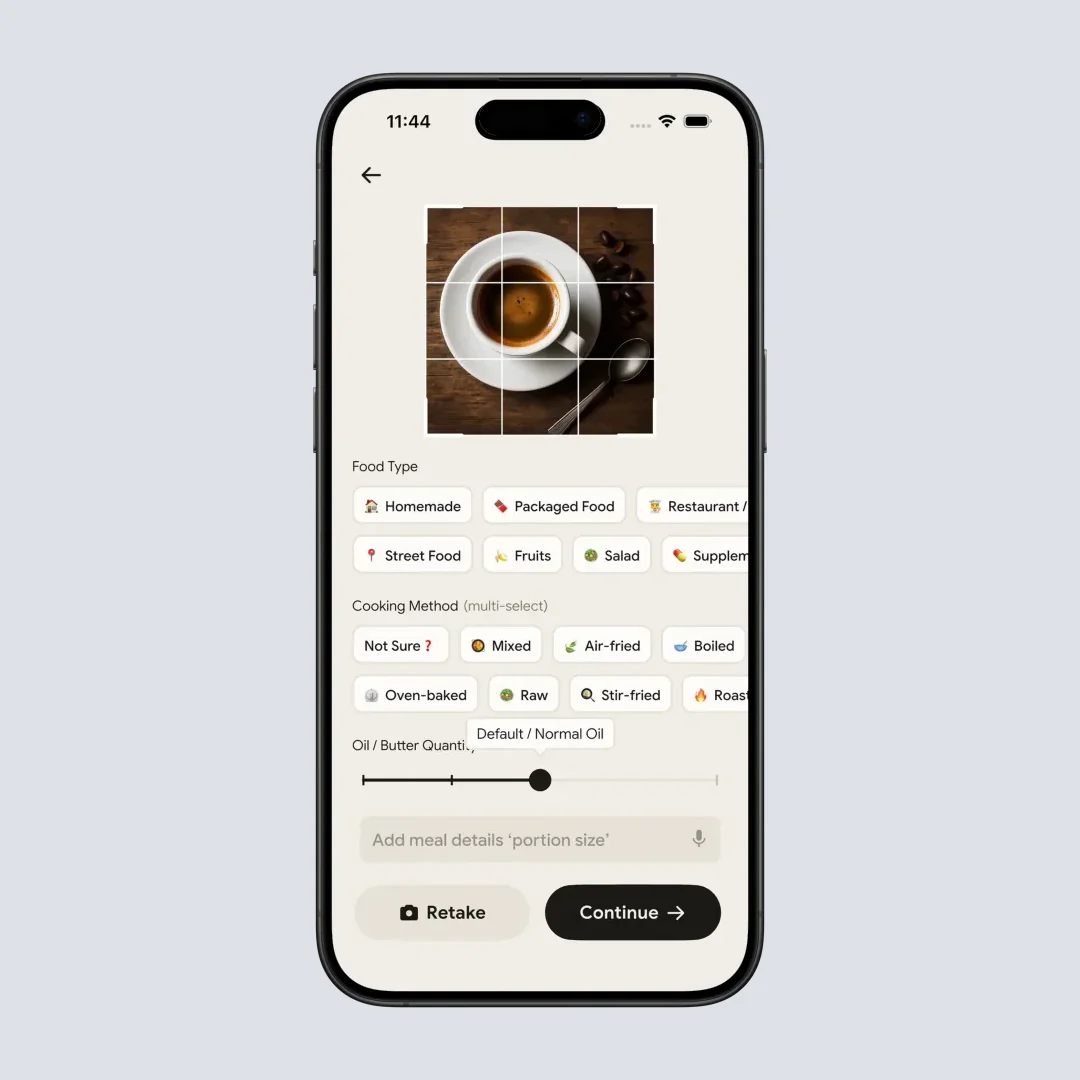
NutriScan crop screen (Home > Camera Icon > Click Picture): food type, cooking method, and oil level - capturing what database lookup misses
Want to set your macro targets before you start logging? Use NutriScan's macro calculator to get personalized targets based on your goal, weight, and activity level.
For users logging mixed meals, home-cooked dishes, or Indian food where database entries often fall short, NutriScan's meal scan guide explains how the photo-first approach works in detail.
 That feeling when you find the tracking method that actually sticks
Seven Tips for Getting the Most from Either App 💡
These habits improve tracking accuracy regardless of which app you choose:
Use barcode scanning for every packaged food. On MyNetDiary, this is free from day one. On MyFitnessPal, it requires Premium at $79.99/year. If barcode scanning is part of your daily routine, factor that cost in before the first month.
Log immediately after eating, not hours later. As Evenepoel et al. note, reducing the time delay between eating and recording improves data quality, and prospective recording is less prone to memory bias (JMIR 2020). Trying to reconstruct an entire day at once compounds inaccuracy with each meal you recall.
Cross-check a new entry on MyFitnessPal before saving it. Because MFP's database is crowdsourced, new entries may carry errors. Checking one field against the nutrition label takes 10 seconds and prevents compounding mistakes over weeks.
Set custom nutrient targets before your first week. MyNetDiary's 108-nutrient tracking is only useful if your targets are calibrated to your situation. Review them once upfront - it takes five minutes and changes what the data means.
Use voice logging for frequently eaten meals. On MyNetDiary, voice logging is free. On MyFitnessPal, it is a Premium feature. Three meals a day by hand entry adds meaningful time across a full week.
Review weekly averages, not just daily totals. Both apps show weekly summaries. A single high-calorie day within a reasonable weekly average usually matters less than daily totals suggest. The weekly view keeps perspective.
Adjust exercise calorie add-back if you use a wearable. MyFitnessPal has reported sync double-counting issues with some devices. MyNetDiary defaults to a 50% add-back rate for exercise calories - more conservative and generally more accurate than the full 100% wearables often suggest.

Who Should Choose MyFitnessPal 🤔
MyFitnessPal is the better fit if:
- You eat a varied diet including obscure, regional, or internationally sourced products that a smaller database may not cover
- You use 10+ third-party fitness apps, gym platforms, or wearables already connected to MyFitnessPal's ecosystem
- You need the app in a language other than English
- You want the Premium+ Meal Planner with grocery syncing through Instacart, Walmart, Kroger, Amazon Fresh or Whole Foods
- You are already a longtime user with a large library of custom foods, saved meals, and logged history
Related: best MyFitnessPal alternatives in 2026 and HealthifyMe vs MyFitnessPal.
Who Should Choose MyNetDiary ✅
MyNetDiary is the better fit if:
- You want an ad-free experience without paying for it
- You eat packaged foods regularly and want barcode scanning without a $79.99/year subscription
- You track more than calories and macros - vitamins, minerals, medication, blood glucose, or custom health metrics
- You are managing a health condition and want a database built on the clinical-grade sources, USDA FoodData Central and NCC
- You want faster daily logging - 711 actions vs 1,035 for the same 127 entries in MyNetDiary's own test
- You are on a GLP-1 medication and want a dedicated companion rather than medication logging on its own
- You prefer a lower subscription cost: $59.99/year vs $79.99/year, or $8.99/month vs $19.99/month
Related: best MyNetDiary alternatives without ads and Cronometer vs MyNetDiary.
Conclusion 📝
Twenty years in, both apps keep updating and both still have loyal users. MyFitnessPal leads on database size and integration breadth - genuine advantages for users who need them. MyNetDiary leads on free-tier value, verified accuracy, nutrient depth, and keeping third-party ads out of every tier.
For users whose priority is a clean daily tracking experience without paying for basic features, MyNetDiary is the practical choice. Free barcode scanning, 108-nutrient tracking, zero ads, and a lower premium price adds up across months of daily use. The 46% logging friction difference at the free tier is the number that decides long-term adherence for most people.
For users with highly varied diets or deep integration dependencies in the MyFitnessPal ecosystem, the database breadth is hard to replace.
And if your meals are home-cooked, mixed, or anything where cooking method changes the numbers - consider NutriScan's photo-first meal scan alongside either app. It closes the gap that neither database tracker handles.
Check NutriScan's insights guide to understand how tracking trends over time turns raw data into actionable patterns - regardless of which app you use to log.

Frequently Asked Questions ❓
Q: Does MyNetDiary have ads in the free version?
A: No. MyNetDiary shows no third-party ads in any tier, free or paid, and the free version gives you the same uninterrupted interface as the paid one. Tracking is a separate question from ads: Apple's privacy label on MyNetDiary's listing declares purchases, identifiers and usage data as used to track you across other companies' apps (App Store, checked 7 August 2026). MyFitnessPal's free version includes both ads and ad-tracking SDKs that monitor usage patterns to serve targeted content.
Q: Is MyNetDiary's barcode scanner actually free?
A: Yes. Barcode scanning is included in all MyNetDiary tiers at no cost. You can scan packaged foods from the first time you open the app, with no subscription required. MyFitnessPal locks barcode scanning behind its Premium plan at $79.99/year or $19.99/month. For users who scan packaged foods daily, this single difference accounts for most of the practical gap between the two free tiers.
Q: Which app has a more accurate food database?
A: They prioritize accuracy differently. MyNetDiary's 2+ million-item database is staff-verified against USDA FoodData Central and NCC research-grade data, with 2,500 to 3,500 new verified entries added daily. MyFitnessPal's 20+ million items are crowdsourced - accuracy varies entry by entry. A 2020 JMIR validation study found MyFitnessPal's energy and macronutrient figures correlated strongly with a reference database, but cholesterol and sodium did not (JMIR 2020). For tracking vitamins and minerals specifically, MyNetDiary's verified data is the safer starting point.
Q: How much cheaper is MyNetDiary than MyFitnessPal?
A: Mid-tier annual: $59.99/year for MyNetDiary versus $79.99/year for MyFitnessPal - a $20/year difference. Monthly billing: $8.99/month versus $19.99/month - a $132/year difference. Over five years on monthly billing, the total difference is $660. MyNetDiary also offers a Lifetime plan at $179.99 that MyFitnessPal does not offer.
Q: Can I try MyNetDiary without creating an account?
A: Yes. MyNetDiary lets you start logging immediately without an email address or account. Your data is stored locally until you choose to sign up. MyFitnessPal requires email registration before you can enter your first meal. For users who want to test an app genuinely before sharing personal information, MyNetDiary's anonymous start removes one barrier.
Q: What is the main reason people switch from MyFitnessPal to MyNetDiary?
A: The most common reasons cited in reviews are the free barcode scanner (eliminates the $79.99/year Premium cost for this feature alone), the complete absence of ads, and the larger nutrient tracking range (108 vs 18 nutrients). The March 2026 redesign moved ads more prominently into the food log feed, which accelerated the comparison searches and switching behavior. If you are ready to move, the step-by-step MyFitnessPal to MyNetDiary switching guide covers the export, the Apple Health bridge, and the rebuild week.