Foodvisor vs MyFitnessPal 2026: Paid Coaching vs Paid Tools
 ChatGPT
  Claude
  AI Mode
  Perplexity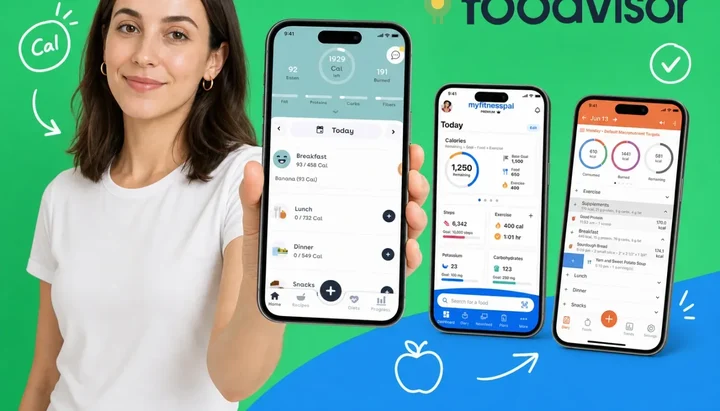
As a NutriScan nutritionist, I get this question almost weekly: "Foodvisor or MyFitnessPal, which paid plan is worth it?" The honest answer is that they sell two very different things wearing similar wrappers. Foodvisor's Premium tier bundles a registered dietitian touchpoint with AI photo logging. MyFitnessPal's Premium plans pile up a deeper feature set: over 20 million food entries, Meal Scan AI, a meal planner, and macro flexibility tools. A 2025 systematic review and meta-analysis found app-based interventions produced a modest but statistically significant weight reduction over 4 to 6 months, with about 75% of users abandoning the apps early (Pujia et al., PMC12093073). This guide breaks down every axis that matters so you pick the plan you will actually open in week 12.
IMPORTANT
Your Foodvisor vs MFP 2026 comparison plan at a glance.
A quick roadmap so you can decide fast.
⏱️ Progress 0/4 • ~0 minutes in • Keep going
⏳ Step 1: What you actually pay for (Foodvisor vs MFP plans)
⏳ Step 2: Photo logging + food database head-to-head
⏳ Step 3: Pricing breakdown + real-world user profiles
🔍 The tracking app built for mixed dishes and multi-item plates (revealed near the end)
Quick Comparison Table 🗂️
Prices are standard US prices as of mid 2026 and change by region.
| Feature | Foodvisor Premium | MyFitnessPal Premium / Premium+ |
|---|---|---|
| Annual price (US) | $23.99 to $89.99 depending on SKU, $83.99 list | $79.99 Premium / $99.99 Premium+ |
| Monthly price | $14.99 to $39.99 depending on SKU | $19.99 Premium / $24.99 Premium+ |
| Free trial | 14-day through the referral program | 7-day on Premium and Premium+ |
| Free tier | Manual food-diary logging only | Full database and manual search, ads, no barcode, no Meal Scan |
| Coaching | Registered dietitian access | No human coach; AI Coach added to Premium and Premium+ in 2026 |
| AI photo logging | Premium only, no free photo scans | Meal Scan, Premium tiers only |
| Food database | No size published | Over 20 million items |
| Barcode scanner | Not on the free tier | Premium only since October 2022 |
| Macro tracking | Yes, target adjustments | Yes, gram-level macros (Premium) |
| Meal planner | Recipe library, no full planner | Premium+ adds full meal planner, six countries |
| Recipe importer | No URL importer published | URL import is free on all tiers |
| Headquarters | Paris, France | Austin, Texas, United States |
| App Store rating | 4.6/5 from about 17K ratings | 4.7/5 from about 2.3M ratings |
Both ratings checked 7 August 2026.
The headline read: Foodvisor sells a credentialed human inside the app. MyFitnessPal sells the most complete self-serve toolkit on the market, and it now rates higher on the App Store as well. They are not really competing on the same axis, and picking the wrong one for your situation is the most common reason people end up paying for two apps in the same year.
What You Actually Pay For 💰
Both apps have a free tier and a paid tier. The split between what is behind the paywall and what is not is where the value question lives.
Foodvisor Premium: A Dietitian, Plus Photo AI
Foodvisor labels its paid tier Premium (Coach) inside the app, and it will not quote you a single price. The help center says the displayed price depends on your country, your platform and any promotion running that week, "which is why we cannot provide a fixed universal price" (Foodvisor help center). On 7 August 2026 its US App Store listing carried ten in-app purchase SKUs at once: annual list prices from $23.99 to $89.99, with $83.99 as the headline Premium SKU, and monthly SKUs at $14.99, $29.99 and $39.99. Treat $83.99 as one list price, not the price.
Premium adds the AI photo analysis, a registered dietitian, deeper macro target adjustments, a recipe library tuned to your goal, and ad removal. Foodvisor's own Premium page sells the coaching as "Coaching by our dietitians" and "Daily advice to reach your goal", and names an RD nutritionist on staff (Foodvisor Premium). The 14-day free trial is not a regional offer, it comes through the referral program: a referred user gets 14 days free, then a 3-month subscription at the end of that period (help center). Two paid trial SKUs also sit on the App Store listing at $59.99 and $71.99.
The product is positioned as a softer, cheaper alternative to a private nutrition practice. You are paying for the fact that a credentialed human looks at your log and steers your plan. What Foodvisor does not publish anywhere is the cadence: no page states how often a dietitian replies, whether you keep the same one, or what a busy week does to reply times. If you want a true coaching relationship, treat this as a starter version, not a replacement for one-on-one care, and ask about response times before you subscribe.
Pro tip
Use the dietitian aggressively. Foodvisor Premium's value lives entirely in the coaching layer. If you pay and never message, you are funding a better UI at whatever SKU price you were shown.
MyFitnessPal Premium and Premium+: Two Tiers, No Human Coach
MyFitnessPal sells two paid tiers with no human coach in either. Premium runs $19.99 per month or $79.99 per year, which its own compare table prints as $6.67 a month. Premium+ runs $24.99 per month or $99.99 per year, printed as $8.34 a month (MyFitnessPal Premium Page). Both tiers strip ads and open up barcode scanning, Meal Scan AI photo logging, voice logging, gram-level macros, net carbs, advanced reports, custom goals by day, multi-day logging, food timestamps, intermittent fasting tracking and data export (Premium feature list). New subscribers get a 7-day free trial on either tier, which is the category norm.
There is no human coach on either tier, but MyFitnessPal did add an AI one. Version 26.17.0, released 28 April 2026, shipped an AI Coach to Premium and Premium+ that answers questions against your goals and logging history (App Store release notes).
Premium+ is the planner tier. It adds a full meal planner with 1,500-plus recipes, an auto-built grocery list, weekly menu generation, and budget-aware plan settings. Check the geography before you pay: MyFitnessPal lists the meal planner in the United States, United Kingdom, Canada, Ireland, New Zealand and Australia, and grocery app syncing in the US only. The cracks here are different. There is no human review, and free users still see ads.
The Practical Difference
Foodvisor's paid plan buys you a person. MyFitnessPal's paid plans buy you the most complete self-serve toolkit on the market. If accountability through another human is what closes your loop, the dietitian access is the thing you cannot get from MyFitnessPal at any price. If you self-coach and want better tools, MyFitnessPal at a fixed, published $79.99 per year is a more predictable spend than a Foodvisor SKU you cannot look up in advance.
IMPORTANT
Checkpoint: here's where you are right now.
Quick status update so you always know the next best move.
⏱️ Progress 1/4 • ~1 minute in • Keep going
✅ Step 1: What you actually pay for (done)
👉 Step 2: Photo logging + food database (you're here)
⏳ Step 3: Pricing breakdown + user profiles
🧩 The tracking gap nobody talks about (coming soon)
Related: Foodvisor pricing 2026 and best MyFitnessPal alternatives.
How Photo Logging Compares 📸
Both apps now ship AI photo logging on their paid tiers. The implementations are not equal, and neither is at the top of the AI photo category.
Foodvisor: Photo AI Behind the Paywall
Foodvisor describes its photo flow simply: "Take a photo of your meal: AI identifies everything instantly", with "Full meal analysis: vitamins, minerals, micronutrients" as a Premium benefit (App Store listing). It publishes nothing about how the model segments a plate, whether it asks you to confirm portions, or when the feature shipped, so treat any specific account of the pipeline as guesswork.
What is clear is that photo analysis is not a capped free feature, it is Premium. Foodvisor's free version is manual food-diary logging, and "meal analysis with photos" sits on the paid side (Is Foodvisor free?). There is no free daily scan budget to burn through.
Zheng et al.'s 2024 JMIR scoping review of 25 AI dietary-assessment studies reported nutrient estimation errors between 10% and 15%, with one RGB-D fusion network hitting 15% mean absolute error on calorie estimation, and named adapting to diverse food types as an open challenge (PubMed 39608003). That is roughly where the category sits.
MyFitnessPal: Meal Scan as a Premium Add-On
MyFitnessPal added Meal Scan to its Premium tiers as a response to the AI logging trend. Real-world reports are mixed. One r/Myfitnesspal post from 20 March 2026 says Premium meal scan "has actually made logging way easier for me" (r/Myfitnesspal Meal Scan thread). Over on MyFitnessPal's official boards, the open question is still which AI scanner is accurate at all: "There are lots of apps that have come out lately where you can take a photo of your food and it'll tell you all the calories in it. I'm curious if anybody has found one that works pretty accurately?" (MFP community AI scanner thread). Nobody in this category has settled the accuracy question in public.
The Practical Difference
Neither app publishes accuracy numbers, so photo logging alone is a weak reason to pick one. If photo logging is one of many tools you want, MyFitnessPal's package is harder to argue with at $79.99 per year because the database, the barcode scanner, the planner and the ad removal all come with it.
 Still on the fence? Good - keep reading, the picture gets clearer ahead

Food Database and Logging Depth 🗄️
The food database is the part of the product that does the most invisible work. A bigger and cleaner database means the search step takes one tap instead of three, and the macros are closer to what is actually on the plate.
MyFitnessPal's database holds over 20 million foods, which the company calls "one of the largest food databases in the world", including restaurant dishes. It runs a community submission queue, and it marks reviewed entries with a green checkmark; anything without one was submitted by a member and has not been checked, so "you may come across incorrect entries sometimes" (How the MyFitnessPal database works). The trade-off is that long tail. Verified items are the safer pick. Custom recipes are free, and so is importing a recipe from a URL. Barcode scanning is not: it has been Premium-only since 1 October 2022 (MyFitnessPal support).
Foodvisor publishes no database size at all, on its site, its help center or either store listing. Its App Store copy only promises "smart search" across "thousands" of foods. Nor does it publish a URL recipe importer, though it does sell "hundreds of diet-friendly recipes". The AI photo flow is meant to take some of the database lookup load, which is consistent with a smaller catalog, but nobody outside the company can size it. If your shopping basket is mostly packaged goods, that unknown is a real risk.
For mixed and home-cooked dishes
Neither app publishes per-cuisine coverage, and neither claims a photo model tuned to sauced, layered or multi-item plates. The 2024 scoping review named adapting to diverse food types as an unsolved problem for the whole field. There is an app built around that case, and it is coming up below.
IMPORTANT
Checkpoint: midway progress update.
You're halfway - decisions get easier here.
⏱️ Progress 2/4 • ~2 minutes in • Keep going
✅ Step 1: What you actually pay for (done)
✅ Step 2: Photo logging + food database (done)
👉 Step 3: Pricing breakdown + user profiles (current)
⏳ The tracking gap nobody talks about (next)
Pricing Side by Side 💵
The pricing question is more nuanced than the sticker numbers because the two apps sell different things, and because only one of them has sticker numbers you can look up.
Prices are standard US prices as of mid 2026 and change by region.
| Plan | Monthly Price | Annual Cost | What you get |
|---|---|---|---|
| Foodvisor Free | $0 | $0 | Manual food-diary logging, ads |
| Foodvisor Premium (monthly) | $14.99 to $39.99 | $180 to $480 | Dietitian, AI scans, recipes, ad-free |
| Foodvisor Premium (longer SKUs) | $2.00 to $7.50 equivalent | $23.99 to $89.99, $83.99 list | Same as monthly, locked in for the term |
| MyFitnessPal Free | $0 | $0 | Database and manual search, no barcode, no Meal Scan, ads |
| MyFitnessPal Premium (monthly) | $19.99 | $239.88 | Barcode, macros, reports, Meal Scan, ad-free |
| MyFitnessPal Premium (annual) | $6.67 | $79.99 | Same as monthly, locked for a year |
| MyFitnessPal Premium+ (annual) | $8.34 | $99.99 | Premium plus full meal planner |
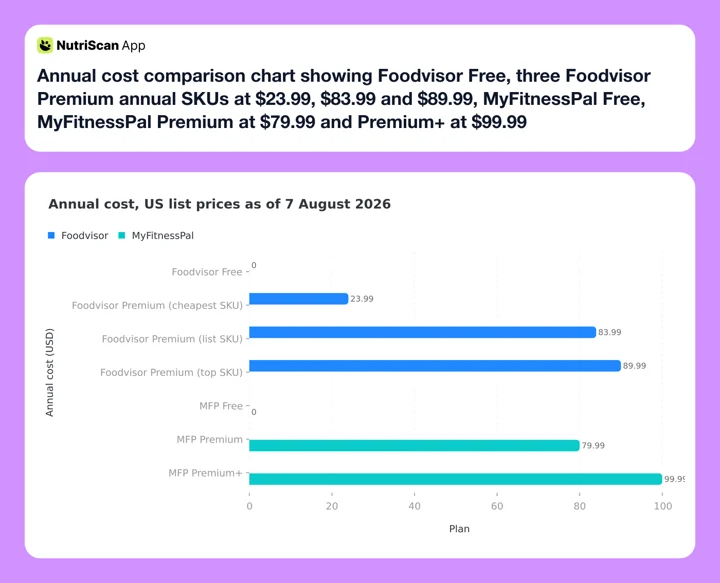 Figure 1: Annual costs compared. Foodvisor gets three bars because its ten live in-app purchase SKUs spread from $23.99 to $89.99, with $83.99 as the list SKU. MyFitnessPal's two bars are the only fixed, published prices on the chart.
Three things stand out. First, MyFitnessPal publishes what it charges and Foodvisor does not, which makes an annual-to-annual comparison mostly theatre: $79.99 against a $83.99 list SKU is a $4 gap inside a $66 spread, and the SKU you are offered decides who is cheaper. Second, Premium+ at $99.99 per year is the only plan here with a full meal planner and grocery list, and it beats a year of Foodvisor at any of the three monthly SKUs. Third, neither product is the cheapest paid tracker on the market. Cronometer Gold sits at $59.99 a year, below both.
Free Tiers Compared 🆓
The free tier decides whether you commit. Both apps let you log meals and see a calorie target without paying. Neither lets you scan anything.
MyFitnessPal Free includes the full 20-million-plus food database, custom foods, meals and recipes including "Add From Web" URL import, exercise logging, weight and measurement tracking, a printable report on the website, and calorie plus percentage-based macro goals (what the free version includes). It does not include barcode scanning, Meal Scan, voice logging, gram-level macro goals, food timestamps, data export or ad removal.
Foodvisor Free is narrower still. The help center describes it as tracking "your food intake by manually logging meals into the food diary" and lists nothing else. Photo analysis, the dietitian and the recipe library are all Premium.
The practical line: MyFitnessPal Free is a serious database with a manual search box on top, and that is genuinely useful if you already know what you eat. Just do not plan a routine around scanning: barcode has been paid since October 2022, and every AI logging shortcut is paid on both apps. Foodvisor Free gives you a diary and a paywall.
Real-World User Profiles 👥
Three quick scenarios help locate the right pick.
Profile 1: The Self-Coach Who Reads Labels. Sara, 32, runs four times a week, packs lunches, and already knows what 30 grams of protein looks like. Her main need is fast logging, gram-level macros, and a meal planner for the weeks she does not feel creative. MyFitnessPal Premium+ at $99.99 per year is the right answer. She does not need a dietitian, she needs the planner and the database.
Profile 2: The Beginner Who Wants Accountability. Raj, 45, has tried four apps and quit each by week three. He does not know what TDEE means and does not want to learn. He needs a person inside the app who notices when he logs three days of takeout. Foodvisor Premium fits because the dietitian touchpoint is the point, whichever SKU he is offered.
Profile 3: The Dual User. Priya, 28, splits her year between two countries. Half her meals are home-cooked one-pot dishes a database cannot itemise, and half are packaged goods with a label on the back. Neither Foodvisor nor MyFitnessPal alone closes that loop. More on this in the section below.
IMPORTANT
Checkpoint: final stretch before the reveal.
One last nudge - the reveal is next.
⏱️ Progress 3/4 • ~3 minutes in • Keep going
✅ Step 1: What you actually pay for
✅ Step 2: Photo logging + food database
✅ Step 3: Pricing breakdown + user profiles
✨ The tracking app built for mixed dishes and multi-item plates (about to reveal)
Tips and Tricks Before You Pay 💡
- Use the free tier for two weeks first, but test the right thing. Free on both apps means typing. Use those two weeks to find out whether the morning log fits your routine at all, not to evaluate scanning, which neither app gives away.
- Do the annual math, not the monthly. MyFitnessPal Premium is $79.99 a year against $239.88 at the monthly rate. Foodvisor's annual SKUs run $23.99 to $89.99 against $180 to $480 monthly. Monthly billing roughly triples the spend on either app.
- Pick the upgrade trigger before you upgrade. "I will pay the week I stop being able to type my lunch" is a real trigger. "It seems nice" is not.
- Cancel where you signed up. On iOS that is the App Store subscriptions page, on Android the Play Store one. MyFitnessPal also lets you cancel from its own Settings menu, and Foodvisor web signups bill through Stripe. Deleting the app cancels nothing.
- Use Foodvisor's dietitian if you pay for Foodvisor. The dietitian is the entire reason the price is what it is. Send a message in the first week.
- Import recipes from URLs before you pay anything. "Add From Web" sits on MyFitnessPal's free tier, so a once-a-week meal prep batch becomes 30 logged meals without a subscription.
- Screenshot the price you were shown. Foodvisor will not quote a universal price, so the SKU on your screen at signup is the only record of what you agreed to.
Step by Step: Picking Between Them ✅
- Audit your last two weeks of food logs. Count how many days you logged at all. If under 7 of 14, neither paid plan will help yet. Fix the habit first.
- Pick your one biggest blocker. Time, accountability, planning, micros, or photo logging. One only.
- Match the blocker to the plan. Time ➡️ MFP Premium. Accountability ➡️ Foodvisor Premium. Planning ➡️ MFP Premium+. Barcode scanning ➡️ MFP Premium, since neither free tier has it.
- Set a 60-day commit budget. Premium+ at $99.99 a year is about $17 of value across a 60-day test. Sixty days of a Foodvisor annual SKU is anywhere from $4 to $15, depending on which one you were shown. Both are cheap enough to test properly, so the real cost is the year you forget to cancel.
- Schedule the cancel reminder before you pay. Day 50 of 60 in your calendar. Decide on day 50 if the renewal is earned.
 The real goal is getting here - logging consistently enough that good food choices become automatic
The App Built for Mixed Dishes and Multi-Item Plates 🔍
You have been patient. Here is the part neither Foodvisor nor MyFitnessPal will tell you on their pricing page.
Both apps share one weakness, and it is the same one the research names. Zheng et al.'s review closed on "challenges remain in adapting to diverse food types". A one-pot curry, a layered casserole, a rice bowl with six things stirred through it: these are the meals where a photo model and a search box both struggle, and neither company publishes a per-cuisine or per-dish accuracy figure in either direction.
That is the case NutriScan was built around.
NutriScan's scan flow is designed for meals that arrive mixed rather than plated. You crop the photo, then tell it the things a picture cannot show: which of the 11 cooking methods was used, which of the 4 oil levels, and which of the 8 food types the meal came from, whether that is Home Made, Restaurant / Cafe or Street Food. A stir-fry at high oil and the same stir-fry steamed do not get the same numbers.
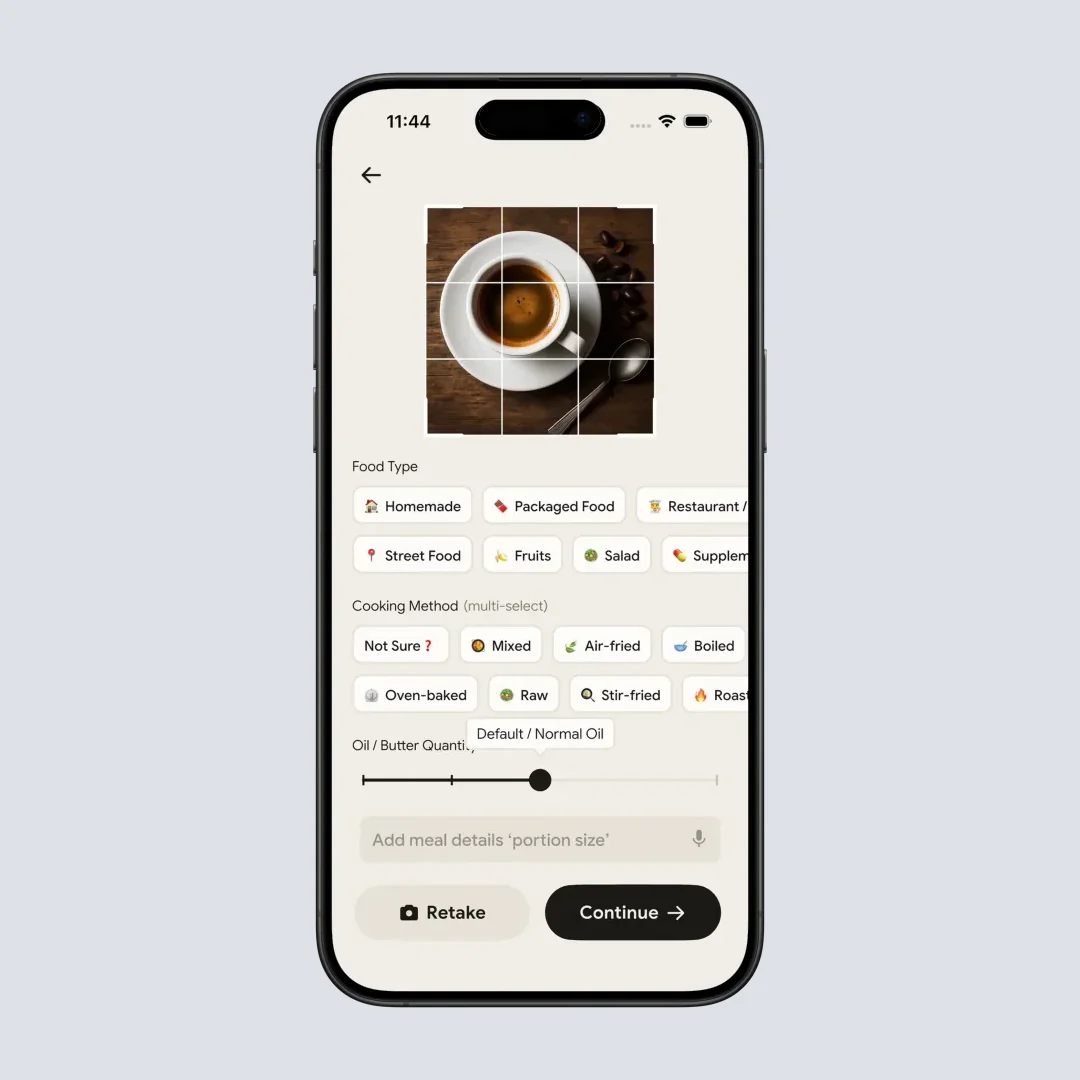
NutriScan - Home > Camera Icon > Crop Picture - the crop step before cooking method and oil level
NutriScan also includes:
- NutriScore - a five-band quality score on every meal, free, so you see more than the calorie count
- Monika - the voice AI nutritionist you can call about your log, 4 calls a week on Free and unlimited on Premium
- Macro Calculator - set your targets from your actual body stats, not a generic formula
- 7-day Premium trial so you can test the scan flow on your own meals first. The trial starts through your app store; whether a card is collected depends on your platform and region.
NutriScan plus one of the above
A common third path: NutriScan for the mixed and home-cooked meals, plus MyFitnessPal Free as a search database for packaged goods. NutriScan Premium is about $59 a year in the US, and the free tier gives you 5 scans a week, which is enough to test the scanner on the meals a database cannot read. Note that MyFitnessPal Free will not scan a barcode for you, so this pairing is search, not scanning.
Related: Cal AI vs Foodvisor 2026 and best AI photo calorie counter apps.
Research Integration: What the Evidence Says 🔬
Pujia et al.'s 2025 systematic review and meta-analysis of mobile apps for obesity management found app-based interventions significantly reduced body weight over a 4 to 6 month window, with a standardized mean difference of -0.33 (95% CI -0.48 to -0.17). Modest, real, and set against the fact that roughly 75% of users stop using these apps early (Pujia et al., PMC12093073).
Couto et al.'s 2025 umbrella review of mobile and web apps for weight management in adults with overweight and obesity reached a similar size: mHealth self-monitoring interventions produced moderate weight loss (Couto et al., PMC12294216). MyFitnessPal makes an early-habit claim of its own, which is worth reading as a vendor claim rather than a finding: users who log food at least four days in their first week are, on average, seven times more likely to show progress towards their weight loss goals (MyFitnessPal).
Johnson et al.'s 2026 retrospective cohort of a digital weight-loss service found engaged users lost 22.9% of body weight at month 12 against 17.5% for non-engaged users, a 5.3 point gap (Johnson et al., PMC12856402). Read the population before you read the gap: every participant was on tirzepatide, a GLP-1 drug, and "engaged" meant at least one coaching session plus a weekly weight log plus an app login, not weekly coaching alone. It is still the closest thing to evidence that a coaching layer changes the curve, which is an argument for Foodvisor users to actually message the dietitian.
Talay et al.'s 2025 retrospective cohort of a UK tirzepatide-supported digital obesity service found weekly weight tracking, not food logging, was the strongest behavioral predictor of adherence, and that heavy tracking in month one predicted worse adherence at 12 months (Talay et al., PMC12786109). That last finding cuts against the log-everything-forever advice these apps run on. The useful question before you pay is not which app you can use hardest in January, it is which one you will still open in October.
Conclusion
Foodvisor Premium is the better paid plan if accountability through a human is the part of your loop that breaks. The dietitian is the differentiator, and MyFitnessPal has nothing equivalent at any price. Just go in knowing you cannot look up what you will be charged, and that the $83.99 list SKU sits at the top of a range that starts at $23.99.
MyFitnessPal Premium at $79.99 per year is the better paid plan if you self-coach and want the most complete toolkit on the market. The 20-million-plus database, the barcode scanner, gram-level macros and Meal Scan are the workhorse set, and only the database half is available free. MyFitnessPal Premium+ at $99.99 per year is the better paid plan if your real bottleneck is "what do I eat this week" and a meal planner with a grocery list will close that loop, assuming you live in one of the six countries where it runs.
For meals that arrive mixed rather than plated, NutriScan is built for the case both apps find hardest. Try NutriScan before committing to any paid plan, test it on the dishes you actually eat, and then decide with real data instead of a pricing page.
IMPORTANT
Recap: everything you covered this round.
You finished the run - save this for next time.
⏱️ Progress 4/4 • ~4 minutes in • Nicely done
✅ Step 1: What you actually pay for (Foodvisor has a dietitian, MFP has better tools)
✅ Step 2: Photo logging + food database (both photo tools are paid, MFP has the bigger DB)
✅ Step 3: Pricing breakdown + user profiles (MFP publishes its price, Foodvisor does not)
✅ The tracking app built for mixed dishes and multi-item plates (NutriScan - revealed)
Frequently Asked Questions ❓
Q1: How much does Foodvisor Premium cost, and is it worth it?
A: Foodvisor's help center says outright that it cannot provide a fixed universal price, because the figure depends on your country, your platform and whatever promotion is running. On 7 August 2026 its US App Store listing carried ten SKUs at once: $23.99 to $89.99 annual, $14.99 to $39.99 monthly, with $83.99 as the headline Premium SKU. Whatever number you see, the value is the dietitian. If you ignore the chat, the AI photo scans alone are not worth it.
Q2: Is MyFitnessPal Premium+ worth the extra $20 per year over Premium?
A: Only if you will use the meal planner. Premium+ adds 1,500-plus recipes, weekly menu generation, and an auto grocery list, and it runs in six countries with grocery app syncing in the US only. If you cook off a routine, Premium is enough.
Q3: Which app has the more accurate AI photo logging?
A: Neither publishes an accuracy figure. The 2024 JMIR scoping review put nutrient estimation errors across 25 studies between 10% and 15%, and named diverse food types as the open challenge. MyFitnessPal has the deeper database to correct a misread. For mixed dishes and multi-item plates, NutriScan is built around exactly that case.
Q4: Can I use both Foodvisor and MyFitnessPal at the same time?
A: Yes, but know what the second app is for. MyFitnessPal Free is a 20-million-plus database with a search box, not a scanner: barcode has been Premium-only since October 2022. The combined yearly cost depends on which Foodvisor SKU you are served, anywhere from $23.99 to $89.99. The downside is duplicate logging if you are not careful.
Q5: What is the cleanest path to cancel either plan?
A: Cancel where you signed up. On iOS that is the App Store subscriptions page, on Android the Play Store one, and MyFitnessPal also lets you cancel from its Settings menu. Foodvisor web signups bill through Stripe. Deleting the app does not cancel anything, and the subscription stays active until the renewal cycle.