MacroFactor vs MyNetDiary 2026: Best Paid Macro Tracker
 ChatGPT
  Claude
  AI Mode
  Perplexity
You're paying for a macro tracker. Which one do you actually stop using by week 8? 🤔
TL;DR - MacroFactor vs MyNetDiary 2026
- MacroFactor - adaptive expenditure algorithm, weekly rebuild of calories and every macro, no free tier, best for 12-20 week cut or bulk goals
- MyNetDiary - 108 nutrients, staff-verified 2M+ database, free tier that stays usable, and a Premium AutoPilot that moves your calorie budget on your weight trend
- Price gap - $12/yr on annual billing (MyNetDiary $59.99 vs MacroFactor $71.99); MyNetDiary has a lifetime option at $179.99
- Bottom line - your first 7 days of logging tells you more than any review
IMPORTANT
Your decision at a glance.
⏱️ Progress 0/4
⏳ Factor 1: The coaching engine (how far each app adjusts)
⏳ Factor 2: Database depth (54 vs 108 nutrients)
⏳ Factor 3: The price reality check
🔍 The one-day test that settles it (near the end)
A 2025 randomized controlled trial of 502 adults found higher adherence to dietary self-monitoring was associated with significantly greater odds of losing 5% or more of body weight (Burke et al., 2025, PMC11897847). The app you stick with is the app that works.
As a NutriScan nutritionist, I get asked about MacroFactor versus MyNetDiary more in 2026 than I expected. Both respect your data, and they earn your money in different ways, so this comparison asks which one you are still using in week 12.
The short version: MacroFactor rebuilds your calorie and macro targets every week from your real results. MyNetDiary is a verified-data tracker with the widest nutrient panel of the two, a strong free tier, and a Premium feature called Advanced AutoPilot that moves your calorie budget on your weight trend. Both adjust. They differ in how much, and in who pays to get it.
At a Glance: MacroFactor vs MyNetDiary 2026 📊
| Factor | MacroFactor | MyNetDiary |
|---|---|---|
| Core strength | Adaptive macro coaching | Verified data + 108 nutrients |
| Automatic target adjustments | Weekly, calories and every macro, all plans | Advanced AutoPilot moves the calorie budget (Premium) |
| Nutrients tracked | 54 items | 108 nutrients |
| Food database | 1.36M+ verified entries | 2M+ staff-verified entries |
| Free tier | None (7-day trial only) | Yes (barcode, 108 nutrients, no ads) |
| Monthly price | $11.99/mo | $8.99/mo |
| Annual price | $71.99/yr ($5.99/mo) | $59.99/yr ($5.00/mo) |
| Lifetime option | No | Yes ($179.99) |
| Coaching modes | 3 (Coached, Collaborative, Manual) | Manual targets, plus AutoPilot on Premium |
| Web/desktop access | No | Yes |
| Works offline | Partial | Yes |
| App Store rating | 4.8/5, 20K ratings | 4.8/5, 161K ratings |
Prices are standard US prices as of mid 2026 and change by region. Ratings checked 7 August 2026.
Both cost under $6.50 a month on annual billing. The price gap is small. The philosophy gap is not.
 Picking between two solid paid trackers is genuinely hard
What "Serious Macro Goals" Actually Requires 🎯
People who pay for a macro tracker fall into three groups, and each stresses a different part of the app.
The cutting or bulking lifter. Two weeks stalled on a cut means your target is now the wrong target, so automatic adjustment earns its keep here.
The recomposition tracker. Protein first, then calories, then enough micronutrient coverage to avoid running on fumes. Logs most days, wants speed.
The data-driven health user. Fiber, sodium, iron, potassium, maybe blood pressure or glucose, all in one app with a desktop view.
A 2025 meta-analysis of 11 randomized controlled trials with 1,717 participants found app-based interventions produced modest but statistically significant reductions in weight and BMI over 4 to 6 months (Pujia et al., 2025, JMIR). The apps made the work measurable; they did not do it. You are buying a feedback system, not results.
Know your group before you pick an app
Lifter with a rate goal? ➡️ MacroFactor. Nutrient-aware long-haul tracker? ➡️ MyNetDiary. Not sure? ➡️ MyNetDiary free for a week, then trial MacroFactor.
MacroFactor: The Adaptive Coaching Engine ⚙️
MacroFactor was built by Stronger By Science, the team behind powerlifter and researcher Greg Nuckols. That origin shows: the app treats your nutrition like an experiment with you as the only subject.
The expenditure algorithm is the product
Every other feature orbits one idea: the app estimates your true daily energy expenditure from your logged food and weight trend, then recalculates it continuously. You never tell it how active you are; it works that out from what you ate against how your weight moved.
That produces the feature people pay for. Each week it compares your trend weight and intake to your goal rate, then updates calories and macros. A stall on a cut triggers a measured reduction, faster-than-planned loss an increase. You never guess when to change your numbers.
Adherence-neutral by design
Eat above target and the app treats it as new data about your expenditure, not a failure. MacroFactor's feature list calls this "adherence neutral", and the FAQ gives the mechanism: next week's numbers come from what you ate and how your weight moved, not from how closely you followed the plan (MacroFactor). No red warnings, no guilt screens. For anyone who quit a tracker because one bad weekend wrecked a streak, that is the main selling point.
Three coaching modes
- Coached - the app sets and adjusts everything. You log and follow.
- Collaborative - you set your macro split, the app adjusts total calories.
- Manual - you control all targets, the app still tracks expenditure in the background.
Where MacroFactor falls short
There is no free tier and never will be. The FAQ answers "Is there a free version?" with "No, there isn't (and will never be)" (MacroFactor). After the 7-day trial you pay or you leave. There is no web or desktop version either; the FAQ calls desktop planned, not shipped.
Barcode coverage is the more nuanced limit. MacroFactor names nine markets where it calls support excellent: the US, Canada, the UK, Australia, Ireland, New Zealand, Japan, France and Spain, with Germany improving. Outside that list its documented workarounds are the Label Scanner, custom foods and its Open Food Facts partnership, which all mean typing rather than scanning.
MacroFactor trade-offs to accept
No free tier. No desktop. Barcode coverage that thins outside its nine named markets. Stop paying and you stop tracking, though MacroFactor publishes full data access and export any time you are subscribed.
IMPORTANT
Checkpoint.
⏱️ Progress 1/4
✅ Factor 1: The coaching engine (done)
👉 Factor 2: Database depth (you're here)
⏳ Factor 3: Price reality check
🧩 The one-day test (coming soon)

MyNetDiary: The Verified-Data Workhorse 🗄️
MyNetDiary launched in 2005, says it is trusted by 32 million people, and holds 4.8/5 across 161K App Store ratings (checked 7 August 2026). It wins on a different axis: breadth and trust of data.
108 nutrients, staff-verified
MyNetDiary tracks 108 nutrients, the widest raw count among mainstream trackers by its own comparison, a page that discloses its commercial interest. Cronometer Gold is the nearest rival at up to 95. The database core is USDA FoodData Central and the NCC research database, around 2 million entries verified by staff rather than crowdsourced, so the protein number on your chicken breast is the protein number.
Accuracy still depends on what you log. A 2020 JMIR validation of MyFitnessPal against the Belgian Nubel database found it accurate for energy, macronutrients, sugar and fiber, but not for cholesterol and sodium (Evenepoel et al., 2020, JMIR). The authors' fixes were removing implausible entries and training users, not changing the database. A deep panel gives you the columns; it cannot guarantee the right portion went into them.
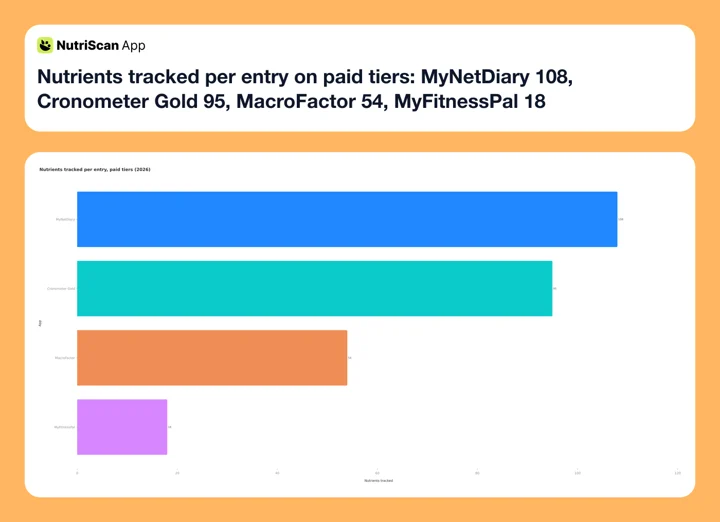 Figure 1: Nutrients per entry on each app's paid tier. MyNetDiary counts 108 against MyFitnessPal's 18; MacroFactor counts 54.
The free tier is genuinely usable
Unlike MacroFactor, MyNetDiary's free tier is a real product: barcode scanning, 108-nutrient tracking, voice logging, food diary, no ads. Premium ($8.99/mo or $59.99/yr) adds custom macro targets in grams, per-meal planning, recipe import, Meal Scan photo logging, fasting tools, diabetes tracking and Advanced AutoPilot. Version 10.0, December 2025, added a Premium Plus AI tier with an AI Coach, meal suggestions, restaurant menu scanning and AI voice logging, plus the $179.99 lifetime option.
Desktop access and offline mode
MyNetDiary has a full web app, a real advantage if you review weeks on a laptop, export data or plan meals at a desk. It also works offline, which matters for travel and gym basements.
Where MyNetDiary falls short
Its adaptation is narrower and it sits behind the paywall. Advanced AutoPilot moves your daily calorie budget from real weight trends, the same idea MacroFactor runs on, but it moves calories rather than rebuilding each macro target, and it is Premium only (MyNetDiary Premium). On the free tier targets sit where you set them, and Daily Analysis plus the weekly reports show the pattern without changing the number. Two limits MyNetDiary publishes itself: three device integrations plus Apple Health and Health Connect against MyFitnessPal's 40+, and English only.
MyNetDiary sweet spot
Long-haul trackers, medical nutrition needs, anyone buying packaged food outside MacroFactor's nine named barcode markets, and people who want a tracker that stays useful if they stop paying.
IMPORTANT
Checkpoint, midway.
⏱️ Progress 2/4
✅ Factor 1: The coaching engine (done)
✅ Factor 2: Database depth (done)
👉 Factor 3: Price reality check (current)
⏳ The one-day test (next)
Pricing: What You Actually Pay 💰
| Plan | MacroFactor | MyNetDiary |
|---|---|---|
| Monthly | $11.99 | $8.99 |
| 6-month | $47.99 ($7.99/mo) | Not offered |
| Annual | $71.99 ($5.99/mo) | $59.99 ($5.00/mo) |
| Lifetime | Not offered | $179.99 |
| Free tier | No | Yes |
| Trial | 7 days | Free trial on both paid plans, length not published |
Prices are standard US prices as of mid 2026 and change by region. Both listings also carry promotional SKUs beside the list price, $9.99/mo and $59.99/yr on MacroFactor's, $39.99 and $29.99 annual on MyNetDiary's, so check your own store.
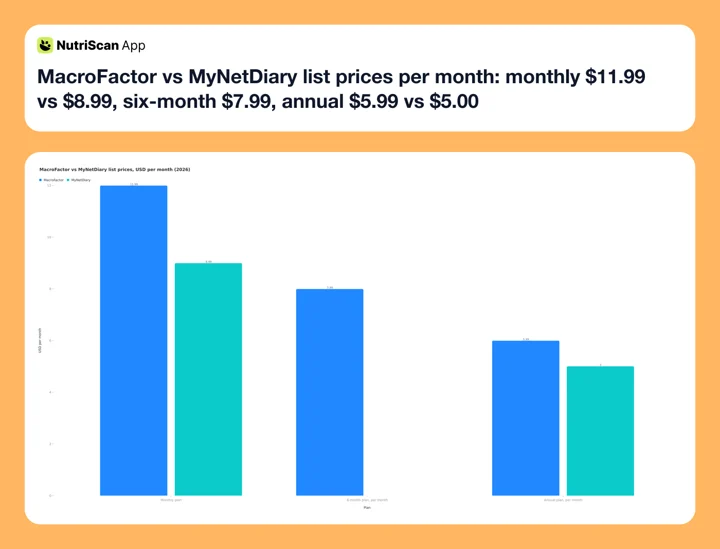 Figure 2: MacroFactor costs more at every plan tier it shares with MyNetDiary. The $12/yr gap on annual billing is small. The asymmetry on cancellation is not.
MyNetDiary is $12 a year cheaper on annual billing, and its lifetime plan breaks even just past 3 years, three annual payments coming to $179.97 against a $179.99 one-time price.
With MacroFactor you are paying for the algorithm's weekly decisions, roughly $1.38 per adjustment cycle on the annual plan. With MyNetDiary you are paying for data depth, AutoPilot and convenience on top of a strong free app. Cancel MyNetDiary and you keep a working tracker; cancel MacroFactor and you keep nothing. That asymmetry outweighs the $12 for some people and means nothing to others.
Logging Speed and Daily Workflow ⚡
For an app you open 3 to 6 times a day, logging friction decides adherence. A study of app-based dietary self-monitoring found consistent, frequent logging was the behavior most associated with short-term weight loss (Payne et al., 2022, PMC9159560).
MacroFactor's logging is built for repeat meals. Its own comparison testing claims MyFitnessPal takes roughly 1.5 times more discrete actions for the same entries, 15 against 10 on a food search. Common foods surface fast, the keypad quick-add speeds up as your history fills, and AI photo logging arrived in April 2025. MacroFactor also markets itself as "the fastest food logger in the world", a vendor line rather than a measured result, and MyNetDiary claims the same crown.
MyNetDiary counters with input variety. Barcode scan (free), voice logging (free), Meal Scan photo logging (Premium), and a web interface for keyboard entry. In a January 2026 iOS comparison, logging 127 identical entries took 711 actions in MyNetDiary versus 1,035 in MyFitnessPal (MyNetDiary comparison, 2026).
In practice: 80% repeat meals and MacroFactor feels faster. Lots of packaged food, varied meals, or a keyboard preference, and MyNetDiary's input paths win.
When neither database covers your meals well
For mixed home-cooked plates, curries, dal and regional dishes that neither database handles well, a photo-first tracker that asks about cooking oil and preparation method before estimating will capture your intake better than barcode-and-search apps.

NutriScan's manual logging with a full macro breakdown, for dishes neither MacroFactor nor MyNetDiary estimates well
Real-World Scenarios: Which App Fits Your Goal 🎭
Scenario 1: Arjun, 28, cutting for 16 weeks. He stalled around week 8 on both previous cuts and quit, not knowing whether to drop calories or hold. The weekly adjustment removes that decision and moves protein and carbs with the calories. He pays $71.99 and runs Coached mode. MacroFactor is the right call.
Scenario 2: Priya, 41, recomposition plus iron and fiber tracking. She lifts three times a week, wants 110g protein daily, and her doctor flagged low iron. MyNetDiary's 108 nutrients cover iron and fiber in one place, and the free tier lets her test the workflow for a month before paying.
Scenario 3: Sam, 33, first structured bulk. Never tracked, wants guidance rather than data. Coached mode teaches energy balance better, but no free tier means committing from day one. Sure about the goal? MacroFactor. Want to learn the habit cheaply first? Start on MyNetDiary free and switch when the goal gets specific.
IMPORTANT
Checkpoint, final stretch.
⏱️ Progress 3/4
✅ Factor 1: The coaching engine
✅ Factor 2: Database depth
✅ Factor 3: Price reality check
✨ The one-day test (next)
What the Research Says About Paid Trackers 🔬
Does paying improve outcomes? No study tests price directly, but two things paid tiers tend to buy do show up: logging consistency and feedback quality.
The 2025 JMIR meta-analysis reported a second finding that matters here. App effectiveness dropped after 6 months, and the authors concluded many apps "lack the personalized support necessary to sustain long-term weight loss" (Pujia et al., 2025, JMIR). Automatic adjustment is the feedback loop they called for, and both apps now sell a version of it. The Burke trial (Burke et al., 2025) adds the other half: higher adherence was associated with better odds of losing 5% or more. Association, not proof, and it favors whichever app you find frictionless.
One caveat: no peer-reviewed trial has compared these two head to head. The evidence backs the categories each leads in, not the choice.
The One-Day Test That Settles It 🔍
This is our recommendation, not a research finding. What the research supports is narrower: in Payne's 90-person study, logging on at least three days a week across eight weeks was the adherence pattern most associated with weight loss, and consistency explained more of the variance than how complete each entry was (Payne et al., 2022). Showing up beats logging perfectly.
So test friction, not the algorithm or the nutrient count. Three extra taps a meal is roughly 750 over 12 weeks, and an app you close half-finished is an app you stop opening by week 6.
The practical test: log the same 3 meals in both apps on the same day. Write down:
- How many taps each entry took
- How often the food you wanted was not the first result
- Whether you closed the app feeling done, or half-done
The app that finishes all three without friction is your app, whatever runs underneath it. One day of your own data beats any review, including this one.
The side-by-side trial playbook
Day 1-7 ➡️ MyNetDiary free tier. Day 8-14 ➡️ MacroFactor's 7-day trial. Same meals on both. Pick whichever you opened without thinking about it.
IMPORTANT
Recap.
⏱️ Progress 4/4, done
✅ Factor 1: The coaching engine (both adjust, MacroFactor adjusts further)
✅ Factor 2: Database depth (MyNetDiary wins at 108 nutrients)
✅ Factor 3: Price reality check (MyNetDiary $12/yr cheaper + lifetime option)
✅ The one-day test (log 3 identical meals in both, pick the one that felt like nothing)

How to Choose: A 5-Step Decision Process 🧭
Name your primary goal in one sentence. "Lose 6 kg in 16 weeks" points to MacroFactor. "Hit 100g protein and fix my iron intake" points to MyNetDiary. A rate of change in the sentence means you want adaptation.
Audit your food environment. Mostly home-cooked and repeated meals? Either app works. Buying packaged food outside MacroFactor's nine named barcode markets? Test MyNetDiary's coverage first.
Run the free options in order. MyNetDiary free for a week, then MacroFactor's 7-day trial. Log the same meals in both and note which one you opened without resistance.
Check how much adjusting you want done for you. Happy setting your own macro split and letting AutoPilot move the calories? MyNetDiary Premium is cheaper. Want calories and macros both decided weekly? That is MacroFactor's entire value.
Commit for 12 weeks, not 12 days. Pay annually only if the trial week felt easy, and re-evaluate at week 12 on trend weight and adherence rate, not on how one bad week felt.
Tips for Getting Full Value From Either App 💡
- Weigh in daily, in the morning, after the bathroom. Both apps adjust off weight data, so both are only as good as your weigh-in consistency.
- Build your top 20 foods in week one. Save regular meals as favorites or recipes immediately. Cheapest way to keep logging under two minutes a day.
- Set protein as the non-negotiable. Calories can flex day to day; weekly protein consistency drives body composition.
- Use verified entries only. Default in MyNetDiary. In MacroFactor, prefer verified results over user-submitted ones for anything you eat often.
- Review weekly, not daily. Single days are noise. Every Sunday check 7-day average calories, average protein and weight trend direction. Adjust one thing at a time.
- Log the misses too. An incomplete log of a high day still feeds MacroFactor's expenditure math and keeps your MyNetDiary average honest. A skipped day teaches neither app anything.
- Turn off notifications you ignore. Two well-timed prompts beat eight that train you to swipe away.
The Verdict 🏆
Choose MacroFactor if your goal has a rate attached: cutting, bulking, or holding a tight maintenance. It rebuilds calories and every macro target weekly for everyone who pays, and the adherence-neutral design keeps one bad weekend from ending your run. Accept no free tier, no desktop, and barcode coverage that thins outside nine markets.
Choose MyNetDiary if you want maximum data per dollar and a tracker that survives you cancelling: the widest nutrient panel of the two, a verified database, desktop access, offline mode, a lifetime exit, a free tier that stays useful, and Advanced AutoPilot on the calorie side. Accept that macro splits stay your call.
For most lifters with a defined 12-to-20-week goal, MacroFactor's deeper adjustments justify the extra $12 a year. For long-haul trackers who want the full nutrition picture, MyNetDiary is the better permanent home.
If your meals are the kind neither database handles well, mixed home-cooked plates, curries, dal, regional dishes, a photo-first tracker like NutriScan asks about cooking oil and preparation method before estimating. Log one full day and compare the numbers.
More comparisons: our MyNetDiary vs Cronometer 2026 breakdown and MyNetDiary vs MyFitnessPal 2026 comparison, plus our MacroFactor vs Cronometer 2026 comparison and is MacroFactor worth it in 2026. You can also check your targets with our free macro calculator.
 Finding the right tracker and sticking with it is the real win
Frequently Asked Questions ❓
Q: Is MacroFactor worth it over MyNetDiary for weight loss?
A: It depends on what stalls you. If you quit because you never knew when to adjust calories, MacroFactor's weekly adjustments solve that for $71.99/yr. If you quit because logging felt tedious, MyNetDiary's free tier, barcode scanner and voice logging lower the daily cost. Consistent self-monitoring is what the research links to results (Payne et al., 2022), so pick the one you will open daily.
Q: Does MyNetDiary adjust macros automatically like MacroFactor?
A: Partly. MyNetDiary Premium's Advanced AutoPilot moves your daily calorie budget from your real weight trend rather than holding it static. It does not rebuild each macro target, and it is paid, so free-tier targets stay where you put them. MacroFactor's weekly check-in changes calories and macros together for every subscriber.
Q: Which app has the more accurate food database?
A: Both use verified data, which puts them above crowdsourced trackers. MyNetDiary is larger, at 2M+ staff-verified entries with 108 nutrients each by its own count. MacroFactor holds more than 1.36M and names nine strong barcode markets, including the UK, France, Spain and Japan. Outside those, expect the Label Scanner or custom foods.
Q: Can I use either app for free long term?
A: MyNetDiary yes: barcode scanning, 108-nutrient tracking, voice logging and no ads, free. MacroFactor no: there is no free version after the 7-day trial, and its FAQ says there never will be.
Q: Which is better for tracking micronutrients?
A: MyNetDiary tracks 108 nutrients against MacroFactor's 54 items, so if micronutrients are a primary goal it wins clearly. MacroFactor covers the common ones, iron, calcium, key vitamins, caffeine and alcohol, but was built for energy and macro management first.
Q: Does MacroFactor work for Indian or mixed-dish meals?
A: India is not on MacroFactor's list of strong barcode markets, and no database indexes home cooking well. For dal, curries, sabzi and mixed plates you will often search and find no exact match in either app. Manual entry works but defeats the verification advantage. Consider a photo-first tracker that estimates mixed dishes directly.
Q: Is the MyNetDiary lifetime plan worth it?
A: At $179.99 it breaks even just past the 3-year mark against the $59.99/yr plan, three annual payments being $179.97. Track actively for longer than that and it is cheaper. If you are unsure, pay annually and buy the lifetime option later if it is still on sale.