Best Simple Alternatives 2026 (Coach-Led Weight Loss)
 ChatGPT
  Claude
  AI Mode
  Perplexity
 Simple publishes no list price and offers no free trial, with App Store SKUs running $14.99 to $59.99, which is the complaint most people leave over. The picks that publish a number span about $59 to $209 a year: NutriScan about $59, MacroFactor $71.99, Noom $209, WeightWatchers $12 a month on CORE. Nourish is the only one with a licensed human dietitian, and it is often free through insurance.
Last verified: August 23, 2026
You joined Simple for the gentle coaching. So why does paying for a price you were never shown feel so wrong? 🤔
TL;DR - Best Simple Alternatives 2026
• Who this is for: Simple users hitting one of three walls: the Premium price hidden until onboarding ends, no free trial, or food logging that ignores portions
• Top picks by exit reason: Nourish (real dietitian, often free with insurance), Noom (behavior coaching), MacroFactor (adaptive algorithm), NutriScan (precise photo logging with an oil prompt)
• Reality check: no single app gives you both a real human coach and Simple's low effort. Human coaching costs more; algorithm coaching costs about the same
• Prices: $59.99 to $209 a year among the picks that publish a price on their own site. Simple, BetterMe and Reverse Health do not publish one at all, which is the whole problem
Referral to a fully automated AI coach produced the same results as referral to a human coach over a full year, according to a randomized clinical trial of 368 adults with prediabetes published in JAMA in December 2025, where 31.7 percent of the AI group and 31.9 percent of the human-coached group hit the primary outcome, a single composite of weight, activity, and HbA1c, a difference of just 0.2 percentage points (Mathioudakis et al., 2025). As a NutriScan nutritionist who tests coaching apps every year, I open with that finding because it changes the whole question. If an AI coach can match a human coach, then "coach-led" is not the thing you are really paying for. What you are paying for is whether the app keeps you engaged long enough to matter.
IMPORTANT
Your Simple escape plan at a glance.
A quick roadmap so you can act fast.
⏱️ Progress 0/4 • ~0 minutes in • Keep going
⏳ Step 1: The three walls that push people out of Simple
⏳ Step 2: Seven alternatives matched to your exit reason
⏳ Step 3: The 5-step switch that protects your fasting routine
🔍 The month-six fade that quietly kills most coaching results (revealed near the end)
Simple does real things well, and it is worth saying so first. Its AI coach, Avo, delivers daily actions in plain, non-shaming language. The free version still covers the basics: log your fasts, meals, hydration, weight and activity, plus two Coach Avo replies and one Avo Vision scan a day (Simple help center). Fortune's testers gave the app 4 out of 5 overall (Phares, 2026). If gentle intermittent fasting guidance is all you want, Simple is a calm, friendly place to start. Our Coach Avo review covers what the paid tier actually adds.
But people leave Simple for three specific reasons: the Premium price is hidden until you finish a long questionnaire, there is no free trial, and the food logging is deliberately loose, so you never see real numbers. If any of those is why you are reading this, the seven alternatives below are matched to what you actually want next, from human dietitian coaching to precise tracking.
Why People Look Beyond Simple in 2026 🚪
After reviewing app store feedback, Fortune's hands-on test, and my own notes, three frustrations come up again and again.
1. The Premium price is hidden until the end of onboarding
Simple does not publish its Premium price. When Fortune's team clicked "get started" to find it, they were sent through a lengthy questionnaire and asked for an email address, with no price shown at any point (Phares, 2026). Fortune reports that other online sources put Premium at around $30 per month, and Simple's own line is that prices "vary based on the subscription length you choose." Treat the $30 as an estimate, not a price. Simple's US App Store listing carries ten concurrent in-app purchases, from a $14.99 Simple Pro SKU up to a $59.99 Simple Premium SKU, and not one of them is priced at $30 a month. Opaque pricing is a real trust problem when every honest competitor lists a number before you sign up. We broke down what is known about the tiers in our Simple pricing guide.
 Every Simple user at the end of the onboarding questionnaire, still waiting to see a price
2. There is no free trial
Simple offers a free version, which is good, but no free trial of Premium (Phares, 2026). So you can use the stripped-down free app forever, but you cannot test the paid coaching, daily Avo check-ins, and educational library before your card is charged. Most rivals give you 7 days to try the full product first, which is the category norm: MacroFactor, NutriScan, and MyFitnessPal all run 7 days. Paying blind for a subscription whose price you were never shown is a hard ask.
3. Food logging skips portions on purpose
Simple's tracking is built to be light. You type a meal like "Greek yogurt, blueberries, and granola," and the app never asks how much you ate, so portion size is ignored. Simple does show a macro breakdown per meal on Premium (Simple help center), but the number rests on an unweighed guess, and the free tier gets no breakdown at all: the Success Score and the macro detail both sit behind Premium (Simple help center). Fortune's tester scored accuracy just 3 out of 5 for exactly this reason (Phares, 2026). That is a feature if you hate counting, and a dealbreaker if you want numbers you can trust to the gram.
IMPORTANT
Checkpoint: here's where you are right now.
Quick status update so you always know the next best move.
⏱️ Progress 1/4 • ~2 minutes in • Keep going
✅ Step 1: The three walls (done)
👉 Step 2: Seven alternatives matched to your exit reason (you're here)
⏳ Step 3: The 5-step switch plan
🧩 The month-six fade (coming soon)
How I Chose These Alternatives 🧪
Every app below was screened against four questions:
- Type of coaching. AI coach, human dietitian, group workshop, or an adaptive algorithm. I say plainly which one you get, because the JAMA trial shows the label matters less than the fit.
- Price transparency. Can you see the price before you commit, and is there a free trial? Simple failed both, so its replacements should not.
- How it handles food logging. Loose habit scores like Simple, or precise calories and macros. Neither is wrong; they suit different people.
- What it fixes. Switching costs effort, so a pick must solve at least one of the three problems above.
One honest note up front: no single app both gives you a real human coach and stays as cheap as Simple. Human coaching costs more, adaptive-algorithm coaching costs about the same, and free-tier apps give you tools without a coach. Pick the trade you can live with.
Quick Comparison: Simple vs the Alternatives 📊
| App | Coaching type | Price | Free trial | Food logging | Best for |
|---|---|---|---|---|---|
| Simple (baseline) | AI coach (Avo) | Not published. App Store SKUs $14.99 to $59.99 | None | Loose, no portions | Gentle fasting habits |
| Noom | Human coaches plus psychology | $209/yr, $70/mo | Trial offered | Calories plus color system | Behavior change |
| WeightWatchers | Live and virtual Workshops | $12/mo CORE, $22/mo CORE+ | Varies | Points plus food log | Group accountability |
| Nourish | Licensed dietitians (human) | Free with insurance, ~$145/session without | n/a (insurance-billed) | RD-guided plans | Real 1:1 coaching |
| Reverse Health | Structured program, support groups | $19.99/mo per Fortune | Varies | Meal plans plus tracking | Women 40 plus |
| MacroFactor | Adaptive algorithm coach | $71.99/yr | 7 days | Precise macros | Data-driven adaptation |
| BetterMe | Habit plus workout coaching | Not published. App Store SKUs $9.99 to $41.99 | Varies | Calories plus habits | Fitness plus nutrition |
| NutriScan | Photo logging layer | about $59/yr | 7 days | Precise, with oil prompt | Accurate tracking |
Prices are standard US prices as of mid 2026 and change by region. They also shift with promotions, so always confirm on the checkout screen. Figure 1 puts the first-year cost side by side for the apps that actually publish one.
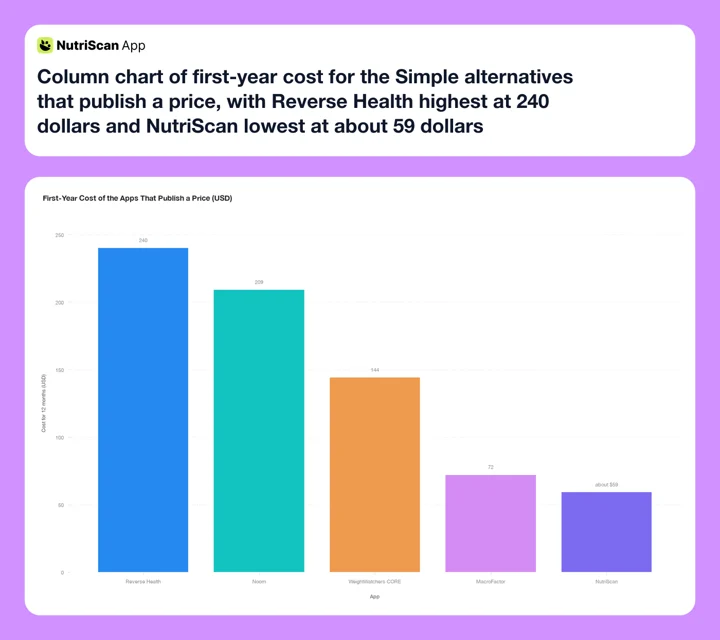 Figure 1: Twelve months on each app's published plan (monthly plans multiplied by 12). Simple and BetterMe are missing because neither publishes a subscription price, Nourish because it bills per session or through insurance. Reverse Health's $19.99 comes from Fortune, and reverse.health says pricing varies by location and plan, so treat that bar as the softest one
1. Noom: The Heavyweight Coach-Led Program 🧠
Noom is the coaching app people usually name first, and Fortune ranks it the best overall weight loss program for 2026 (Fortune, 2026). Where Simple keeps guidance light, Noom leans hard into psychology, teaching you why you eat the way you do through daily lessons, a color-coded food system, and check-ins with human coaches whom Noom describes as expertly trained in its method, many of them board-certified health professionals.
The trade-off is commitment length. Noom's monthly plan is $70, a bit over twice Fortune's ~$30 estimate for Simple Premium, but the annual plan brings it to $209, which is roughly $17.42 a month. Noom's own page adds that pricing "may vary slightly depending on promotions or your signup method." So Noom is not several times Simple's price; it is the same order of money spent differently, buying lessons and a human in the loop instead of an AI chat. We put the two head to head in our Noom vs Simple comparison.
Trade-off: you log more and read more. Noom's daily lessons take a few minutes and demand consistency Simple never asks for.
Choose Noom if you want habit and mindset coaching with a human in the loop, and you will pay a premium for the most structured behavior program in the category. Still on the fence? Our honest Noom review runs the numbers.
2. WeightWatchers: Group Accountability With Live Coaching 👥
WeightWatchers answers the one thing an app coach cannot fake: other people. Its Points system simplifies food choices into a single number, and its Workshops, both in person and virtual, put you in a room with a coach and members chasing the same goal. Garage Gym Reviews named WeightWatchers its best weight loss app for beginners for 2026, scoring it 4.23, the highest score in their roundup even though the overall pick went to Noom at 3.67 (Garage Gym Reviews, 2026). The beginners award is the right fit for what this app is: the easiest on-ramp for someone who wants other people in the room.
The digital-only-versus-Workshops split no longer exists. WeightWatchers now runs $12 a month for CORE and $22 a month for CORE+ on a 12-month commitment, with a separate MED+ medication tier at $74 (weightwatchers.com/us/plans). CORE includes two free weeks of Coaching and Workshops; CORE+ makes them unlimited. A 50% promotion was running on the 12-month plan in August 2026. Unlike Simple, the price is on the page before you sign up.
Trade-off: the Points system is its own language to learn, and the community format is not for people who want to track quietly and alone.
Choose WeightWatchers if accountability from real people, live or virtual, is the missing ingredient that makes coaching stick for you.
Two picks down. Still ahead: five more apps and the month-six fade that decides whether any of them stick.
3. Nourish: A Real Dietitian, Often Free With Insurance 🩺
If "coach" to you means a credentialed human, Nourish is the strongest pick here. It connects you with licensed registered dietitians for 1:1 telehealth sessions and personalized nutrition plans, and because it bills through insurance, many users pay nothing out of pocket; without insurance a session runs about $145 (Phares, 2026).
This is a genuine upgrade over Avo. A registered dietitian can manage medical conditions, tailor advice to your labs, and adjust in real time, none of which an AI coach is licensed to do. The JAMA trial found AI noninferior to a human coach on average outcomes (Mathioudakis et al., 2025), but "on average" is not "for a complex case," and that is exactly where a human earns the fee.
Trade-off: it bills through insurance, so what you pay depends on your plan, and it is US-only. Its dietitians are in network with hundreds of policies across all 50 states, and the app ships on both iOS and Android.
Choose Nourish if you want actual clinical coaching and can use insurance to get it at or near free.
4. Reverse Health: Structured Coaching for Women 40 and Over 🌸
Reverse Health targets an audience Simple treats generically: women over 40. Its own words are "fitness & weight loss plans for women 40+" and "midlife fitness & nutrition tips" (reverse.health), and it delivers a structured program with meal plans, recipes, low-impact workouts like wall pilates and chair yoga, and online support groups. Fortune lists it at $19.99 per month (Phares, 2026). One caution: that figure comes from Fortune, not from Reverse Health, which hides pricing behind a quiz exactly the way Simple does. Its own FAQ says pricing "varies depending on your location, language, and selected plan" and is revealed only "at the end of the quiz."
The support-group element gives it a light version of WeightWatchers' community without the Workshop scheduling, and the age-specific programming is something neither Simple nor most general trackers offer.
Trade-off: the focus is narrow by design, and you will not see a price until you finish the quiz. If you are not in its target group, a general coaching app will fit you better.
Choose Reverse Health if you are a woman over 40 who wants a program built for that group rather than a one-size plan, and the quiz-gated pricing does not bother you the way Simple's did.
IMPORTANT
Checkpoint: midway progress update.
You're halfway - decisions get easier here.
⏱️ Progress 2/4 • ~5 minutes in • Keep going
✅ Step 1: The three walls (done)
✅ Step 2a: Four coach-led alternatives (done)
👉 Step 2b: Three precision picks (current)
⏳ The month-six fade (next)
5. MacroFactor: The Algorithm That Coaches Your Numbers 📈
MacroFactor is coaching of a different kind. There is no chat and no human, but its adaptive expenditure engine recalculates your calorie and macro targets every week based on your logged intake and weight trend. It is the data-driven answer to Simple's vibe-based approach, and it costs $71.99 per year with a 7-day trial that starts through your app store. The real contrast with Simple is not the trial, it is that MacroFactor prints its price on its own website.
The JAMA finding matters here too: since an algorithm can match a human coach on outcomes, an app that adapts your targets automatically is doing real coaching work, just through math instead of messages (Mathioudakis et al., 2025). And unlike Simple, MacroFactor gives you exact numbers, tracking full macros with fast logging.
Trade-off: no in-app coach to message, no human on the other end, no daily lesson plan. Its community lives in a Facebook group and a subreddit rather than in the app, and its teaching happens in long-form articles on the website. It hands you an adaptive plan and expects you to run it.
Choose MacroFactor if you want a coach that adjusts the math weekly and you would rather log a portion than let an app guess it.
6. BetterMe: Coaching That Adds the Workout Half 🏋️
BetterMe widens the lens from food to the whole routine, pairing nutrition guidance with structured workout plans and habit coaching. Where Simple stays focused on fasting windows, BetterMe builds a broader behavior program covering movement, mindset, and meals.
BetterMe does not publish a standard price. Its US App Store listing carries ten concurrent subscription SKUs at once, with monthly plans at $9.99 and $19.99 and annual plans at $19.99 and $29.99, so what you pay depends on which funnel and promotion you land in. Note also that the workouts and the fat-loss program appear as separate purchases on that list, at $14.99 and $9.99, so "one subscription for everything" is not what the SKUs describe. The BetterMe pricing guide breaks down every SKU, the web plans and the refund rules.
That makes it a fit for people whose weight loss stalls not because of what they eat but because nothing moves them off the couch. The coaching is app-delivered and plan-based rather than a live human, closer to Simple in format but wider in scope.
Trade-off: breadth can mean less depth on any single area, and the pricing is as hard to pin down as Simple's, which is an odd thing to inherit from the app you are leaving.
Choose BetterMe if you want nutrition and workout coaching bundled, and a plan that pushes activity as hard as diet.
Six down, one to go. The month-six fade is two sections away, and it changes how you should read all of these picks.
7. NutriScan: The Precise Tracking Layer Any Coach Needs 📸
Full disclosure again: NutriScan is our app, so weigh this section with that in mind. I include it because it fixes Simple's third problem, loose food logging, more directly than anything else here, and it pairs with any coaching approach above.
Research keeps finding the same weakness in photo-based tracking: AI reads foods well but misses what it cannot see. A 2025 evaluation of ChatGPT-4 on meal photographs found strong food identification precision, 93 percent, alongside systematic underestimation of medium and large portions (O'Hara et al., 2025). That was a general-purpose model rather than a nutrition app, and the paper says so, but the failure mode is the one every camera-based logger has to answer for. Cooking oil is the biggest invisible variable; a tablespoon absorbed into a curry adds about 120 calories no camera can count, since oils run near 884 kcal per 100 g in USDA FoodData Central. NutriScan handles this with an oil level prompt (No Oil, Low Oil, Medium Oil, High Oil) and 11 cooking method options after every scan, so the number reflects how the dish was actually made, the exact portion detail Simple skips. You can read how the pipeline works in our meal scan guide.
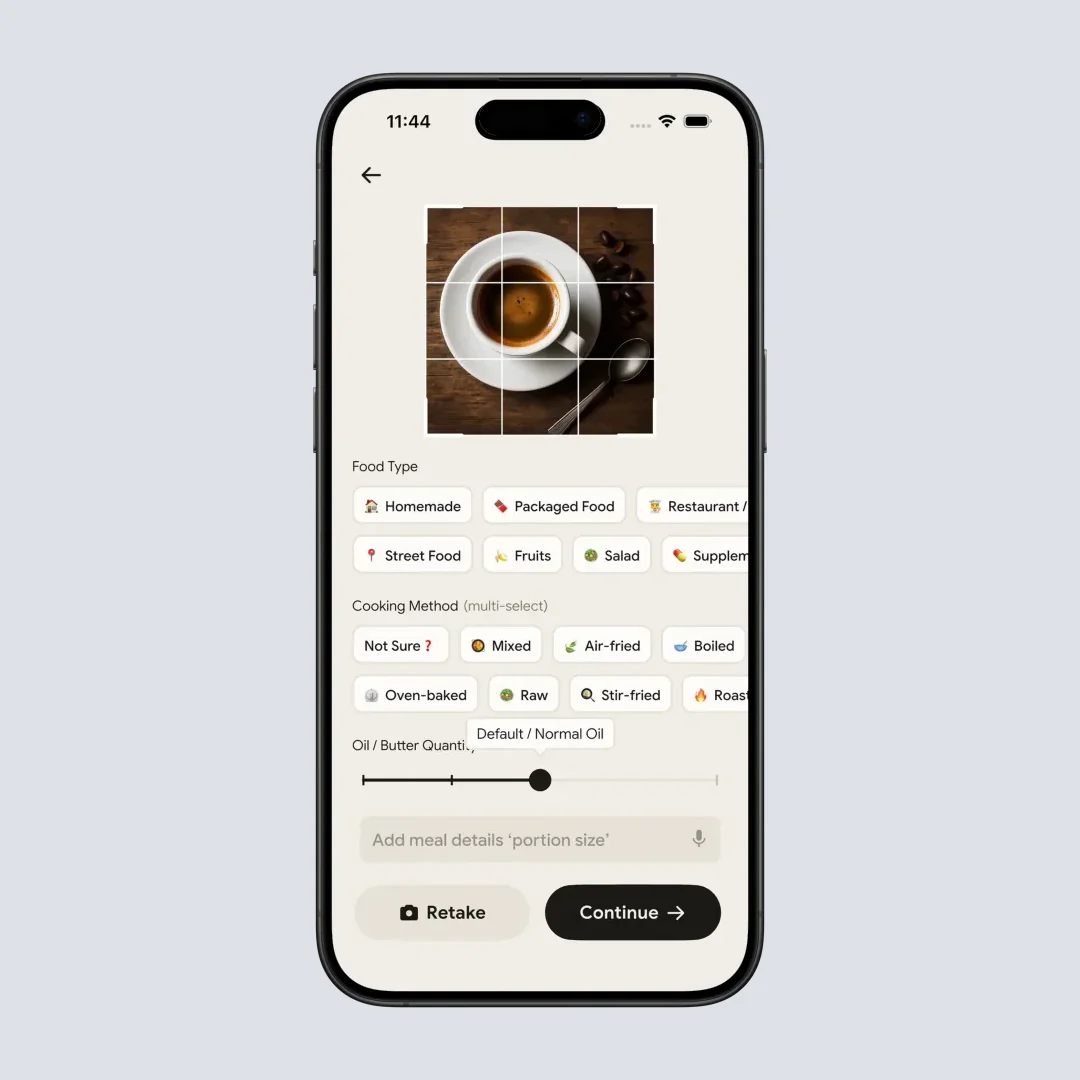
NutriScan's photo logging flow (Home > Camera Icon > Click Picture > Crop). After the scan, the oil prompt and cooking method tags catch the calories the camera cannot see
The structure is transparent where Simple is not: 5 photo scans per week on the free tier, Premium at about $59 a year, and a 7-day trial that starts through your app store, with card collection depending on your platform and region. Manual search, voice entry, and a fasting timer are included.
Trade-off: NutriScan is a tracking and logging tool, not a behavior coach. It counts accurately; it does not send you daily missions.
Choose NutriScan if you liked Simple's fasting timer but want the food log to show real, portion-aware numbers.
How to Switch Without Losing Your Progress 🔄
Moving off Simple costs less than people fear if you do it in order. Here is the five-step process I recommend:
- Write down your current plan first. Note your fasting window, your goal weight, and any habits Avo assigned. You are keeping the routine, not the app. Our free macro calculator gives you real calorie and macro targets to carry into the new app.
- Screenshot your Success Score patterns. Simple publishes no in-app export option, so capture the trends you found useful, such as which meals scored low, before you cancel.
- Run the new app in parallel for one week. Log everything in both. You will learn the replacement's coaching style and logging speed on your real meals, not a reviewer's test meals.
- Rebuild your top 10 meals early. Most people eat the same core foods. Recreating them in the first week removes most future friction, especially in apps that track precise portions.
- Cancel Simple before the renewal date. Cancel through the App Store or Google Play subscription screen at least 24 hours before renewal; our step-by-step cancellation guide walks through both stores. The free tier stays available, so you can keep it as a backup fasting timer.
 Photo by S O C I A L . C U T on Unsplash
 One week of parallel logging answers the question no review can: which coach YOU keep answering
Tips for Making Coaching Actually Stick 💡
The app matters less than whether you keep showing up. These habits protect the streak:
- Act on one coaching prompt a day, not all of them. Whether it is Avo, Noom, or a dietitian, doing one suggested action beats reading ten and doing none.
- Tie logging to an existing habit. Log after your morning coffee or before your commute. Consistency beats completeness every time.
- Use the fastest input for each moment. Barcode for packaged food, photo or voice when cooking, saved meals for repeats. Friction adds up.
- Accept good-enough estimates when eating out. A 90 percent accurate log you keep beats a perfect one you abandon. Pick the closest entry and move on.
- Review one weekly trend, not daily numbers. Weight and intake bounce day to day. A single weekly check keeps motivation steady.
- Keep exactly two reminders on. Zero lets the habit fade; six teaches you to ignore them all.
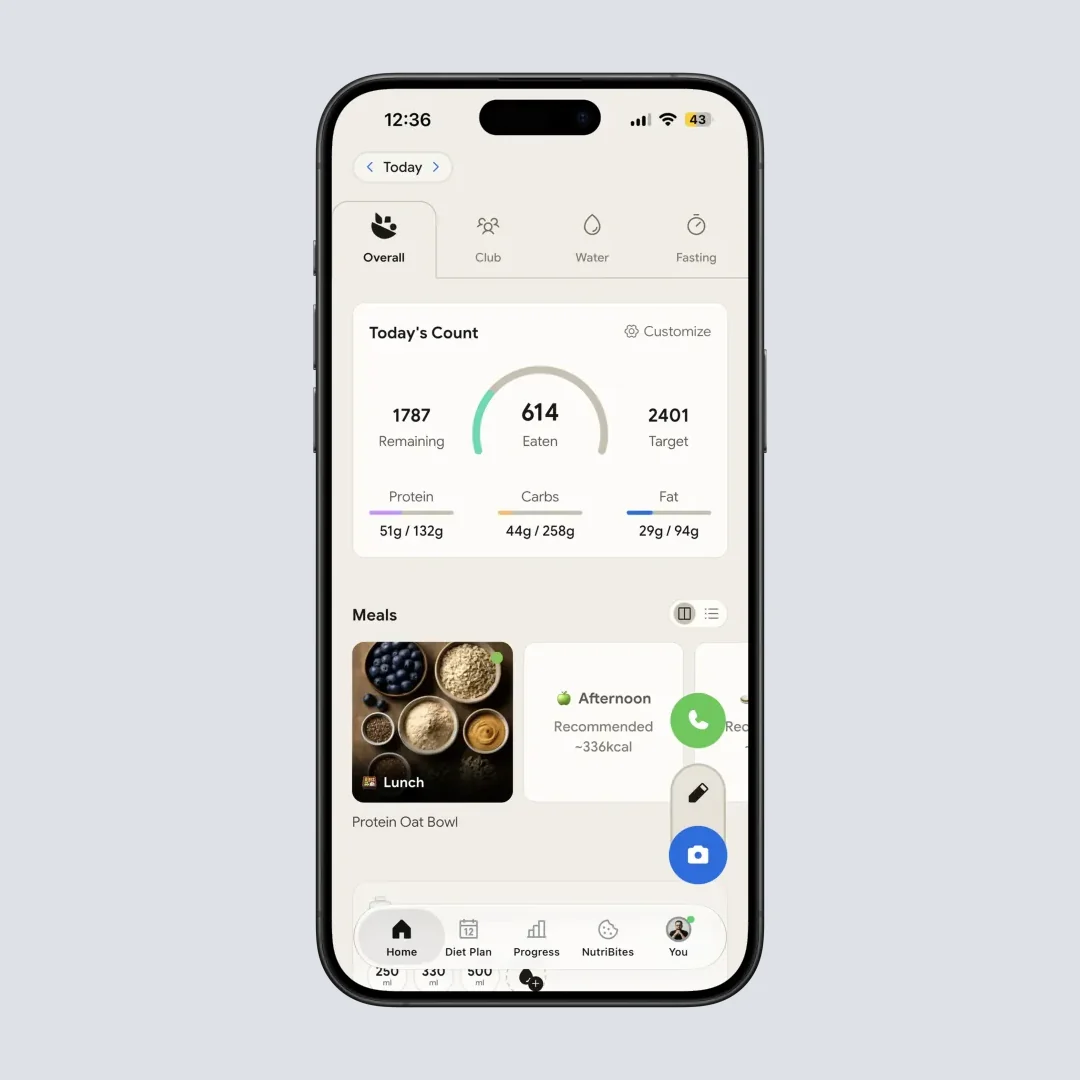
A one-glance daily breakdown (NutriScan Home tab) turns the weekly review into a 30-second habit instead of a spreadsheet session
IMPORTANT
Checkpoint: final stretch before the reveal.
One last nudge - the reveal is next.
⏱️ Progress 3/4 • ~7 minutes in • Keep going
✅ Step 1: The three walls
✅ Step 2: Seven alternatives compared
✅ Step 3: The 5-step switch plan
✨ The month-six fade (about to reveal)
The Month-Six Fade: What Actually Decides If Coaching Works 🔍
You've been patient. Here is the research that should shape your final choice more than any feature list.
The benefit window of app-based coaching is real but front-loaded. A 2025 meta-analysis of 11 randomized trials with 1,717 participants found significant weight and BMI reductions at 4 to 6 months that faded afterward, partly because many apps lack the personalized support that sustains long-term loss, which in turn drives high dropout (Pujia et al., 2025). That is the month-six fade: whichever app you pick from this list, the odds say your results flatten around month six unless something keeps pulling you back.
Two more findings sharpen the picture:
First, the coach's format matters less than you think. The JAMA randomized trial found referral to a fully automated AI-led program noninferior to referral to a human-led one on a composite of weight, HbA1c, and activity over 12 months, with outcome rates of 31.7 versus 31.9 percent, as Figure 2 shows (Mathioudakis et al., 2025). Do not overpay for "human" alone unless you have a medical reason.
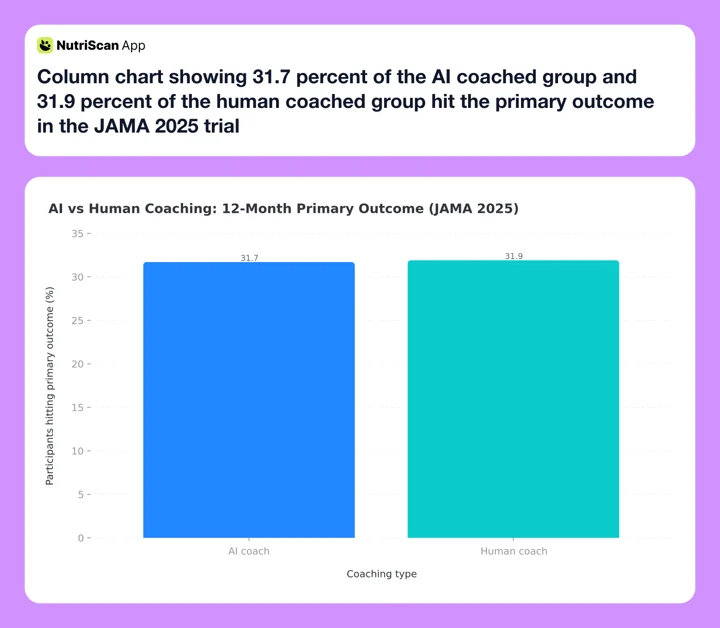 Figure 2: The JAMA 2025 trial result behind this whole article. A 0.2 point gap between AI and human coaching means the label on the coach is not what you should pay for
Second, retention is where the three coaching formats actually separate. A 2025 systematic review of human, AI and hybrid coaching in digital health interventions found both human and AI coaching improved engagement and lifestyle outcomes, and inferred higher retention for human coaching, 80 to 100 percent, than for AI, 90 to 93 percent with outlying studies as low as 9.8 percent, or hybrid programs at 55 to 56.5 percent (Loughnane et al., 2025). Hybrid handoff programs did worst of the three. The best coach is the one whose check-ins you actually answer.
So the practical translation of the month-six fade: pick the app whose daily interaction you will still tolerate in month seven. Apps that adapt to you, through recalibrating targets or a real coach, are built to fight the fade; apps you quietly stop opening are not, no matter how good the coaching label sounded.
How to apply the month-six rule this week
Run your two shortlisted apps in parallel for one week (step 3 of the switch plan). Then ask one question: which one's check-in did you answer without sighing? That app wins, regardless of what any comparison table says.
Who Should Stay With Simple 🏠
Switching is the wrong call for some readers, and it is worth saying so plainly.
Stay if the free version covers you. Basic tracking for fasts, meals, hydration, weight and activity, plus two Coach Avo replies and one Avo Vision scan a day, is a friendly, non-shaming way to build a fasting habit, and you may never need to pay. Just know what the free tier does not include: the Success Score and the per-meal macro breakdown are both Premium (Simple help center).
Stay if you want zero counting. Simple's whole design is to avoid portions and macros. If numbers stress you out, that is a feature, and switching to a precise tracker would undo the thing you liked.
Stay if gentle intermittent fasting is your method and it is safe for you. Simple's fasting guidance is clear and sustainable, and Fortune's tester praised exactly that. Just remember intermittent fasting is not advisable for everyone, including people with a history of disordered eating and those who are pregnant or breastfeeding, per dietitian Sydney Lappe, quoted by Fortune; check with a healthcare provider first. If you are weighing Simple against other fasting-first apps, our YAZIO vs Simple comparison covers that angle.
Leave if you hit one of the three walls: you refuse to pay a price you were never shown, you want to test coaching before you buy, or you need to see real calories and macros.
Final Verdict: Match the Alternative to Your Reason for Leaving ✅
The seven apps above are not interchangeable. They map to specific exits:
- Left because you wanted a real human coach? Nourish gives you a licensed dietitian, often free with insurance.
- Left for structure and accountability? Noom for behavior science, WeightWatchers for live group Workshops.
- Left because Simple ignored your life stage? Reverse Health builds the program around women over 40, though it hides its price behind a quiz just like Simple.
- Left because you wanted real numbers? MacroFactor coaches your macros with a weekly-adapting algorithm and a transparent price.
- Left because logging was too loose? NutriScan puts the camera first and asks the follow-up questions that keep estimates honest, with 5 free scans a week to test it on your hardest meals. You can try NutriScan free with a 7-day trial.
Whichever you choose, decide within a two-week parallel test and commit. The research is consistent: the coach you still answer in month seven is the only one that ever mattered.
IMPORTANT
Recap: everything you completed this round.
You finished the run - save this for next time.
⏱️ Progress 4/4 • ~9 minutes in • Nicely done
✅ Step 1: The three walls that push people out
✅ Step 2: Seven alternatives matched to exits
✅ Step 3: The 5-step switch plan
✅ The month-six fade (revealed: pick the check-in you'll still answer)
Frequently Asked Questions ❓
How much does the Simple app cost?
Simple has a free version covering basic tracking, two Coach Avo replies a day, and one Avo Vision scan a day. Premium is not publicly listed; the company says prices vary by subscription length, and Fortune reports that other online sources estimate about $30 per month. Simple's US App Store listing shows ten concurrent SKUs from $14.99 to $59.99, none of them priced at $30 per month. There is no free trial of Premium, and Fortune's testers noted you cannot see the price until you finish a long onboarding questionnaire.
What is the best Simple alternative with a real human coach?
Nourish is the strongest human-coaching alternative because it pairs you with licensed registered dietitians for 1:1 telehealth, often free through insurance and about $145 per session without. WeightWatchers offers live and virtual Workshops led by coaches, and Noom includes check-ins with human coaches it describes as expertly trained in its method, many of them board-certified health professionals.
Is an AI coach as good as a human coach for weight loss?
On average, a 2025 JAMA randomized trial found that referral to a fully automated AI-led program was noninferior to referral to a human-led program on a composite outcome combining weight, HbA1c, and activity over 12 months. For complex medical situations, a registered dietitian still adds value an AI cannot legally provide, which is why Nourish exists on this list.
Which Simple alternative lets me track exact calories and macros?
MacroFactor and NutriScan both track precise numbers from a portion you confirm. Simple does show a macro breakdown on Premium, but it never asks how much you ate, so the number rests on an unweighed guess, and the free tier gets no breakdown at all. MacroFactor recalculates your macro targets weekly, and NutriScan adds photo logging with an oil and cooking-method prompt so portion-heavy meals are counted more accurately. Both list their prices and offer a 7-day trial.
Can I keep intermittent fasting after leaving Simple?
Yes. Simple's free fasting timer stays available even if you stop paying, and NutriScan, YAZIO, and Cronometer Gold all include fasting timers alongside food logging. You keep the fasting window; you just gain a food log built on a portion you confirm rather than on an unweighed guess.