How to Stop Eating at Night to Lose Weight
 ChatGPT
 Claude
 AI Mode
 Perplexity
If you can't stop eating at night, start by eating more earlier. Night eating usually traces back to three things: a daytime deficit that is too steep, a habit tied to a time or place, and short sleep. The fix is to move 200 to 300 calories and 25 to 40 grams of protein into breakfast and lunch, close the kitchen at a set time, and plan one evening snack of 60 to 190 calories so the decision is made before you are hungry.
Here is the checklist for this post:
TL;DR
- Start by day: move 200 to 300 calories and 25 to 40 g protein into breakfast and lunch.
- Plan one snack: 60 to 190 calories, chosen at 4 pm, eaten from a bowl.
- Close the kitchen: pick a set time and change the cues around the couch and screen.
- Example day: about 1,670 kcal and 138 g protein, with 62 percent of calories before dinner.
- Why the pull toward the kitchen gets stronger after dinner
- The three causes, and how to tell which one is yours
- Four fixes you can start tonight
- 11 planned evening snacks with calories and protein
- A full day of eating that adds up to about 1,670 kcal
- One small rule that makes the snack plan hold (near the end)
- The signs that mean it is time to talk to a doctor
Why you can't stop eating at night
Evening is when three pressures stack up. You have used your willpower on work and errands, you have finally stopped moving, and the food is within reach. If you also ate little during the day, your body is asking for the missing calories right when your guard is lowest.
Researchers have looked at this directly. In a lab study of 225 healthy adults, with food intake tracked in a subset of 37, people held to four hours of sleep a night ate about 553 extra calories between 10 pm and 4 am, and a larger share of those calories came from fat (Spaeth, Dinges and Goel, Sleep, 2013). That is a lab with forced short sleep, so treat it as a demonstration of what late hours can do, not as your exact numbers.
A review of nighttime eating adds a useful point. Large mixed meals late at night were linked with worse outcomes, but small, nutrient-dense, lower-calorie foods did not show the same pattern (Kinsey and Ormsbee, Nutrients, 2015). So the goal is not zero food after dinner. The goal is a planned, small amount instead of an open-ended evening.

Real food at lunch is what keeps the evening quiet: a salad on its own is not enough, so add protein and calories by day.
Cause 1: You under-eat during the day
This is the most common cause and the easiest to test. If breakfast is coffee, lunch is a small salad, and you are at 700 to 900 calories by 6 pm, your body collects the balance after dinner. A 1,500 calorie day eaten as 900 before dinner and 600 after is still 1,500, but it feels like failure because the evening part arrives as a binge on chips and ice cream.
NIDDK, part of the National Institutes of Health, notes that for some people, dieting in unhealthy ways, such as skipping meals or not eating enough food, may contribute to binge eating (NIDDK, Binge Eating Disorder: Symptoms and Causes).
A quick self-check: write down what you ate before 6 pm yesterday. If it is under about 40 percent of your daily target, the evening pull is probably your body asking for the rest. Find your target with the TDEE calculator or the weight loss calculator. If your deficit is already steep, the posts on why a calorie deficit stops working and how much protein you need per day cover the fix in more detail.
Cause 2: Habit and cues
Some night eating has little to do with hunger. It is a chain: sit on the couch, open the show, reach for the snack. The couch, the show, and the time on the clock are the cues, and the snack is the routine. Boredom, stress, and the feeling of "I earned this" feed the same chain.
How to tell habit from hunger:
- You eat the same thing at the same time most nights, even when dinner was big.
- You stop thinking about food when you are out of the house or busy.
- You feel like eating but a glass of water and a short walk make it fade within 15 minutes.
- Plain food such as a pear or plain yogurt does not appeal, but crackers and sweets do.
If three or more of these fit, habit is a big piece of your pattern, and the fixes below that change the setting will work better than willpower.
Cause 3: Short or late sleep
Staying up later gives you more hours to eat in. Poor sleep also pushes appetite the wrong way when you are dieting. In a small randomized crossover study of 10 overweight adults on a calorie-restricted diet, sleeping 5.5 hours instead of 8.5 hours cut the share of weight lost as fat by 55 percent, and the group reported more hunger (Nedeltcheva et al., Annals of Internal Medicine, 2010). The sample is small and the study ran for two weeks, so it points to a direction rather than proving a rule.
Timing matters too. In a 20-week weight-loss program with 420 adults, people who ate their main meal later in the day lost less weight than early eaters, even though their reported intake looked similar (Garaulet et al., International Journal of Obesity, 2013). That study looked at lunch timing, not midnight snacks, but it fits the same idea: shifting calories earlier tends to help.
If you are awake past midnight most days, the sleep fix may do more than any snack swap.

Short sleep adds hours to eat in and raises hunger, so an earlier night can do more than any snack swap.
Progress check: three causes done. Next come four fixes and 11 snacks, and the 4 pm rule is still coming.
Fix 1: Move calories and protein earlier
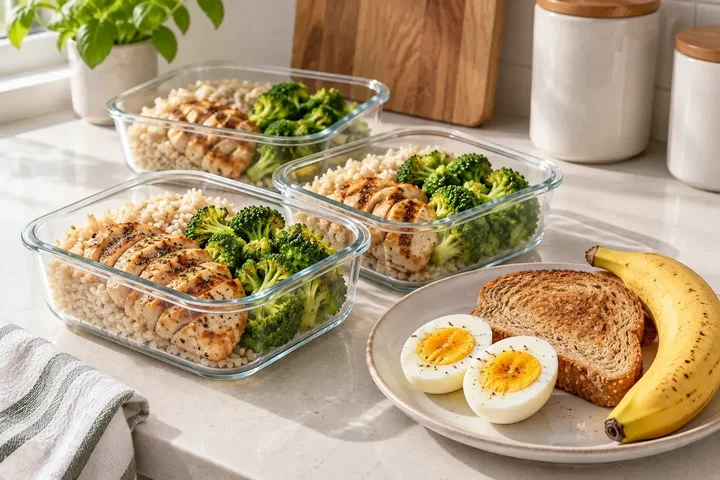
Do this first, for one week, before changing anything else. Raise breakfast and lunch by 200 to 300 calories and aim for 25 to 40 grams of protein at each. Keep dinner as it is.
| Meal | Before | After | Change |
|---|---|---|---|
| Breakfast | Coffee and one banana, 105 kcal, 1 g protein | 2 boiled eggs, 2 slices whole wheat toast, 1 banana, 419 kcal, 22 g protein | +314 kcal, +21 g protein |
| Lunch | Small salad with dressing, about 200 kcal, 4 g protein | 5 oz (142 g) chicken breast, 1 cup rice, 1 cup broccoli, 473 kcal, 51 g protein | +273 kcal, +47 g protein |
Per our food pages: a boiled egg is 78 kcal with 6.3 g protein, a slice of whole wheat toast is 79 kcal with 4 g, and cooked chicken breast is 165 kcal and 31 g protein per 100 g. The "before" meals are an illustrative example of a typical under-eating day, not survey data.
You are not adding calories for good. If your evenings were running 500 kcal or more of unplanned food, a breakfast and lunch that are 300 kcal bigger plus a 100 to 150 kcal planned snack nets out lower, and the evening has less left to ask for.
WARNING
Talk to your doctor before changing your eating pattern if you have diabetes, take medication that affects blood sugar or appetite, are pregnant or breastfeeding, or have a history of an eating disorder.
Fix 2: Set a kitchen close time and plan one snack
Pick a time, usually two to three hours before bed, and treat it as the end of dinner. One planned snack is allowed in the window after dinner and before the close. The snack goes in a bowl or a cup and is eaten sitting down.
This is a plan, not a ban. A ban fails the first night you are tired. A plan gives your brain something to say yes to.
The kitchen-close rule has three parts:
- Dinner ends at a set time, for example 8 pm.
- One snack from the list below, portioned into a bowl, eaten by 9 pm.
- Kitchen closed after that: lights off, brush your teeth, tea or water only.
Some people find that brushing their teeth early makes more food less appealing. It costs nothing to try.
TIP
Decide tonight's snack at 4 pm. Write it on a note or in your food log, so at night you follow a plan instead of negotiating at 9:30 pm on the couch.
Fix 3: Change the cues
If habit is part of your pattern, change the setting, not just the food.
- Keep the snack foods you tend to overeat out of the house or out of sight. Put fruit and yogurt where you can see them.
- Do not eat out of the bag or box. Take one portion, put the package away, and sit down.
- Give your hands something else on the couch: a hot tea, a puzzle, knitting, a stretching routine.
- Move the habit. If you always snack during one show, watch it somewhere other than the couch for a week.
- Wait 15 minutes before you open the kitchen after your snack. Some cravings pass in that time. If you are still hungry afterward, eat the planned snack, not whatever is nearest.
Fix 4: Protect your sleep
You do not need a perfect routine. Three changes help most people:
- Pick a fixed wake-up time and keep it within an hour on weekends.
- Stop screens in bed, and keep the bedroom dark and cool.
- Cut caffeine from mid-afternoon on.
For more on how food and rest affect each other, see Sleep Better Tonight: What I Learned About Food and Rest. The NHS sleep and tiredness guide has more self-help tips.
An extra hour of sleep gives you an hour less of kitchen time and a lower chance of reaching for food out of tiredness. Of the four fixes, this one is the least exciting and often the most useful.
Progress check: all four fixes done. The snack list is next, then the full day of eating, then the 4 pm rule.
11 planned evening snacks with calories
These are all small, high in protein or fiber, and easy to portion. Calorie and protein numbers come from our food pages for each food; sums are rounded.
| Snack | Portion | kcal | Protein |
|---|---|---|---|
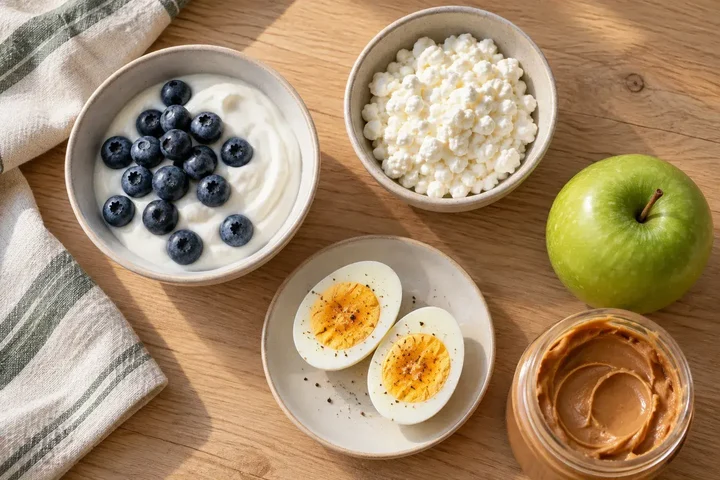
| Cottage cheese | 1/2 cup (113 g) | 111 | 12.5 g |
| Plain nonfat Greek yogurt | 6 oz tub (170 g) | 100 | 17 g |
| Greek yogurt with blueberries | 6 oz yogurt plus 1/2 cup (74 g) berries | 142 | 18 g |
| Boiled eggs | 2 large | 156 | 12.6 g |
| String cheese and an apple | 1 stick plus 1 medium apple | 175 | 6.5 g |
| Apple with peanut butter | 1 medium apple plus 1 tbsp | 189 | 4 g |
| Air-popped popcorn | 4 cups popped (2 tbsp kernels) | 60 | 2 g |
| Whole wheat toast with hummus | 1 slice plus 2 tbsp | 126 | 6.2 g |
| Baby carrots with hummus | 3 oz (85 g) bag plus 2 tbsp | 77 | 3 g |
| Almonds | 1 oz (28 g), about 23 nuts | 164 | 6 g |
| Skim milk, warm | 1 cup (245 g) | 86 | 8.3 g |
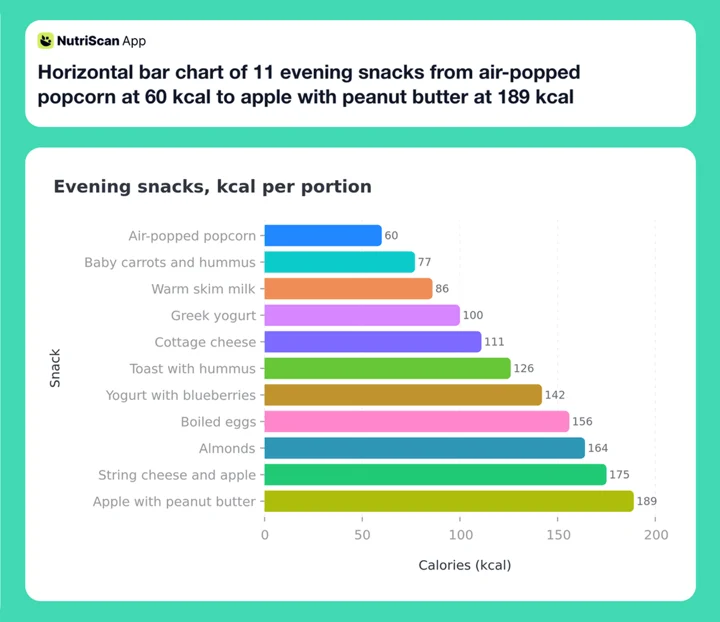
Figure 1: The 11 planned snacks run from 60 kcal for popcorn to 189 kcal for an apple with peanut butter.
How to choose:
- Hungry for real: pick one with 10 grams of protein or more, such as cottage cheese, Greek yogurt, or eggs.
- Want something crunchy or salty: popcorn or carrots with hummus give volume for 60 to 80 calories.
- Want something sweet: Greek yogurt with berries, or an apple with peanut butter.
- Want to settle before bed: warm skim milk or a small bowl of cottage cheese.
Measure the first few times. Nuts and peanut butter are easy to over-pour, and 2 tablespoons of peanut butter instead of 1 doubles the snack to about 280 kcal.
A full day that adds up
Here is one day with a planned evening snack. It comes to about 1,670 kcal and 138 g protein. Your numbers will differ with your size, age, and activity, so use it as a template and not a target. A doctor or registered dietitian can set a calorie goal if you have a medical condition.
| Meal | Food | kcal | Protein |
|---|---|---|---|
| Breakfast | 2 boiled eggs, 2 slices whole wheat toast, 1 medium banana | 419 | 21.9 g |
| Lunch | 5 oz (142 g) cooked chicken breast, 1 cup cooked white rice, 1 cup chopped broccoli | 473 | 51.0 g |
| Afternoon | Greek yogurt (6 oz) with 1/2 cup blueberries | 142 | 17.6 g |
| Dinner | 3 oz (85 g) cooked salmon, 1 cup cooked pasta, 2 cups broccoli, 1 tsp olive oil | 524 | 35.0 g |
| Evening snack | Cottage cheese, 1/2 cup | 111 | 12.5 g |
| Total | 1,669 | 138.0 g |
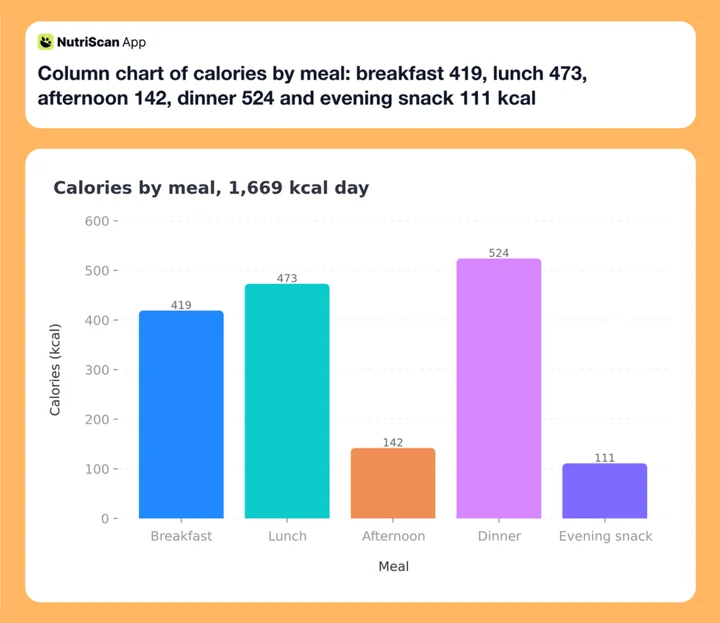
Figure 2: Breakfast, lunch and the afternoon snack carry 1,034 of the day's 1,669 kcal, and the evening snack is 111.
About 62 percent of the calories and 66 percent of the protein land before dinner, and the evening has a clear, small place to land. That shape is what makes the evening quieter.
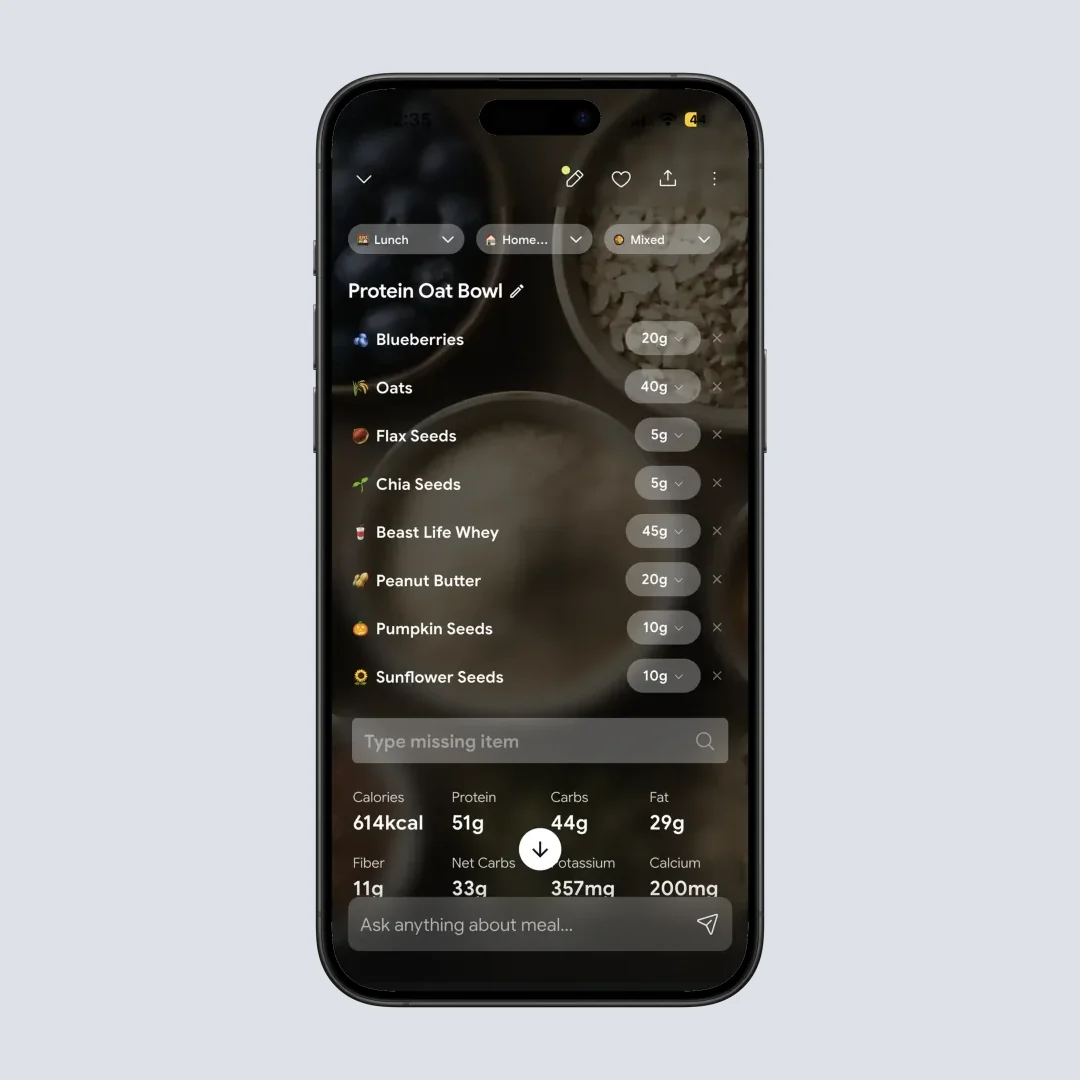
If you do not want to weigh food, a photo log helps: NutriScan reads a meal photo and returns calories and macros. On the Free plan you get 5 photo scans a week, and Premium is about $59 a year with unlimited scans. NutriScan reports 95 percent accuracy on calories as its own figure. Our AI calorie counter app page shows how it works. If you work nights, the night shift diet plan shows how to time meals and snacks around a 7 pm to 7 am shift.
What a night snack costs, and the small rule that holds the plan
Say you eat a 500 calorie snack every night. That is 3,500 calories a week. Swapping it for a 100 to 150 calorie planned snack saves about 2,450 to 2,800 calories a week, most of the roughly 3,500 calorie weekly gap behind the usual 1 lb a week rule of thumb. That rule is an approximation and real results vary, but the direction is clear: the big wins come from replacing the open-ended evening, not from eliminating all evening food.
Now the rule that was promised at the top: decide tonight's snack at 4 pm. Write it on a note, or put it in your food log, and put it on the fridge or phone. When you decide while you are not hungry, you choose better than you do at 9:30 pm on the couch. Then at night, you are not deciding, you are following a plan you already made. This small step is what keeps the plan from turning into a negotiation.
If a night goes off the plan, log it, drop the guilt, and run the plan again the next day. One bigger night does not undo a week.
When night eating feels out of control
Most night eating is habit, sleep, or a daytime deficit and responds to the fixes above. Some of it does not. See a doctor, registered dietitian, or mental health professional if any of these sound familiar:
- You feel unable to stop once you start, and you eat a large amount of food in a short time.
- You eat until you are uncomfortably full, or you eat alone because you are embarrassed.
- You wake up at night and need to eat to get back to sleep, and this happens often.
- You feel guilt, shame, or distress afterward, or the pattern has lasted months.
Two conditions are worth asking about. NIDDK describes binge eating as eating a large amount of food in a short amount of time while feeling unable to control it, and says regular binge eating, at least once a week for three months, may be binge eating disorder (NIDDK, Binge Eating Disorder: Definition and Facts). The NHS page on binge eating disorder lists symptoms and treatment options.
Night eating syndrome is a separate condition. A 2010 international expert consensus described its core feature as abnormally increased food intake in the evening and nighttime, shown by eating at least 25 percent of daily intake after the evening meal and/or waking to eat at least twice a week, with awareness of the eating, distress or impairment, and a duration of at least three months (Allison et al., International Journal of Eating Disorders, 2010).
This article cannot tell you whether you have either one, and neither can an app. A doctor can. If it sounds like you, talk to your doctor soon, and bring a few days of notes on when you eat and how you feel. If you are in crisis or thinking of hurting yourself, contact local emergency services right away.
Also talk to your doctor before changing your eating pattern if you have diabetes, take medication that affects blood sugar or appetite, are pregnant or breastfeeding, or have a history of an eating disorder. Waking up hungry on certain medications is worth mentioning to your prescriber.
A one-week plan
| Day | What to do |
|---|---|
| Day 1 | Write down yesterday's food before 6 pm. Check it against your daily target in the TDEE calculator. |
| Days 2 to 3 | Add 200 to 300 kcal and 25 to 40 g protein to breakfast and lunch. |
| Day 4 | Choose a kitchen close time. Pick your planned snack at 4 pm. |
| Day 5 | Change one cue: put the snack foods away or watch your show somewhere else. |
| Day 6 | Fix a wake-up time and cut caffeine after 2 pm. |
| Day 7 | Review: how many nights did you follow the plan? Keep what worked. |
Check your protein target with the protein intake calculator, and if you want a library of snack ideas with protein counts, browse High Protein Snacks: Complete Guide.
FAQ
How do I lose weight when I can't stop eating at night?
Eat enough earlier in the day (a protein-rich breakfast and lunch), set a kitchen close time, plan one 100 to 200 calorie snack for the evening instead of grazing, and protect sleep. Most people see the pull ease within one to two weeks of eating more by day. If it still feels out of control, talk to your doctor.
Is eating at night bad for weight loss?
Calories count the same at any hour, but late-night eating tends to add calories on top of a full day. In a lab study of sleep-restricted adults, people ate about 553 extra calories between 10 pm and 4 am. A small planned snack inside your daily target does not stop weight loss.
What is a good snack to eat at night when losing weight?
Pick something with protein or fiber and 60 to 190 calories: plain Greek yogurt, cottage cheese, two hard-boiled eggs, an apple with peanut butter, or air-popped popcorn. Portion it into a bowl instead of eating from the package.
Why do I crave food at night after eating well all day?
Common reasons are a daytime deficit that was too large, too little protein at dinner, short sleep, boredom or stress, and a habit tied to the couch or TV. Raising daytime food by 200 to 300 calories is the first thing to test.
When is night eating a medical issue?
If you eat a large share of your food after dinner or wake up to eat at least twice a week for three months, and it distresses you, ask a doctor about night eating syndrome or binge eating disorder. A doctor makes that call, not an article.
Key takeaways
- Eat more by day: 200 to 300 extra calories and 25 to 40 g protein at breakfast and lunch.
- Plan one evening snack of 60 to 190 calories, decide it at 4 pm, and portion it into a bowl.
- Set a kitchen close time and change the cues around the couch and screen.
- Protect sleep, because short sleep raises late-night intake and hunger.
- If it feels out of control, talk to your doctor about night eating syndrome or binge eating disorder.