Ultra Processed Food: What Counts and How Much Is Too Much
 ChatGPT
 Claude
 AI Mode
 Perplexity
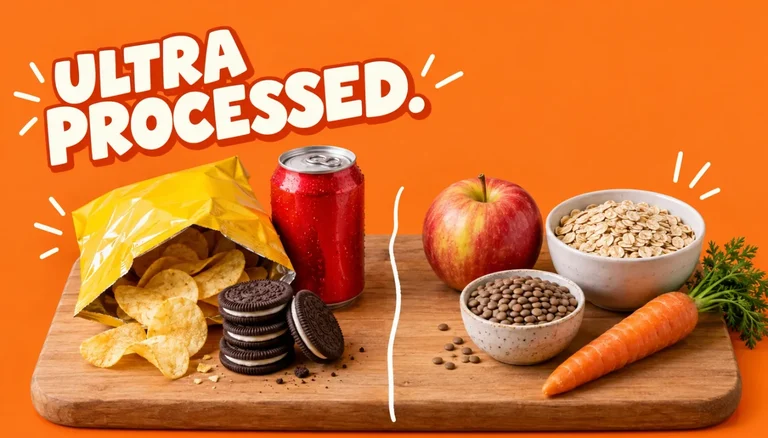
Ultra processed food is the fourth group in the NOVA food classification: industrial formulations built mostly from substances extracted from foods, plus additives, with little or no whole food left in them. US adults get 53.0% of their daily calories from it. No health body has published a safe amount or a "too much" line, and the rest of this page covers what the research does show.
Figures checked on October 14, 2026 against the sources linked in each section: the CDC's National Center for Health Statistics, the NIH inpatient trial by Hall and colleagues, the NOVA papers by Monteiro and colleagues, the 2025-2030 Dietary Guidelines for Americans and the Lancet series on ultra-processed foods. The calorie sums are our own arithmetic.
Summary
- Definition: NOVA group 4. The Monteiro paper calls these "formulations made mostly or entirely from substances derived from foods and additives, with little if any intact" whole food.
- How much Americans eat: adults got 53.0% of calories from ultra-processed foods in August 2021 to August 2023. Youth aged 1 to 18 got 61.9%.
- Is there a safe amount: no body has set one. The 2025-2030 Dietary Guidelines say to limit highly processed foods and name no percentage.
- What the one controlled trial found: 20 adults ate 508 more calories a day on an ultra-processed diet than on an unprocessed one and gained 0.9 kg in 2 weeks.
- Chomps: the ingredient list is short and has no cosmetic additives, but NOVA's own list names reconstituted meat products as group 4. There is no official rating.
What is ultra processed food?
NOVA sorts every food into one of four groups by the nature, extent and purpose of its industrial processing. NOVA is a name, not an acronym. The four groups, with examples from the Monteiro paper:
| NOVA group | What it holds |
|---|---|
| 1. Unprocessed or minimally processed | Fresh fruit, vegetables, dried beans and lentils, grains, meat, eggs, milk |
| 2. Processed culinary ingredients | Oils, butter, sugar, salt |
| 3. Processed foods | Foods made by adding group 2 ingredients to group 1 foods, such as canned beans, cheese and fresh bread |
| 4. Ultra-processed foods | Formulations of food-derived substances and additives |
The FAO's 2019 report on NOVA and the Monteiro paper describe group 4 the same way. Its ingredients include sugar, oils, fats and salt, plus substances you would not cook with at home: casein, whey, hydrolysed proteins, soya protein isolate, maltodextrin, high-fructose corn syrup and hydrogenated oils. It also carries additives that imitate or enhance sensory qualities, such as dyes, flavors, flavor enhancers, non-sugar sweeteners, emulsifiers and glazing agents.
A 2026 paper in the American Journal of Public Health gives the working test researchers use. A product is ultra-processed if it contains a food substance used only or mostly in industrial settings, or an additive with a cosmetic function.

Which foods are ultra processed?
The Monteiro paper's group 4 list includes soft drinks, sweet or savoury packaged snacks, ice cream, chocolate, mass-produced packaged breads and cookies, breakfast cereals and cereal bars, margarine, sausages, burgers, hot dogs, poultry nuggets and instant noodles and soups. Here is how that sorts foods that have a NutriScan page:
| Food | NOVA group | Why |
|---|---|---|
| Potato chips | 4 | Named on the list as a savoury packaged snack |
| Oreo cookies | 4 | Named on the list as packaged cookies |
| Chicken nuggets | 4 | Named on the list as poultry nuggets |
| White bread | 4 if mass-produced and packaged | The list names mass-produced packaged bread; fresh bread of flour, water, yeast and salt is group 3 |
| Oatmeal, rolled oats | 1 | A whole grain, rolled |
| Apple | 1 | Fresh fruit |
| Lentils | 1 | Dried legume, cooked |
Group depends on the product and not only the food name. Two loaves called white bread can land in different groups, and a flavored instant oatmeal packet is group 4 where plain rolled oats are group 1. Read the ingredient list, not the front of the pack.
How much ultra processed food do Americans eat?
More than half of what they eat. The CDC's NCHS Data Brief 536, which covers August 2021 to August 2023, reports:
- Adults (19 and older): 53.0% of daily calories.
- Youth (1 to 18): 61.9%. Children aged 6 to 11 were highest at 64.8%.
- Adults by age: 54.4% at ages 19 to 39 and 52.6% at ages 40 to 59.
- Adults by income: 54.7% in households under 130% of the poverty level and 50.4% at 350% or more.
A 2,000 calorie day at 53% puts about 1,060 calories from ultra-processed foods. That sum is ours. The Lancet series published on November 18, 2025 found the share in the USA and the UK has stayed above 50% for two decades.
How much ultra processed food is OK?
No agency has published a number. The 2025-2030 Dietary Guidelines for Americans tell people to limit highly processed foods, packaged and ready-to-eat items that are salty or sweet, such as chips, cookies and candy. They set no percentage of calories. The nearest thing to a number is for added sugars: one meal should have no more than 10 grams.
So any figure you see for a "safe" share is somebody's opinion. What the research gives is a direction and a size of effect, in the next section.
How much ultra processed food is too much?
Two kinds of evidence exist, and they answer different questions.
One controlled trial. Hall and colleagues admitted 20 weight-stable adults to the NIH Clinical Center. Each ate an ultra-processed diet for 2 weeks and an unprocessed diet for 2 weeks, in random order, with meals matched for presented calories, energy density, sugar, sodium, fiber and macronutrients. They could eat as much as they wanted. On the ultra-processed diet they ate 508 calories a day more (plus or minus 106) and gained 0.9 kg. On the unprocessed diet they lost 0.9 kg. The trial was small and short, and it shows that the diet changed how much people ate, not where the harmful amount begins.
Long-term studies. The Lancet series reviewed 104 long-term studies. Ninety-two reported a higher risk of one or more chronic diseases with more ultra-processed food, and the pooled results were significant for 12 conditions, including obesity, type 2 diabetes, cardiovascular disease, depression and early death from all causes. These studies compare groups of eaters, so they find a pattern and cannot set a threshold. People who eat more ultra-processed food also tend to differ in other ways.
The practical reading: the trial gives a mechanism for gaining weight, the cohort studies give a risk pattern, and neither draws a line at 20%, 40% or 53%. If you want a target, treat it as your own: pick a share you can reach, then check it.
If you have a medical condition
This article is general information. If you have diabetes, kidney disease or high blood pressure, or take medication that depends on what you eat, follow your care team's advice before changing your diet.
Are Chomps ultra processed?
NOVA has no official rating for Chomps, so the answer depends on how the classification is applied.
The Chomps Original Beef Stick page lists 100% grass fed and finished beef, sea salt, black pepper, celery, red pepper, garlic, cherry and coriander. The brand's help center says it cures with celery juice powder and cherry powder and cooks the meat to remove water. Nothing on that list is a color, a flavor enhancer, a sweetener or an industrial-only substance, so the working test in the AJPH paper would not flag it.
The catch is that NOVA's own group 4 list names "sausages, burgers, hot dogs and other reconstituted meat products". A beef stick is a formed meat product, so a strict rater could place it in group 4 on the form of the food alone. Ingredient lists also change, so check the pack in your hand.
What we can say from the numbers on our pages: one 32 g stick has 100 calories, 10 g of protein and 380 mg of sodium, as on the Chomps Original Beef Stick page. Our Chomps meat snacks page covers the other flavors, and the sodium adds up quickly across several sticks, which we cover in how much sodium per day.
How can you cut back without overhauling everything?
Each step below targets the group 4 items, not the whole diet.
- Start with the drinks and snacks. Soft drinks and packaged snacks head the NOVA list, and they are the easiest to swap for water, fruit or plain nuts.
- Read the ingredient list for cosmetic additives. Dyes, flavors, flavor enhancers, emulsifiers and non-sugar sweeteners point to group 4. A short list of foods you recognize does not. The nutrition label guide explains the rest of the panel, and added sugar vs total sugar covers the sugar line.
- Swap one item per meal, not the whole plate. Plain rolled oats for a flavored packet is one change. Dried lentils or plain canned beans for a ready meal is another.
- Keep the group 3 foods. Canned beans, cheese and fresh bread are processed foods, not ultra-processed foods. They do not belong in the same pile.
How can you see your own ultra processed share?
Count it the way the CDC did: the calories from group 4 foods divided by the day's total calories. You need your meals logged first. With NutriScan you can photo-scan a plate or type a meal in, and each logged meal shows its calories and a meal grade. The meal grade is a nutrition grade and is not a NOVA group, so the group 4 tally is a step you do yourself from the foods listed.
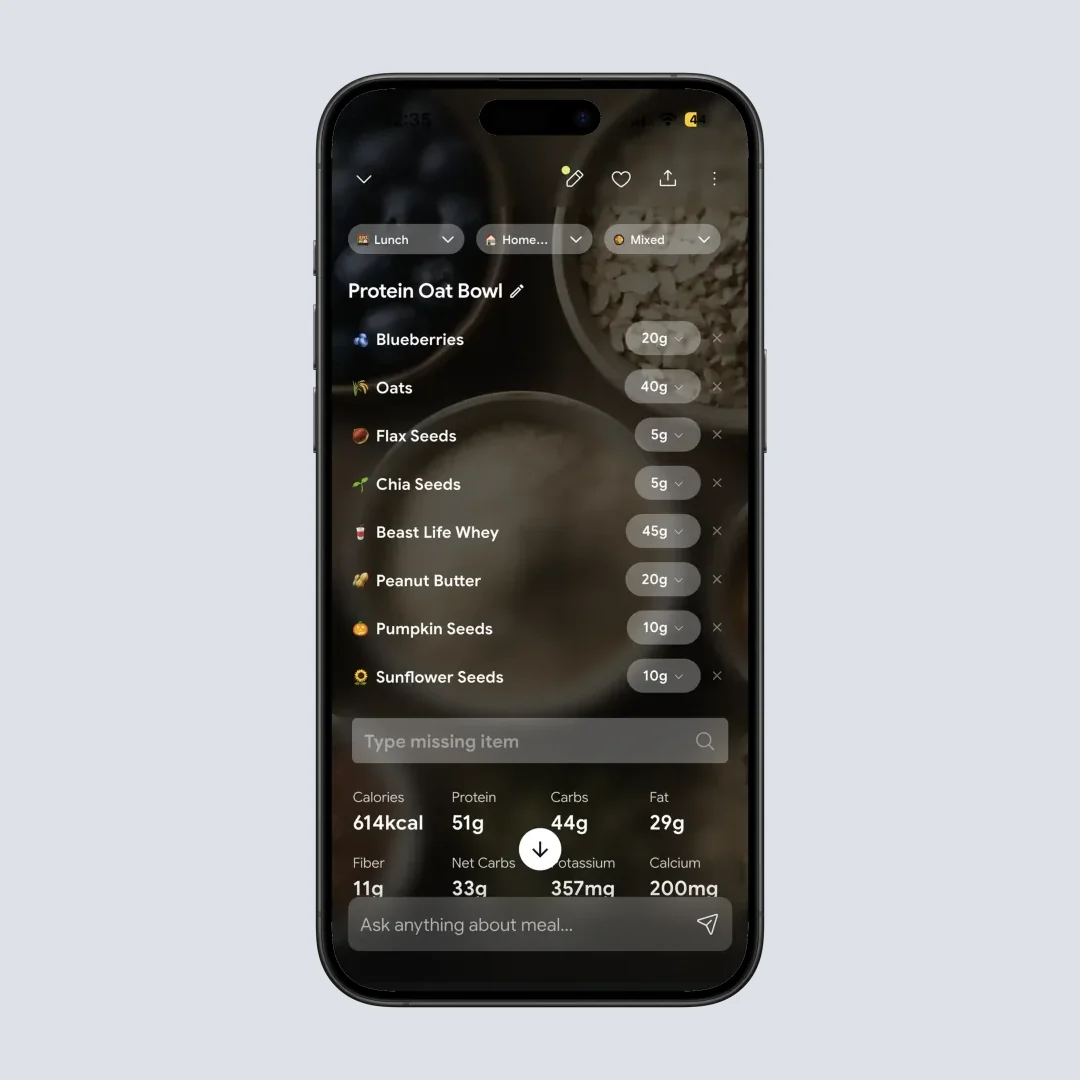
Nutrition Details for a logged meal. Add up the calories on the packaged items and divide by the day's total.
The free plan includes 5 scans a week.
What else do people ask about ultra processed food?
What is ultra processed food?
Ultra processed food is NOVA group 4: industrial formulations made mostly or entirely from substances derived from foods plus additives, with little or no intact whole food. Soft drinks, packaged snacks, mass-produced bread, cookies, sausages, chicken nuggets and instant noodles are all on the NOVA list. The test in practice is the ingredient list, looking for substances you would not find in a home kitchen or additives that change color, flavor or texture.
How much ultra processed food do Americans eat?
The CDC's National Center for Health Statistics reports that US adults got 53.0% of their daily calories from ultra-processed foods between August 2021 and August 2023. Youth aged 1 to 18 got 61.9%. A 2,000 calorie day at 53% is about 1,060 calories from ultra-processed foods.
How much ultra processed food is OK?
No health body has set a safe amount. The 2025-2030 Dietary Guidelines for Americans tell people to limit highly processed foods but give no percentage. The one controlled trial, run at the NIH, found that people ate 508 calories a day more on an ultra-processed diet than on an unprocessed one, so less is the direction every source agrees on.
How much ultra processed food is too much?
There is no published cutoff. A Lancet series from November 2025 reviewed 104 long-term studies and found 92 reported higher risk of at least one chronic disease with more ultra-processed food. Those studies compare groups, so they show a pattern and do not name a threshold.
Are Chomps beef sticks ultra processed?
It depends on who applies NOVA. The Original stick lists grass-fed beef, sea salt, black pepper, celery, red pepper, garlic, cherry and coriander, with no colors, flavor enhancers or sweeteners. NOVA's own list names sausages and other reconstituted meat products as group 4, so a strict rater could still place it there. Chomps has no official NOVA rating, and one stick has 380 mg of sodium.
Is all processed food ultra processed?
No. NOVA has four groups: unprocessed or minimally processed foods, processed culinary ingredients, processed foods and ultra-processed foods. Canned beans, plain cheese and fresh bread made from flour, water, yeast and salt are processed foods in group 3. Group 4 is the one with industrial ingredients and cosmetic additives.