What Are Food Macros? How to Read and Compare Them
 ChatGPT
 Claude
 AI Mode
 Perplexity
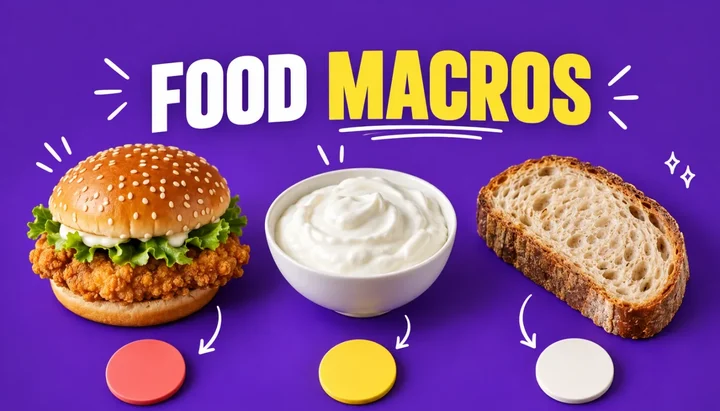
A food's macros are the grams of protein, carbohydrate and fat in one serving. Each gram of protein or carbohydrate supplies about 4 calories and each gram of fat about 9, so the three numbers also tell you where the calories come from. A McChicken has 14 g of protein, 38 g of carbohydrate and 21 g of fat.
Checked on October 11, 2026. McDonald's figures are from the McDonald's USA Nutrition Calculator. Other food figures are from the linked NutriScan food pages. Calorie factors are from the FAO and from US labeling rules in 21 CFR 101.9. Percentages are our own arithmetic.
Summary
- Macros is short for macronutrients: protein, carbohydrate and fat, counted in grams per serving.
- Calories from macros: protein x 4, carbohydrate x 4, fat x 9. The FAO credits these factors to W.O. Atwater's work at the USDA in the 1890s.
- Grams and calories rank the macros differently. A McChicken has more grams of carbohydrate (38) than fat (21), yet fat supplies 48% of its calories.
- Compare foods on the same basis. Use the same weight, or use the share of calories from each macro, which does not change with portion size.
- Daily targets are a separate question. The macro calculator sets those. This article covers reading a single food.
What does "macros" mean when you search for a food?
Macros means macronutrients, the three nutrients that supply the calories in food: protein, carbohydrate and fat. A search for "Greek yogurt macros" or "seitan macros" asks for the grams of each in a serving, usually with the calories alongside. Alcohol supplies calories too, at 7 per gram in the FAO table below, but it is not one of the three.
The serving matters as much as the numbers. "Per 100 g", "per sandwich" and "per cup" give three different sets of macros for the same kind of food, so read the serving line first.

How many calories are in a gram of protein, carbs and fat?
Protein and carbohydrate each provide 4 calories per gram, and fat provides 9. The USDA's Food and Nutrition Information Center states it in one line: "Carbohydrates provide 4 calories per gram, protein provides 4 calories per gram, and fat provides 9 calories per gram."
These are the Atwater general factors. The FAO's report on food energy says the system "was developed by W.O. Atwater and his colleagues at the United States Department of Agriculture (USDA) Agricultural Experiment Station in Storrs, Connecticut at the end of the nineteenth century".
| Nutrient | Calories per gram | Kilojoules per gram |
|---|---|---|
| Protein | 4 | 17 |
| Carbohydrate | 4 | 17 |
| Fat | 9 | 37 |
| Alcohol | 7 | 29 |
Source: FAO Food and Nutrition Paper 77, chapter 3.
US food labels use the same numbers. The FDA's nutrition labeling rule, 21 CFR 101.9, allows calories to be calculated using "the general factors of 4, 4, and 9 calories per gram for protein, total carbohydrate, and total fat".
How do you read a food's macros?
Read the serving size, then the grams of protein, carbohydrate and fat. Multiply each by its factor to see how many calories it supplies, and divide by the total to get its share. The share shows what kind of food you are looking at, and it stays the same whether you eat half a serving or two.
Here is the sum for one McChicken:
- Protein: 14 g x 4 = 56 calories.
- Carbohydrate: 38 g x 4 = 152 calories.
- Fat: 21 g x 9 = 189 calories.
- Total: 56 + 152 + 189 = 397 calories. The menu lists 390.
- Shares: protein 56 / 397 = 14%, carbohydrate 152 / 397 = 38%, fat 189 / 397 = 48%.
By weight the sandwich holds almost twice as much carbohydrate as fat. By calories, fat is the largest part, because a gram of fat carries more than twice the calories of a gram of carbohydrate.
What are the macros of the foods people search for most?
These 19 foods are among the ones people most often look up with the word "macros". McDonald's rows use the McDonald's USA Nutrition Calculator, read on October 11, 2026. Every other row uses the serving and figures on the linked NutriScan food page.
| Food | Serving | Calories | Protein | Carbs | Fat | Calories from protein / carbs / fat |
|---|---|---|---|---|---|---|
| McDonald's McChicken | 1 sandwich | 390 | 14 g | 38 g | 21 g | 14% / 38% / 48% |
| McDonald's Egg McMuffin | 1 sandwich | 310 | 17 g | 30 g | 13 g | 22% / 39% / 38% |
| Popeyes Chicken Sandwich | 1 sandwich | 700 | 28 g | 50 g | 42 g | 16% / 29% / 55% |
| KFC Popcorn Chicken | 1 order | 620 | 23 g | 40 g | 41 g | 15% / 26% / 59% |
| David protein bar | 1 bar (45 g) | 150 | 28 g | 8 g | 5 g | 59% / 17% / 24% |
| Greek yogurt, plain nonfat | 100 g | 59 | 10.2 g | 3.6 g | 0.4 g | 69% / 24% / 6% |
| Tuna, cooked | 100 g | 132 | 29 g | 0 g | 1.3 g | 91% / 0% / 9% |
| Seitan, prepared | 100 g | 120 | 21 g | 7 g | 2 g | 65% / 22% / 14% |
| Bone broth | 1 cup (240 ml) | 45 | 10 g | 0 g | 1 g | 82% / 0% / 18% |
| Nutritional yeast | 2 tbsp (16 g) | 50 | 8 g | 5 g | 0.5 g | 57% / 35% / 8% |
| Ceviche | 1 cup (250 g) | 158 | 26.2 g | 8.9 g | 1.9 g | 67% / 23% / 11% |
| Burrata | 100 g | 330 | 18 g | 1 g | 28 g | 22% / 1% / 77% |
| Beef pho | 1 bowl (600 g) | 450 | 28 g | 55 g | 10 g | 27% / 52% / 21% |
| Pad thai with shrimp | 1 serving (250 g) | 350 | 15 g | 40 g | 14 g | 17% / 46% / 36% |
| Acai bowl | 1 bowl (350 g) | 388 | 8 g | 62 g | 12 g | 8% / 64% / 28% |
| Spam musubi | 1 piece (165 g) | 253 | 6 g | 42 g | 6 g | 10% / 68% / 22% |
| Sourdough bread | 1 slice (50 g) | 136 | 5.4 g | 26 g | 1.2 g | 16% / 76% / 8% |
| Couscous, cooked | 1 cup (157 g) | 180 | 6 g | 37 g | 0.3 g | 14% / 85% / 2% |
| Gnocchi, cooked | 1 cup (140 g) | 183 | 4.8 g | 35 g | 0.7 g | 12% / 85% / 4% |
The last column is each macro's calories (grams x 4, 4 or 9) divided by the sum of the three, rounded to a whole percent, so a row can add up to 99 or 101. Restaurant and homemade dishes such as pho, pad thai, ceviche and acai bowls vary with the recipe. Where our nutrition numbers come from is on the NutriScan data sources page.
The table sorts into three groups. Tuna, bone broth, Greek yogurt, ceviche and seitan get about two thirds or more of their calories from protein. Couscous, gnocchi, sourdough and spam musubi are mostly carbohydrate. Burrata and the fried chicken items get about half or more of their calories from fat.
Why don't the macros add up to the calories on the label?
The 4, 4 and 9 sum rarely matches the printed calories exactly, and the labeling rules explain most of the gap. 21 CFR 101.9 has calories above 50 stated to the nearest 10, and protein and carbohydrate to the nearest gram. That is how 397 becomes 390 on the McChicken.
The same rule gives makers other methods to choose from:
- Fiber. Calories may be calculated on total carbohydrate "less the amount of non-digestible carbohydrates and sugar alcohols", with 2 calories per gram for soluble non-digestible carbohydrate.
- Specific factors. A maker may use the food-specific Atwater factors in USDA Handbook No. 74 in place of the general 4, 4 and 9.
The David bar in the table shows how large the difference can get. Its label reads 150 calories, while 28 g of protein, 8 g of carbohydrate and 5 g of fat come to 189 with the general factors. We have not confirmed which method the maker uses, so read that row's percentages as shares of the 189.

How do you compare two foods by their macros?
Put both foods on the same basis first. Compare them at the same weight, or compare the share of calories from each macro. Per-serving numbers mislead when the servings differ, as a 16 g spoonful of nutritional yeast and a 600 g bowl of pho do.
Two comparisons from the table show how the basis changes the answer.
Burrata and Greek yogurt, per 100 g. Burrata has more protein by weight, 18 g against 10.2 g. It also has 330 calories against 59. Per 100 calories, burrata gives 5.5 g of protein and nonfat Greek yogurt gives 17.3 g, about three times as much.
Popeyes Chicken Sandwich and McChicken. The Popeyes sandwich has twice the protein, 28 g against 14 g. It also has 700 calories against 390, so protein supplies 16% of its calories against 14% for the McChicken. The portion is much bigger and the protein share barely moves.
To compare any two McDonald's items this way, the McDonald's nutrition calculator adds up an order from the same official figures.
What is a good macro split?
There is no single correct split for a food. For a whole day of eating, the National Academies set Acceptable Macronutrient Distribution Ranges for adults: 45 to 65% of calories from carbohydrate, 20 to 35% from fat and 10 to 35% from protein.
Those ranges apply to the day. Tuna at 91% protein and burrata at 77% fat both sit far outside them, and both can be part of a day that lands inside.
For your own daily numbers in grams, use the macro calculator or the protein intake calculator. There are separate versions for diabetes, PCOS and pregnancy.
A note on health
This article is general information. If you are pregnant or manage diabetes, kidney disease or another condition, your protein, carbohydrate and fat targets should come from your doctor or dietitian.
How do you see the macros of a meal you actually ate?
A food page gives you macros for a standard serving, and most meals mix several foods in other amounts. NutriScan reads a photo of the meal, lists each food it finds, and shows calories, protein, carbs and fat for each item and for the whole meal.

Nutrition Details for a logged meal. Each item has a portion you can change, and the macros update with it.
Photo estimates miss sometimes, mostly on portion size and hidden oil, and our article on how accurate AI calorie counters are covers the published tests. Edit Macros lets you type in the numbers from a label. On the home screen, Today's Count shows protein, carbs and fat as grams eaten against your daily targets.
The free plan includes 5 scans a week. The app has 150k+ downloads and a 4.6 star rating.
What else do people ask about food macros?
What does macros mean for a food?
Macros is short for macronutrients. For a food, it means the grams of protein, carbohydrate and fat in a stated serving, usually listed next to the calories. A search such as "McChicken macros" is asking for those three numbers: 14 g of protein, 38 g of carbohydrate and 21 g of fat in one sandwich.
How do you calculate calories from macros?
Multiply protein grams by 4, carbohydrate grams by 4 and fat grams by 9, then add the three results. These are the Atwater general factors, which FDA labeling rules allow under 21 CFR 101.9. A McChicken works out to 56 + 152 + 189 = 397 calories, and the menu lists 390 after rounding.
What are the macros of a McChicken?
One McChicken has 390 calories, 14 g of protein, 38 g of carbohydrate and 21 g of fat, according to the McDonald's USA Nutrition Calculator on October 11, 2026. About 48% of its calories come from fat, 38% from carbohydrate and 14% from protein.
What are the macros of Greek yogurt?
Plain nonfat Greek yogurt has 59 calories, 10.2 g of protein, 3.6 g of carbohydrate and 0.4 g of fat per 100 g on the NutriScan food page. About 69% of its calories come from protein. Full-fat and flavored versions have different numbers, so check the label of the tub you buy.
Why don't the macros add up to the calories on the label?
Three things move the total. US labels round calories to the nearest 10 above 50 calories, and protein and carbohydrate to the nearest gram. Makers may subtract non-digestible carbohydrate such as fiber before applying the factor of 4. They may also use food-specific Atwater factors in place of 4, 4 and 9.
What is a good macro ratio?
The National Academies set Acceptable Macronutrient Distribution Ranges for adults of 45 to 65% of calories from carbohydrate, 20 to 35% from fat and 10 to 35% from protein. Those ranges describe a whole day of eating. A single food can sit far outside them and still fit the day.