Best App for PCOS Meal Tracking: 5 Apps Compared
 ChatGPT
  Claude
  AI Mode
  Perplexity
TL;DR - Best PCOS Meal Tracking Apps
Short answer: the best app for PCOS meal tracking is Cronometer if you want to chart symptoms against nutrients, and NutriScan if photo-logging real home-cooked meals is the part that keeps ending your food diary. Prices here are standard US prices as published in July 2026 and change by region and promotion.
• Best nutrient detail and symptom patterns: Cronometer. Gold's custom biometrics let you invent a cramp score and chart it against fiber. Free, Gold $59.99 a year.
• Best if you want a professional: Nourish, registered dietitian video visits billed through insurance. United States only.
• Best for logging real home-cooked meals: NutriScan. Photograph the plate, tag the cooking method and oil level, get macros plus micronutrients. 5 free scans a week, Premium about $59 a year.
• Biggest free database: MyFitnessPal. No PCOS features at all, and that is fine for some people. Best in India: Uvi Health.
• The honest note: NutriScan has no cycle log and no symptom diary. We do the food half. Pair us with something that does the pattern half.
In a 12-week diet trial for women with PCOS, 100% of participants turned up for their body measurements and blood tests, but only 69% of their food records came back (Scannell et al., 2025). Same women, same study, same 12 weeks. The measurement that needed a researcher was completed. The measurement that needed the participant to write down her own dinner was not.
As a NutriScan nutritionist, I think about that gap more than any accuracy statistic. PCOS affects an estimated 10% to 13% of women of reproductive age, and up to 70% of cases go undiagnosed worldwide (World Health Organization, January 2026). Most of those women are told to change how they eat, with almost no support for the part that is genuinely hard: noticing what their own food is doing to their own body, week after week, for years.
This guide ranks five apps for that job, names the one free app worth installing next to whichever you pick, and is direct about where NutriScan falls short.
IMPORTANT
Your PCOS tracking plan at a glance.
A quick roadmap so you can pick before you pay for anything.
⏱️ Progress 0/4 • ~0 minutes in • Keep going
⏳ Step 1: What PCOS actually asks of a food app
⏳ Step 2: The three jobs I ranked on
⏳ Step 3: All 5 apps, ranked and priced
🔍 The 5-step setup that survives past week two (revealed near the end)
What PCOS Actually Asks of a Food App 🩺
Start with what the evidence does not say, because it saves you money.
There is no official PCOS diet. The 2023 international evidence-based guideline states it plainly: recognizing the benefits of many diet and physical activity regimens, there is no one specific regimen that has benefits over others in PCOS (Teede et al., 2023, Journal of Clinical Endocrinology and Metabolism). A companion review of the guideline's lifestyle recommendations adds that in women with PCOS, there is no or limited evidence that any specific energy equivalent diet type is better than another (Cowan et al., 2023, BMC Endocrine Disorders).
So any app selling you a proprietary hormone-balancing eating plan is selling packaging. What the guideline does support, where weight loss is a goal, is a practical energy deficit of roughly 30%, or 500 to 750 calories per day, adjusted for your body and activity (Cowan et al., 2023).
And weight loss is not the only reason to track. WHO is specific on this point: healthy lifestyle behaviors, including healthy eating and physical activity, are important for all women with PCOS, even if they do not lead to weight loss (WHO, 2026).
That single sentence should shape your choice of app. If the app only knows how to celebrate a falling number on a scale, it will make you feel like a failure during the months when your energy, your cycles and your skin are improving and your weight is flat.
Three PCOS Days That Break a Generic Calorie App 📉
Before the ranking, here is what actually goes wrong.
Whichever app you land on, you need numbers to log against. The free PCOS macro calculator gives you daily calorie and macro targets in about a minute.
The 1,400-calorie day that felt terrible. Two coffees, a sandwich, a large evening meal. The calorie total looks correct, so the app shows a green ring for the day. Fiber was low, protein was low, and most of the carbohydrate arrived after 8pm. Nothing in that green ring explains the afternoon energy crash.
The month where everything shifted at once. New job, less sleep, more takeaway food, worse cramps, worse skin. Something in there is driving symptoms. Without a record that holds food and symptoms in the same place, you are guessing, and PCOS advice online will happily supply you with a dozen confident guesses.
The home-cooked dinner nobody can log. Dal, two rotis, a vegetable cooked in an unmeasured amount of oil. There is no barcode. Manual search returns a long list of similar entries with a wide calorie spread between them, and no way to tell which one matches your kitchen.
 This is where most food diaries quietly end, in week two, at the meal that takes four minutes to enter.
IMPORTANT
Checkpoint: here's where you are right now.
Quick status update so you always know the next best move.
⏱️ Progress 1/4 • ~2 minutes in • Keep going
✅ Step 1: What PCOS actually asks of a food app (done)
👉 Step 2: The three jobs I ranked on (you're here)
⏳ Step 3: All 5 apps, ranked and priced
🧩 The 5-step setup that survives past week two (coming soon)
How I Ranked These PCOS Meal Tracking Apps 📋
I judged each app on three jobs, in this order.
Job 1: Can it show the nutrients PCOS guidance actually talks about? Not just calories. Fiber, protein, carbohydrate quality and total fat, visible per meal and per day, so you can act on Tuesday rather than at a doctor visit in five months.
Job 2: Can it connect food to patterns? Cycle dates, symptoms, energy, weight, labs. PCOS is a long condition with a slow feedback loop. An app that stores only calories cannot answer the question you actually have, which is what changed and did it help.
Job 3: Can you keep doing it? Logging a real home-cooked meal in seconds, not minutes. Meal plans for when decision-making runs out. A human being for when the plan needs judgment. The Scannell trial is the warning: food records are the step people abandon, even with researchers checking in.
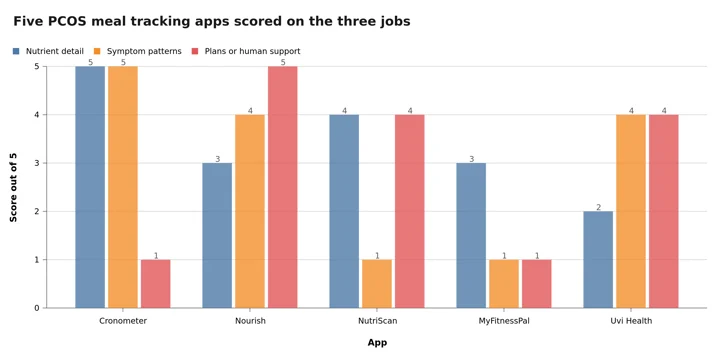 Figure 1: My own scoring of the five apps against the three jobs, not an independent rating. Read the shape rather than the numbers: no single app clears all three columns, which is why most people here end up with two apps.
Detailed logging is not right for everyone
If tracking pulls you toward restriction, guilt or bingeing, the correct app is no app, and the correct next step is a conversation with a clinician who treats disordered eating. Nothing below is worth that cost.
IMPORTANT
Checkpoint: midway progress update.
You're past the theory. The ranking starts now.
⏱️ Progress 2/4 • ~4 minutes in • Keep going
✅ Step 1: What PCOS actually asks of a food app (done)
✅ Step 2: The three jobs I ranked on (done)
👉 Step 3: All 5 apps, ranked and priced (current)
🧩 The 5-step setup that survives past week two (next)
1. Cronometer: Best for Nutrient Detail and Symptom Patterns 🥇
Cronometer wins because it is the only mainstream tracker that can hold your food and your symptoms in one dataset and chart them against each other.
The free plan covers what job 1 needs: fiber, protein, carbohydrates, fat and a long micronutrient list from verified data sources, plus a barcode scanner that stays free. That already puts it ahead of most calorie apps, which treat fiber as an afterthought.
Job 2 is where it separates. Gold adds Custom Biometrics, which lets you define and log a metric the app does not ship with. Cycle day, cramp severity on a 1 to 10 scale, acne, sleep hours, mood, a lab result. Gold also builds custom charts that correlate any two data points over time, so you can plot fiber intake against sleep, or carbohydrate intake against a symptom score you defined yourself (our Cronometer Gold review). That is a real pattern engine, not a marketing claim about hormones.
Gold costs $4.99 per month billed annually, charged as $59.99 upfront, or $10.99 per month billed monthly. Exports are straightforward, which matters if you want to take six months of eating to an endocrinologist.
Honest limits: it is the least friendly app here to log a mixed curry in, the interface is dense, and it has no PCOS content, no meal plans and no coaching. You are buying a precise instrument, not guidance. If you want more on this side of tracking, we compared the options in best app for micronutrient tracking.
Choose Cronometer if you want to run experiments on yourself and see your own symptom score plotted against your own nutrition.
2. Nourish: Best if You Want a Registered Dietitian 👩⚕️
If your real problem is not the logging but not knowing what to do with it, skip the app-only options.
Nourish connects you with registered dietitians by video, with food logging, symptom notes and messaging built around that relationship rather than replacing it. Its PCOS page states that it accepts hundreds of insurance plans in all 50 states and that 94% of Nourish patients pay $0 out of pocket (Nourish PCOS page, checked July 2026). That claim is the company's own, and what you pay depends entirely on your plan, so verify your coverage before your first session.
Why this ranks second rather than fifth: a dietitian is the only option here that can read your log and tell you which single change to make next. The guideline's answer to what should I eat is that no one regimen wins, which is deeply unsatisfying until a professional turns it into your groceries.
Go in with realistic expectations. Interviews with 12 women receiving telehealth nutrition care for PCOS found it acceptable and convenient, but often underpersonalized and psychologically undersupported, with the researchers calling for individual metabolic data, mental health screening and dietitian-initiated follow-ups (Chen et al., 2025, Journal of Medical Internet Research). That was a small qualitative study in China rather than a review of Nourish, so read it as the shape of a common complaint: bring your own tracked data to the session, and ask directly for a follow-up date.
Honest limits: United States only, which rules it out for most of the world. It is a care service, not a PCOS tracker, so the food log is a means to a conversation. And insurance-based pricing is the least predictable model on this list.
Choose Nourish if you are insured in the US and you would rather ask a qualified person than read a chart.
3. NutriScan: Best for Photo Logging Real Meals 📸
This is our app, so here is the shortest possible summary of what it does and does not do.
It does job 1 and job 3 well. You photograph the plate, crop it, and tag the meal on the nutrition details screen: the meal time, one of 8 food types, one of 11 cooking methods, and an oil level across 4 steps from No Oil to High Oil. Those tags are the two things a flat photo cannot see and the two things that decide whether a home-cooked dinner was 500 or 800 calories. You get calories, protein, carbohydrates and fat, the top 4 micronutrients ranked high to low with fiber usually leading, and a NutriScore band on every meal (NutriScan for PCOS).
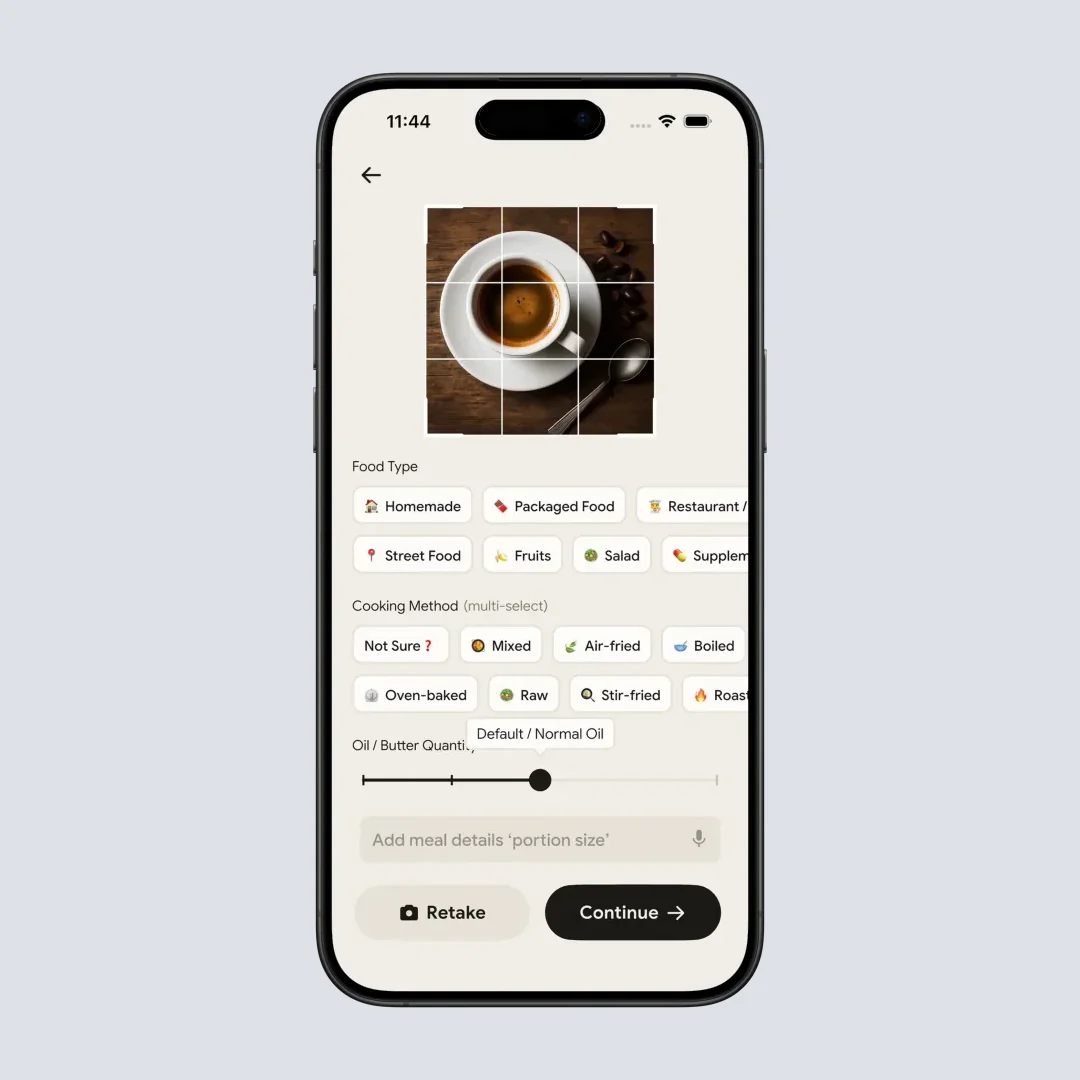
Home > Camera Icon > Click Picture > Crop Picture. The oil and cooking method prompts are the difference between a guess and a number. More in our meal scan guide.
Choosing PCOS as your goal shapes a 28-day plan built from your cuisine preferences, food restrictions, eating schedule and daily routine, which answers the plans half of this topic. That plan is a Premium feature; the free tier gives you the scanning, the macros and the micronutrients without it. Manual text entry, voice input and copying an earlier meal are all there, so a repeat breakfast takes one tap.
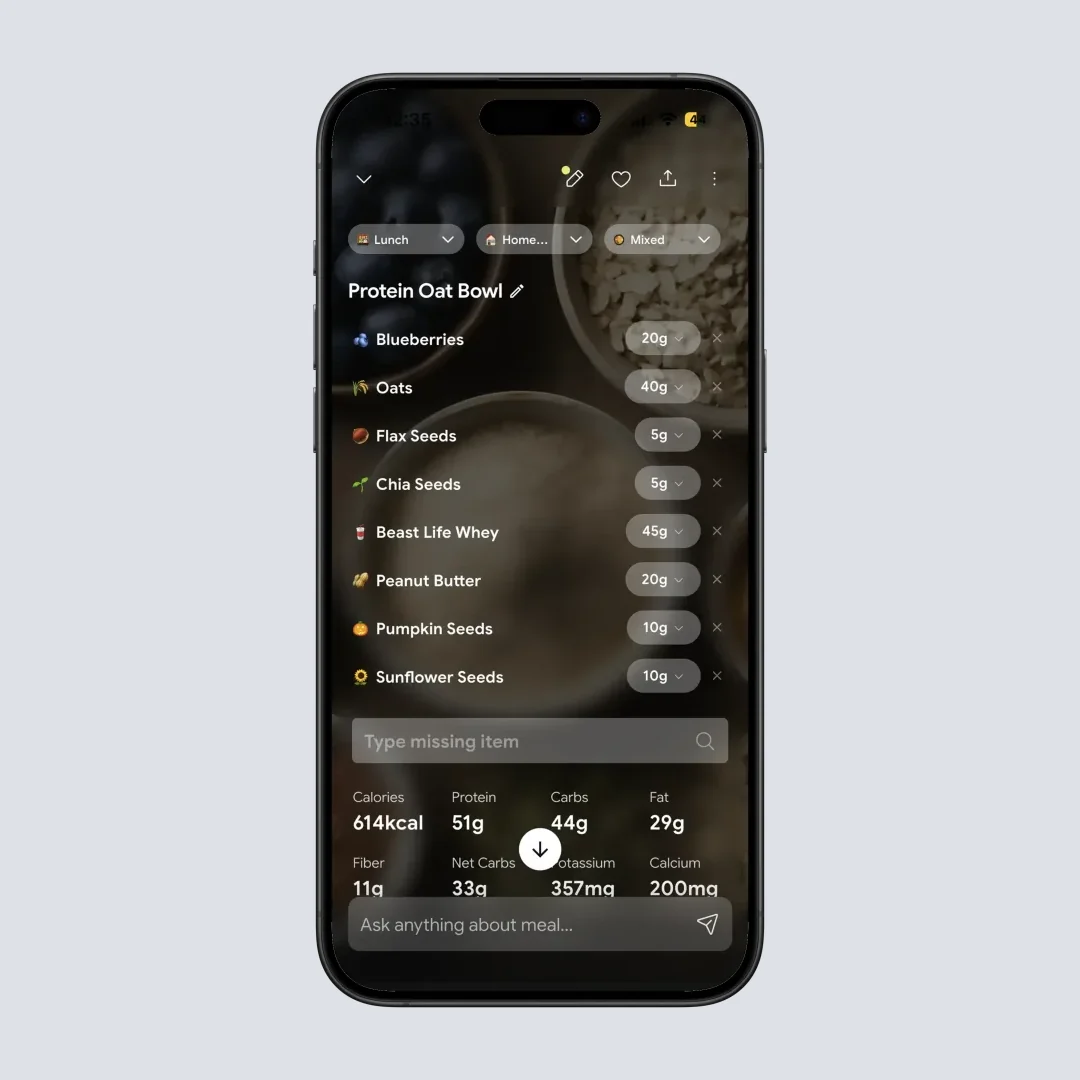
Home > Meal Item. Fiber usually leads the micronutrient list on a PCOS-shaped plate, which is exactly the number tip 1 below asks you to watch. More in our NutriScore guide.
The free plan covers 5 photo scans a week and 4 Monika voice calls a week; Premium is about $59 a year in the US (NutriScan pricing guide). Five scans a week is 0.7 meals a day, so treat it as a test rather than a daily habit: it is enough to run the scanner on the meals that usually break a food database, your curries, your restaurant plates, your mixed bowls, before you decide whether the prompts are worth paying for.
It does not do job 2. There is no cycle tracking, no period log, no symptom diary and no chart that puts a cramp next to a carbohydrate total. If the pattern question is the reason you are searching, we are not the complete answer, and any page telling you otherwise is overselling. The sensible setup is our app for the food half and a dedicated cycle app, or Cronometer with custom biometrics, for the pattern half.
Also honest: a photo scan takes around 20 seconds because of those follow-up tags, which is slower than a barcode, and micronutrient depth does not match Cronometer's (our own NutriScan Premium review).
Choose NutriScan if logging real home-cooked meals takes so long that it quietly ends your food diary in week two.
4. MyFitnessPal: Best Free Database and Cheapest Starting Point 💸
MyFitnessPal has nothing PCOS-specific. It ranks because the largest food database in the category is a genuine advantage when you eat food that no PCOS app has ever heard of, and because you can start for free today.
Its free tier logs calories and macros and covers most packaged products in most countries. Premium at $79.99 per year adds macro goals by meal, food analysis and the barcode scanner (our MyFitnessPal pricing guide). For a PCOS user, the useful Premium feature is per-meal macro targets, since spreading protein and fiber across the day is more actionable than one daily total.
Honest limits: much of the database is user-submitted, so entry quality varies and two entries for the same food can differ substantially. There is no symptom tracking, no cycle log and no PCOS education. It is a large, cheap, plain food diary, and for some people that is exactly right. If carbohydrate distribution is your focus, the reasoning in best app for tracking carbs transfers well to insulin resistance in PCOS.
Choose MyFitnessPal if your budget is the binding constraint and you eat a lot of packaged food.
5. Uvi Health: Best PCOS-Specific Option in India 🍛
Uvi Health: PCOS Diet & Fitness is the strongest diet-focused PCOS app in the only independent quality assessment I could find. In a review of 15 PCOS apps, it scored a mean 4.42 out of 5 on the Mobile App Rating Scale, second overall behind an information-only app, and a maximum 5.00 for design and appeal, with cycle tracking, recipes, exercise plans and doctor consultations, at 4.4 stars from 195 ratings and more than 50,000 downloads (Arabkermani et al., 2025, Journal of Medical Internet Research).
It is the only app on this list built around Indian food and Indian clinical practice, which matters if your meals are dal, roti, idli and sabzi rather than salads. If that is your kitchen, the food-side thinking in our low-GI Indian PCOS meal prep playbook pairs well with it.
Honest limits: this is a program with a community and consultations, not a precise nutrient tracker, and it needs a login and an internet connection. The independent scores describe the app as it was assessed in June 2024, and both features and pricing change. Its own marketing leans toward fertility programs. Check the current store listing and what a paid program includes before you commit money.
Choose Uvi Health if you are in India and want PCOS-specific food guidance in your own cuisine.
The Free PCOS App Worth Installing Next to Any Tracker 🆓
AskPCOS is not a food diary, so it is not in the ranking, but it scored highest overall for quality in that same 15-app review at 4.48 out of 5, and it is free with no in-app purchases (Arabkermani et al., 2025).
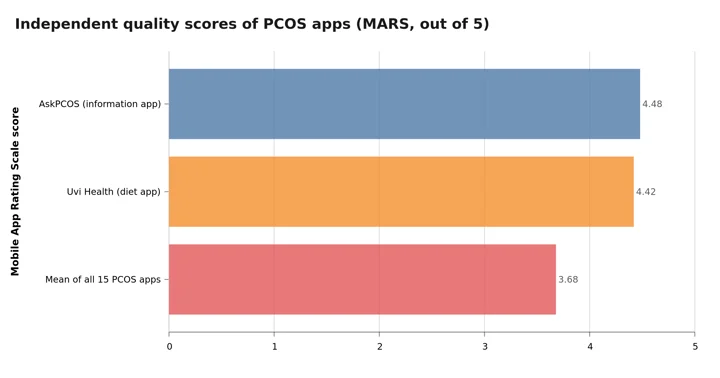 Figure 2: The two best-scoring PCOS apps against the average of the 15 assessed. The gap between 4.4 and 3.68 is the reason a strong general tracker usually beats a weak PCOS-branded one.
It was developed at Monash University by the faculties behind the international PCOS guideline (Monash Innovation), and it tracks symptoms, activity and cycle, includes a self-assessment tool, a moderated forum and a list of questions to take to your next appointment.
Pair it with whichever tracker you choose: one app for the food numbers, one app for reliable information and the symptom record.
One caution about AskPCOS before you rely on it
The version listed in the store dated from December 2021 when the researchers assessed it in June 2024. Treat it as a reference library from a trustworthy source rather than a product in active development, and check the guideline itself if a detail matters clinically.
PCOS Apps Compared: The Quick Table 📊
| App | Nutrient detail | Symptom or cycle patterns | Plans or human support | Price (July 2026) | Best for |
|---|---|---|---|---|---|
| Cronometer | Strongest, fiber and micros | Yes, custom biometrics and charts (Gold) | No | Free, Gold $59.99/yr | Precision and self-experiments |
| Nourish | Via your dietitian | Symptom notes reviewed by a person | Registered dietitian video visits | Insurance-based, US only | Wanting a professional plan |
| NutriScan | Good, macros plus fiber and oil prompts | No | 28-day PCOS plan (Premium), Monika voice AI | Free, 5 scans/wk, about $59/yr | Photo logging home-cooked meals |
| MyFitnessPal | Basic macros | No | No | Free, Premium $79.99/yr | Biggest database, lowest cost |
| Uvi Health | Light | Cycle tracking | Recipes, doctor consults | Free with in-app purchases | India-specific PCOS support |

What the Research Says About PCOS Apps 📚
Digital tools do help, and the honest version of that sentence has a caveat attached.
A 2026 systematic review with meta-analysis pooled 10 trials covering 930 women with PCOS and found that digital health interventions improved BMI (mean difference -1.19, 95% CI -1.84 to -0.55), waist circumference (mean difference -2.14, 95% CI -3.11 to -1.17), overall healthy lifestyle scores, physical activity, stress management, depression and anxiety (Zeng et al., 2026, Frontiers in Endocrinology).
Read the one outcome that did not reach significance, because it is the most useful line in the paper for anyone choosing an app. The nutrition subscale improved by 0.83 with a confidence interval of -0.11 to 1.78, which crosses zero. Body measurements, activity, mood and stress moved. Eating behavior, measured on its own, did not clearly move. The authors also flag small trial numbers, short follow-up and possible publication bias, and the interventions studied were messaging programs and multidisciplinary support, not consumer calorie apps.
My reading: an app is very good at producing a record and moderately good at prompting activity, and it does not by itself change how you eat. The change comes from what you or a professional do with the record.
The app market itself deserves skepticism. In that 15-app review, mean quality was 3.68 out of 5, and while every app offered a free version, 11 of 15 used in-app purchases and one gated close to 90% of its features behind a subscription. The lowest-rated app in the set held one star and had not been updated since 2018. The authors conclude that many apps scored low in informational quality and engagement, limiting their effectiveness for people with PCOS (Arabkermani et al., 2025). Note the sample was drawn from Google Play and one regional store in June 2024, so iOS-only apps were not assessed. A scoping review of digital technology use by women with PCOS reached a similar place, describing an active but uneven field (Wright et al., 2025).
That is the case for picking a strong general tracker over a weak PCOS-branded one.
Seven Tips for PCOS Meal Tracking That Lasts 💡
1. Track fiber and protein before calories. Both are things you can change deliberately at every meal. A calorie total only reports what already happened; fiber and protein tell you what to put on the plate now.
2. Log the oil. A tablespoon of cooking oil is around 120 calories (USDA FoodData Central), and a curry or a stir fry can hide three of them. If your app does not ask about cooking fat, add it yourself as a separate line.
3. Give yourself a symptom scale of 1 to 5. Energy, cramps, skin, sleep. Five seconds a day. Without it, six months of food data cannot answer a single question about your symptoms.
4. Mark cycle day 1 in the same app if you can. Comparing your food data by cycle phase is far more informative than comparing it week by week, because appetite and cravings are not constant across a cycle.
5. Do not chase a target weight only. WHO is explicit that healthy eating and activity matter for women with PCOS even when they do not produce weight loss (WHO, 2026). Add a second measure you can win at, such as fiber days hit or walks completed.
 Walks completed is a measure you can win at during the months your weight refuses to move.
6. Choose an eating pattern you can repeat, not the strictest one. A 12-week trial of a Mediterranean pattern without calorie restriction was feasible and acceptable for women with PCOS and improved diet adherence and waist circumference, though it was small at 26 participants and underpowered (Scannell et al., 2025). The pattern matters less than your ability to keep it.
7. Plan for the month you stop. Everyone stops. Decide now what your minimum version looks like: photograph dinner only, or log one symptom score a day. A thin record you maintain beats a perfect record you abandon in week three.
IMPORTANT
Checkpoint: final stretch before the reveal.
One last nudge, the setup is next.
⏱️ Progress 3/4 • ~7 minutes in • Keep going
✅ Step 1: What PCOS actually asks of a food app
✅ Step 2: The three jobs I ranked on
✅ Step 3: All 5 apps, ranked and priced
✨ The 5-step setup that survives past week two (about to reveal)
The 5-Step Setup That Survives Past Week Two 🧩
The setup I promised at the top works in every app on this list, and it is the reason the Scannell number matters more than any feature comparison. Sixty-nine percent of food records came back from women who had already agreed to be in a study. Your odds without a protocol are worse.
Step 1: Write down the question you want answered. Is it weight, energy, cycle regularity, or preparing for a doctor's appointment? The answer decides your app. Pattern questions need Cronometer or a PCOS app. Do-not-know-what-to-eat questions need a dietitian. Log-my-real-dinner questions need photo logging.
Step 2: Set targets you can defend. If weight loss is the goal, a deficit of roughly 500 to 750 calories a day is the guideline's practical starting point (Cowan et al., 2023). Our PCOS macro calculator turns that into protein, carbohydrate and fat numbers, and any app here lets you override its defaults. If you want the general version, the macro calculator does the same job without the PCOS shaping.
Step 3: Log three normal days before changing anything. Not three good days. You cannot adjust a diet you have not measured, and the first honest week is usually the most informative data you will ever collect.
Step 4: Add exactly one pattern field. A symptom score, cycle day, or sleep hours, in the same app as your food if possible. One field, every day. Two fields is where people quit.
Step 5: Review on a fixed day, once a week. Fifteen minutes. Look for one connection and make one change. Daily review turns normal fluctuation into anxiety, and monthly review is too slow to correct anything.
The weekly review, in five rows
| What you record | Why it matters for PCOS |
|---|---|
| Fiber and protein, per day | The two levers you can pull at the next meal, not the next month |
| Your 1 to 5 symptom score | Turns "I felt awful this month" into something you can plot |
| Cycle day | Appetite and cravings are not constant, so week-by-week comparison misleads |
| Cooking oil, logged separately | Three unmeasured tablespoons is 360 calories a generic entry never sees |
| Days logged out of 7 | The honest measure of whether the app you chose actually fits your life |
Five rows. That table is the product, and it is what you take to an endocrinologist instead of a feeling.
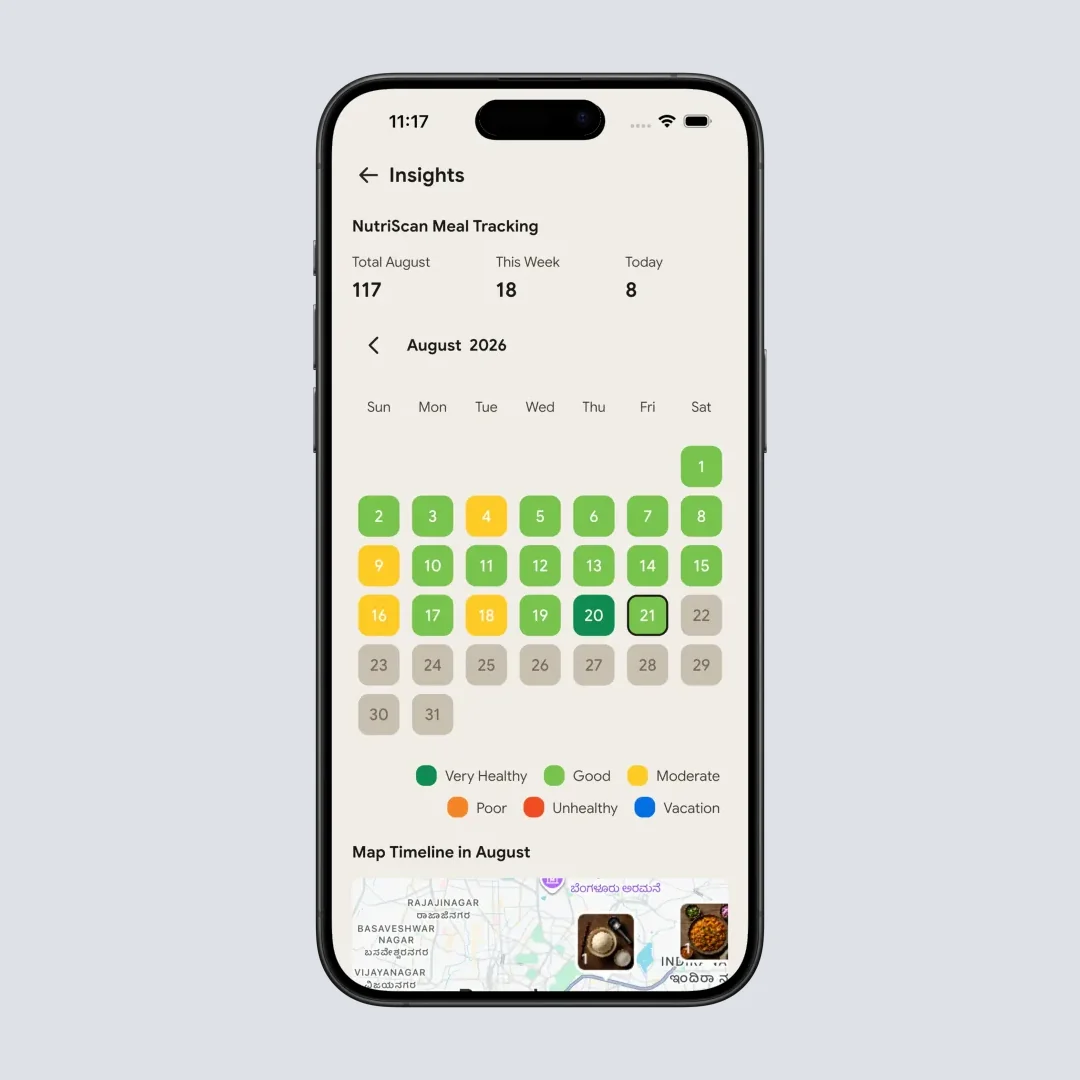
Home > Bottom Nav - Progress. The month view answers row five without any arithmetic, which is the only row that predicts whether the other four will still exist in March. More in our insights guide.
The sequence I actually recommend
Install the free tier of your chosen tracker and AskPCOS on the same evening. Run steps 1 and 2 that night, steps 3 and 4 for one week, and your first review on the following Sunday. Pay for nothing until after that first review, because the review is what tells you which paid feature you actually need.
Why weekly and not daily
PCOS feedback loops run in weeks and cycles, not hours. A daily check-in shows you noise: water weight, sleep debt, a single salty dinner. You will read that noise as failure and quit. The weekly cadence is slow enough to average out the noise and fast enough that a bad pattern gets caught inside one cycle rather than after six.
If a structured week of meals would remove some of the decisions, our diet plan guide covers what the 28-day PCOS plan actually produces.
IMPORTANT
Recap: everything you covered this round.
You finished the run, save this for the evening you install something.
⏱️ Progress 4/4 • ~9 minutes in • Nicely done
✅ Step 1: What PCOS actually asks of a food app
✅ Step 2: The three jobs I ranked on
✅ Step 3: All 5 apps, ranked and priced
✅ The 5-step setup: pick your question ➡️ set defensible targets ➡️ three normal days ➡️ one pattern field ➡️ one weekly review (revealed)
The Verdict: Which One Should You Pay For? ✅
If you want to run experiments on yourself and see connections between food and symptoms, buy Cronometer Gold at $59.99 per year. It is the only app here that charts your own defined metric against your nutrition.
If you are in the United States and insured, book Nourish first and worry about tracking apps afterwards. A dietitian who reads your log is worth more than any feature list.
If your problem is that logging real home-cooked meals takes too long and quietly ends your food diary in week two, that is the problem NutriScan was built for. Five free photo scans a week is enough to find out whether photo logging suits your kitchen. Choose PCOS as your goal so your macro targets and plan are shaped for it, then add AskPCOS or a cycle app for the pattern half we do not cover.
If your budget is limited, MyFitnessPal free plus a paper symptom note works. If you are in India and want PCOS-specific food guidance, look at Uvi Health.
Whichever you choose, install AskPCOS alongside it. It is free, it comes from the university group behind the international guideline, and it is a better source than most of what search results will offer you.
If you want more on the food side of PCOS, we have written the practical guides too: tracking PCOS macros with photo scanning, a 7-day anti-inflammatory PCOS meal plan, PCOS breakfast frameworks for insulin control, and a PCOS grocery and pantry swap checklist. 🌸
Frequently Asked Questions ❓
Is there an app that tracks both food and PCOS symptoms together?
Yes, but not many, and none of them do both halves equally well. Cronometer comes closest for anyone who wants numbers, because Gold's custom biometrics let you define a symptom score and chart it against any nutrient. Purpose-built PCOS apps such as Uvi Health and AskPCOS track cycle and symptoms well but keep food at the recipe level rather than the nutrient level. Most people end up running two apps.
Does NutriScan track periods or PCOS symptoms?
No. NutriScan has a PCOS goal that shapes your macro targets, and on Premium a 28-day plan, and it logs food including fiber and cooking oil, but it has no cycle log and no symptom diary. If you want food and symptoms in one place, use Cronometer Gold, or pair NutriScan with a dedicated cycle app.
Is there a best diet for PCOS that an app should follow?
No. The 2023 international guideline states there is no one dietary regimen with benefits over others in PCOS (Teede et al., 2023). Where weight loss is a goal, an energy deficit of about 500 to 750 calories a day is the practical recommendation. Any app claiming a unique hormone-balancing protocol is selling a story rather than evidence.
Do PCOS apps actually improve anything?
Digital interventions in PCOS improved BMI, waist circumference, activity, stress and mood across 10 trials of 930 women, but the nutrition behavior measure did not reach significance (Zeng et al., 2026). Treat an app as a measuring tool that makes change possible, not as the change itself.
Can I track PCOS meals on a free plan?
Yes. Cronometer's free tier shows fiber and micronutrients and includes a barcode scanner, MyFitnessPal free covers calories and macros, AskPCOS is fully free, and NutriScan gives 5 photo scans a week plus 4 Monika voice calls a week at no cost. Pay only when you hit a specific wall, such as wanting custom symptom charts or unlimited photo logging.
How much does a PCOS tracking app cost in 2026?
Cronometer Gold is $4.99 a month billed annually, charged as $59.99 upfront, or $10.99 billed monthly. NutriScan Premium is about $59 a year in the US. MyFitnessPal Premium is $79.99 a year. Uvi Health is free with in-app purchases. Nourish bills through insurance in the United States. These are standard US prices as published in July 2026 and they change by region and promotion.
This article is educational and is not medical advice. PCOS management should be guided by your own clinician, especially if you are trying to conceive, taking metformin or hormonal medication, or have a history of disordered eating. If food tracking increases anxiety or restriction for you, stop and speak to a health professional.