Is Mayonnaise High in Cholesterol? 23 Foods Compared
 ChatGPT
 Claude
 AI Mode
 Perplexity
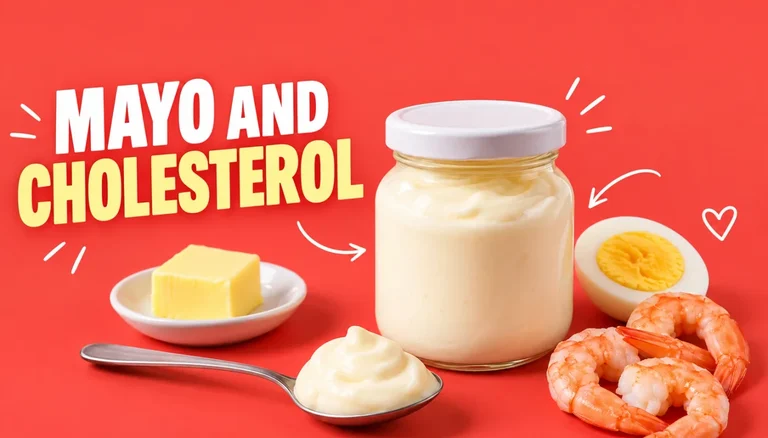
Mayonnaise is low in cholesterol. USDA FoodData Central lists regular mayonnaise at 42 mg per 100 g, which works out to about 6 mg in a tablespoon, or 2% of the 300 mg Daily Value on US food labels. One large egg has about 187 mg. The numbers to watch in mayonnaise are calories and saturated fat.
Sources checked on October 11, 2026: USDA FoodData Central (SR Legacy entries, FDC id in each table row), McDonald's US nutrition pages, FDA labeling rules, three editions of the Dietary Guidelines for Americans and the American Heart Association's 2019 science advisory on dietary cholesterol. Per-serving figures and % Daily Value are our arithmetic from USDA's per 100 g values.
Summary
- Mayonnaise: about 6 mg of cholesterol per tablespoon (FDC 171009), 2% of the Daily Value. Light mayonnaise has about 2 mg.
- Label yardstick: the FDA sets the Daily Value at 300 mg and calls 5% or less per serving low and 20% or more high.
- Highest per serving in our table: duck egg, beef liver, an Egg McMuffin, squid and a chicken egg. Plant foods have none.
- Daily limit: the 300 mg a day cap left the Dietary Guidelines for Americans in the 2015 edition. The advice since then is to keep dietary cholesterol low within a healthy eating pattern.
- Saturated fat: the Dietary Guidelines cap it at 10% of calories and the American Heart Association at under 6%. Check it next to cholesterol on every label.
Is mayonnaise high in cholesterol?
No. A 13.8 g tablespoon of regular mayonnaise has about 6 mg of cholesterol, 2% of the 300 mg Daily Value, and the FDA treats 5% or less per serving as low. The cholesterol comes from egg yolk, and a tablespoon holds very little yolk. The same spoonful carries about 94 calories and 1.6 g of saturated fat.
USDA lists three kinds of mayonnaise, and they differ:
| Type | Serving | Cholesterol | Saturated fat | Source |
|---|---|---|---|---|
| Regular | 1 tbsp (13.8 g) | 6 mg | 1.6 g | FDC 171009 |
| Light | 1 tbsp (15 g) | 2 mg | 0.5 g | FDC 173594 |
| Egg-free ("mayonnaise dressing, no cholesterol") | 1 tbsp (15 g) | 0 mg | 1.6 g | FDC 167736 |
Portion still counts. Four tablespoons in a potato salad serving come to about 23 mg of cholesterol, which is still under 8% of the Daily Value, along with about 375 calories and 6.5 g of saturated fat. Our mayonnaise page has the full nutrition profile.

What counts as high or low cholesterol on a food label?
The FDA gives two yardsticks. The first is % Daily Value: the Daily Value for cholesterol is 300 mg, and the FDA says "5% DV or less of a nutrient per serving is considered low" and "20% DV or more of a nutrient per serving is considered high." That puts the lines at 15 mg and 60 mg per serving.
The second is the wording a brand may print on the pack, set in 21 CFR 101.62:
| Claim | Cholesterol | Saturated fat |
|---|---|---|
| Cholesterol free | Less than 2 mg per reference amount | 2 g or less per reference amount |
| Low cholesterol | 20 mg or less per reference amount | 2 g or less per reference amount |
| Reduced cholesterol | At least 25% less than the regular food | 2 g or less per reference amount |
Foods with a small reference amount (30 g or less, or 2 tablespoons or less) must also meet the 20 mg limit per 50 g. The reference amount for mayonnaise is 15 g. At USDA's 42 mg per 100 g, regular mayonnaise has 6.3 mg per 15 g and 21 mg per 50 g, so by our arithmetic it misses the printed "low cholesterol" claim by 1 mg on the 50 g test. A brand's own recipe can land on either side of that line.
Every one of these claims carries a saturated fat condition. Sodium has its own set of label rules, covered in how much sodium per day, and our guide to reading a nutrition label covers the calorie lines.
How much cholesterol is in common foods?
Cholesterol is found in animal foods. The 2020-2025 Dietary Guidelines note that it occurs "naturally in some animal source foods", which is why every plant food in this table reads 0 mg. Rows are sorted from most to least cholesterol per serving, and % Daily Value uses the FDA's 300 mg.
| Food | Serving | Cholesterol | % Daily Value | Saturated fat | Source |
|---|---|---|---|---|---|
| Duck egg, whole, raw | 1 egg (70 g) | 619 mg | 206% | 2.6 g | FDC 172189 |
| Beef liver, braised | 3 oz (85 g) | 337 mg | 112% | 2.5 g | FDC 168626 |
| McDonald's Egg McMuffin | 1 sandwich | 250 mg | 83% | 6 g | McDonald's |
| Squid, fried | 3 oz (85 g) | 221 mg | 74% | 1.6 g | FDC 171982 |
| Egg, hard-boiled | 1 large (50 g) | 187 mg | 62% | 1.6 g | FDC 173424 |
| Egg yolk, raw | 1 large (17 g) | 184 mg | 61% | 1.6 g | FDC 172184 |
| Shrimp, cooked | 3 oz (85 g) | 161 mg | 54% | 0.05 g | FDC 175180 |
| Octopus, cooked | 3 oz (85 g) | 82 mg | 27% | 0.4 g | FDC 174249 |
| Chicken breast, roasted | 3 oz (85 g) | 72 mg | 24% | 0.9 g | FDC 171477 |
| Ground beef, 80% lean, pan-broiled | 3 oz (85 g) | 71 mg | 24% | 5.1 g | FDC 171798 |
| Salmon, Atlantic, farmed, cooked | 3 oz (85 g) | 54 mg | 18% | 2.0 g | FDC 175168 |
| Butter, salted | 1 tbsp (14.2 g) | 31 mg | 10% | 7.3 g | FDC 173410 |
| Cheddar cheese | 1 oz (28 g) | 28 mg | 9% | 5.3 g | FDC 173414 |
| Whole milk | 1 cup (244 g) | 24 mg | 8% | 4.6 g | FDC 171265 |
| Mayonnaise, regular | 1 tbsp (13.8 g) | 6 mg | 2% | 1.6 g | FDC 171009 |
| Mayonnaise, light | 1 tbsp (15 g) | 2 mg | 1% | 0.5 g | FDC 173594 |
| Mayonnaise dressing, no cholesterol | 1 tbsp (15 g) | 0 mg | 0% | 1.6 g | FDC 167736 |
| Egg white, raw | 1 large (33 g) | 0 mg | 0% | 0 g | FDC 172183 |
| McDonald's fries | 1 medium | 0 mg | 0% | 2 g | McDonald's |
| Hummus | 2 tbsp (30 g) | 0 mg | 0% | 0.8 g | FDC 174289 |
| Avocado | 100 g | 0 mg | 0% | 2.1 g | FDC 171705 |
| Olive oil | 1 tbsp (13.5 g) | 0 mg | 0% | 1.9 g | FDC 171413 |
| Coconut oil | 1 tbsp (13.6 g) | 0 mg | 0% | 11.2 g | FDC 171412 |
USDA rows are per 100 g values from FoodData Central multiplied by the serving weight shown. The two McDonald's rows are the chain's own published US figures. Linked food names go to the NutriScan food page for that item, and how we source nutrition data is on the data sources page.
Two rows answer questions people search for. McDonald's lists its fries at 0 mg of cholesterol, the same as the plain vegetable oils in the table. A salted egg is usually a cured duck egg, and USDA's fresh duck egg has about 619 mg, more than three chicken eggs. In a chicken egg the yolk holds 184 of the 187 mg.
USDA's SR Legacy dataset has no entry for oxtail, so we give no figure for oxtail stew here.
Is there still a daily limit for dietary cholesterol?
US guidelines no longer give one. The 2015-2020 Dietary Guidelines for Americans removed the number and kept the caution: "The Key Recommendation from the 2010 Dietary Guidelines to limit consumption of dietary cholesterol to 300 mg per day is not included in the 2015 edition, but this change does not suggest that dietary cholesterol is no longer important to consider when building healthy eating patterns."
The same passage says people "should eat as little dietary cholesterol as possible while consuming a healthy eating pattern", and puts average US intake at approximately 270 mg a day.
The 2020-2025 edition repeated the position in a note, citing the National Academies recommendation that dietary cholesterol be "as low as possible without compromising the nutritional adequacy of the diet." The 2025-2030 edition, a 10-page document, gives no cholesterol figure. Its number is for saturated fat: "In general, saturated fat consumption should not exceed 10% of total daily calories."
The 300 mg that still appears on packaging is the FDA's Daily Value, a reference for comparing labels. It is no longer a guideline target.
Why do guidelines focus on saturated fat?
Because the two usually arrive in the same foods, and saturated fat has the firmer target. The 2015-2020 Guidelines note that foods higher in dietary cholesterol, "such as fatty meats and high-fat dairy products, are also higher in saturated fats." The American Heart Association recommends "less than 6% of total calories from saturated fat", about 13 g a day on 2,000 calories.
The table shows where a cholesterol figure alone misleads:
- Coconut oil has 0 mg of cholesterol and 11.2 g of saturated fat per tablespoon, most of the AHA's 13 g.
- Butter has 31 mg of cholesterol, a tenth of the Daily Value, and 7.3 g of saturated fat.
- Shrimp has 161 mg of cholesterol and 0.05 g of saturated fat.
The AHA's 2019 science advisory, Dietary Cholesterol and Cardiovascular Risk (Carson and colleagues, Circulation), reviewed the human studies. It reports that evidence from observational studies "generally does not indicate a significant association with cardiovascular disease risk", and also that most pooled reviews of intervention studies link cholesterol intakes above current average levels with higher total or LDL cholesterol.

Are eggs and shrimp a problem?
The AHA advisory addresses both by name. On eggs: "Healthy individuals can include up to a whole egg or equivalent daily." On shellfish: "A 3-oz serving of shrimp is equivalent to about a whole egg", and shrimp and other shellfish "can be incorporated into a heart-healthy dietary pattern when paired with other lean or plant-based protein sources."
What comes with the egg changes the meal. An Egg McMuffin has 250 mg of cholesterol and 6 g of saturated fat on McDonald's own page, against 187 mg and 1.6 g for a boiled egg on its own. The sandwich adds American cheese and Canadian bacon. You can total a full order in our McDonald's nutrition calculator.
If you have high cholesterol or heart disease
This article is general information. People with high LDL cholesterol, familial hypercholesterolemia, diabetes or heart disease are often given individual limits. Your target for dietary cholesterol and saturated fat should come from your doctor or dietitian.
How do you track saturated fat and cholesterol in your meals?
Read both lines on the Nutrition Facts label, and for unlabeled food use a tracker that reports more than calories and macros.
In NutriScan, the Nutrition Details page of a logged meal shows calories, protein, carbs and fat first, then fiber, net carbs and the top micronutrients. Tapping Show More lists the rest, saturated fat and trans fat included. Saturated Fat is also one of 18 nutrients you can pin to Today's Count on the Home screen (Profile > Customize Home), so the running total sits next to your calories. With Apple Health connected, each logged meal is written there with its fat types and cholesterol.

Nutrition Details for a logged meal. Saturated fat and trans fat sit in the same grid as the vitamins and minerals.
The free plan includes 5 scans a week, and the meal scan guide shows how a photo becomes this breakdown.
What else do people ask about cholesterol in food?
Is mayonnaise high in cholesterol?
No. USDA FoodData Central lists regular mayonnaise at 42 mg of cholesterol per 100 g, which is about 6 mg in a 13.8 g tablespoon. That is 2% of the FDA Daily Value of 300 mg, and the FDA treats 5% or less per serving as low. The same tablespoon has about 94 calories and 1.6 g of saturated fat.
How much cholesterol is in a tablespoon of mayonnaise?
About 6 mg in a tablespoon of regular mayonnaise (USDA FDC 171009), about 2 mg in a tablespoon of light mayonnaise (FDC 173594) and 0 mg in the egg-free product USDA lists as mayonnaise dressing, no cholesterol (FDC 167736). For comparison, one large hard-boiled egg has about 187 mg.
Is there a daily limit for dietary cholesterol?
US guidelines no longer set one. The 2015-2020 Dietary Guidelines for Americans dropped the earlier 300 mg a day recommendation and advised eating as little dietary cholesterol as possible within a healthy eating pattern. The 2025-2030 edition gives no cholesterol figure and keeps saturated fat at no more than 10% of daily calories. The FDA Daily Value on food labels is still 300 mg.
Which foods are highest in cholesterol?
Per serving in USDA FoodData Central, a whole duck egg has about 619 mg, 3 oz of braised beef liver about 337 mg, 3 oz of fried squid about 221 mg, one large hard-boiled egg about 187 mg and 3 oz of cooked shrimp about 161 mg. Plant foods such as olive oil, avocado, hummus and potatoes have 0 mg.
What does low cholesterol mean on a food label?
Under FDA rule 21 CFR 101.62, a food labeled low cholesterol has 20 mg or less of cholesterol and 2 g or less of saturated fat per reference amount. Foods with a small reference amount, 30 g or less, must also stay at 20 mg or less per 50 g. Cholesterol free means less than 2 mg per reference amount, with the same saturated fat cap.
Does saturated fat matter more than cholesterol in food?
Current guidance puts its numbers on saturated fat. The American Heart Association recommends less than 6% of calories from saturated fat, about 13 g a day on 2,000 calories, and the Dietary Guidelines say no more than 10%. A tablespoon of coconut oil has 0 mg of cholesterol and 11.2 g of saturated fat, so a cholesterol figure alone can mislead.