Uncooked Rice: Calories, Nutrition and Health Benefits
 ChatGPT
 Claude
 AI Mode
 Perplexity
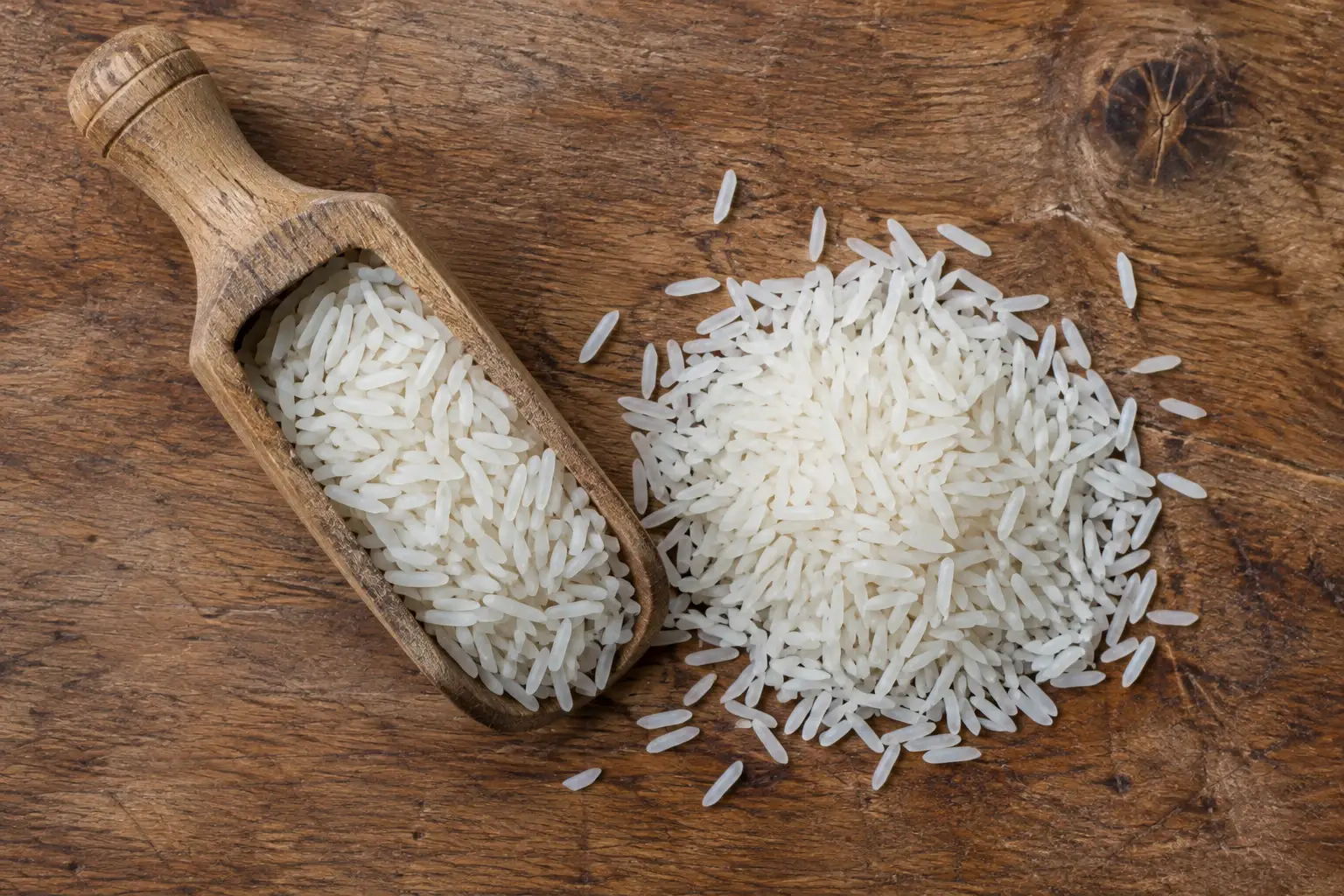
Uncooked white rice has about 365 calories per 100 g. A quarter cup dry (45 g) has about 164 calories, 36 g of carbohydrate, 3.2 g of protein, 0.3 g of fat and 0.6 g of fiber, and a full dry cup (185 g) has about 675 calories. Dry rice cooks to roughly three times its weight, so the same grains come to about 130 calories per 100 g once cooked. Check which state a recipe or tracker entry means before you log it.
Quick Nutrition Facts
Per 1/4 cup dry (45 g)
| Nutrient | Amount |
|---|---|
| Calories | 164 kcal |
| Protein | 3.2g |
| Carbohydrates | 36g |
| Fiber | 0.6g |
| Sugars | 0.1g |
| Fat | 0.3g |
| Sodium | 2 mg |
Macronutrient Breakdown

NUTRITIONIST'S INSIGHT
The most common rice logging error is mixing up dry and cooked. A cup of dry rice has about 675 calories, while a cup of cooked rice has about 205, because the grains absorb water. If you weigh rice before cooking, log it as raw at about 3.65 calories per gram. If you weigh it after, use the cooked entry at about 1.3 calories per gram. Never mix the two. Raw white rice is almost pure starch with little fiber, protein or fat, so pair the cooked portion with protein and vegetables. Dry rice is not eaten as is: it needs cooking, and rinsing and cooking in extra water is the main way to lower inorganic arsenic.
Myth Busters
MYTH #1: A cup of rice is about 200 calories, so a cup of dry rice is too
TRUTH: About 205 calories is the figure for a cup of cooked rice. A cup of dry rice is 185 g and about 675 calories, because it swells with water and roughly triples in size when cooked. Always check whether the label or tracker entry is raw or cooked. Rice, white, long-grain, regular, raw, enriched, USDA FoodData Central; Rice, enriched, raw, regular, long-grain, white, nutritional value (USDA Standard Reference data)
MYTH #2: Cooked rice has fewer calories than dry rice, so cooking burns off calories
TRUTH: The grains lose nothing. They absorb water, which adds weight and no calories, so per gram the cooked rice looks lower. A quarter cup of dry rice (about 164 calories) and the three-quarter cup of cooked rice it makes have the same total energy. Rice, white, long-grain, regular, raw, enriched, USDA FoodData Central; Rice, enriched, raw, regular, long-grain, white, nutritional value (USDA Standard Reference data); Goya White Rice, 1/4 cup uncooked (45 g), FatSecret
MYTH #3: Rinsing rice before cooking removes the carbs
TRUTH: Rinsing removes surface starch and dust and changes stickiness, but the carbohydrate stays in the grain. About 36 g of carbs per quarter cup dry stays about the same. Rinsing and cooking in extra water does lower inorganic arsenic in some rice. Rice, enriched, raw, regular, long-grain, white, nutritional value (USDA Standard Reference data); Effects of Cooking Techniques on the Nutritional Profile, Glycemic Index, and Sensory Evaluation of Rice: A Systematic Review, Preventive Nutrition and Food Science, 2025; Arsenic in Rice and Rice Products, U.S. Food and Drug Administration
MYTH #4: Raw rice is a healthy snack
TRUTH: Dry rice is hard, hard to digest and not meant to be eaten raw. It can also carry Bacillus cereus spores, which survive cooking and can multiply if cooked rice sits at room temperature, so cooked rice should be chilled quickly and reheated until steaming hot. Can you reheat rice?, NHS
MYTH #5: All white rice has the same glycemic effect
TRUTH: Harvard reports rice glycemic index values from 48 to 93, depending on variety, processing and cooking. Dry white rice is nearly all starch with about 1.3 g of fiber per 100 g, so the cooked result tends to be high GI, while basmati and parboiled tend lower. Rice, The Nutrition Source, Harvard T.H. Chan School of Public Health; Effects of Cooking Techniques on the Nutritional Profile, Glycemic Index, and Sensory Evaluation of Rice: A Systematic Review, Preventive Nutrition and Food Science, 2025
NutriScore by Health Goals




PERSONALIZED NUTRITION
Track your meals with NutriScan for personalized NutriScores based on your specific health goals!
Blood Sugar Response to Uncooked Rice
Dry rice has to be cooked, and once cooked plain white rice gives a quick rise that peaks about 45 minutes after eating and returns to baseline by about two hours in healthy adults. Values are illustrative for the cooked rice from a quarter cup of dry (about 164 kcal, 36 g carbs) eaten alone. Harvard reports rice GI values from 48 to 93, and cooling the cooked rice or eating it with protein, fat and vegetables lowers the peak. Rice, The Nutrition Source, Harvard T.H. Chan School of Public Health; Effects of Cooking Techniques on the Nutritional Profile, Glycemic Index, and Sensory Evaluation of Rice: A Systematic Review, Preventive Nutrition and Food Science, 2025
Typical Glucose Response Curve
Modeled estimate for a person without diabetes, not a measured trace. Individual responses vary.
How to flatten the spike
- Weigh the rice dry and keep to about a quarter to a third of a cup per person per meal, then fill half the plate with vegetables.
- Eat protein and some fat in the same meal; chicken, fish, eggs, tofu or lentils slow the rise.
- Cook extra, cool it in the fridge quickly, then reheat until steaming hot; cooling forms resistant starch that lowers the glycemic response.
- Eat the vegetables and protein first, rice last.
- Swap in basmati, parboiled or brown rice on days when glucose control matters.
Cultural Significance
Rice is the staple grain for more than half the world. Dry white rice is sold in bags from 1 lb to 50 lb and stored for years, which is why it anchors pantries from Asia and Africa to the Americas, as the base of dishes such as steamed rice, fried rice, risotto and pilaf. Cooks in many regions rinse the grains before cooking, and in Japan and South Asia the rinse is a routine step. In the U.S., long-grain white rice is the standard shelf variety, with basmati and jasmine the most common specialty types.
Compare & Substitute
Uncooked Rice vs Similar Foods
| Nutrient | Dry brown rice (1/4 cup, 45 g) | Dry quinoa (1/4 cup, 43 g) | Dry pearled barley (1/4 cup, 50 g) | Cauliflower rice (1 cup, 125 g) |
|---|---|---|---|---|
| Calories | 162 kcal | 157 kcal | 177 kcal | 25 kcal |
| Protein | 3.5g | 6g | 4g | 2g |
| Carbohydrates | 34.5g | 28g | 39g | 5g |
| Fat | 1.3g | 2.5g | 0.6g | 0.3g |
Frequently Asked Questions
How many calories are in uncooked rice?
Raw white long-grain rice has about 365 calories per 100 g. A quarter cup dry (45 g) is about 164 calories, and a full dry cup (185 g) is about 675 calories. Packs list 150 to 170 calories for a quarter cup.
How many calories are in 1/2 cup of uncooked rice?
Half a cup of dry white rice (about 92 g) has about 337 calories, 73 g of carbs and 6.5 g of protein. It cooks to roughly 1 1/2 cups.
Is it better to weigh rice dry or cooked?
Either works if you log it the same way. Weigh dry rice and use the raw entry of about 3.65 calories per gram, or weigh it cooked and use about 1.3 calories per gram. Mixing a raw weight with a cooked entry gives a total two to three times too high or low.
How much does rice expand when cooked?
White rice roughly triples. A quarter cup of dry rice makes about three-quarters of a cup cooked, and the calories stay the same because the grains only absorb water.
How many carbs are in uncooked rice?
About 80 g of carbohydrate per 100 g dry, or about 36 g in a quarter cup (45 g), with 0.6 g of fiber and under 0.1 g of sugar.
Is uncooked rice safe to eat?
Dry rice is meant to be cooked. Raw grains are hard to digest, and cooked rice left at room temperature can grow Bacillus cereus, so chill leftovers fast and reheat until steaming hot. Rinsing and cooking in extra water also lowers inorganic arsenic, per FDA guidance.


Similar Nutritious Foods
4505 Chicharrones Classic Chili Salt
7 Eleven Japan Crispy Corn Cheese
Explore More Tools
AI Calorie Counter App - Snap a Photo, Get Macros
AI Nutritionist App That Reads Your Logged Meals
Best Protein Supplements for Women
Bulking Meal Plan App That Sets Your Surplus
ChatGPT Calorie Counter Alternative That Keeps the Total
ChatGPT Diet Plan Alternative That Tracks What You Eat
ChatGPT Weight Loss Coach Alternative With a Food Log
Fast Food Calorie Counter App That Reads the Tray
Free Calorie Tracker App with AI Photo Scans | NutriScan
Indian Diet Plan App With Veg and Non Veg Meals
Indian Food Calorie Calculator - Get Instant Nutrition Facts for Desi Meals — 2026
Intermittent Fasting for Women, Timer and Meal Log App
Intermittent Fasting Tracker App - Free Fasting Timer
Macro Tracker App That Fills the Numbers From a Photo
Mediterranean Diet Meal Plan App That Counts the Oil
Micronutrient Tracker App for Vitamins and Minerals
MyFitnessPal Alternative That Stays Free | NutriScan
NutriScore App: A Free Grade on Every Meal | NutriScan
Nutrition Label Scanner App for the Amount You Ate
Second Trimester Protein Guide
Vegetarian Meal Plan App With a Protein Target
Voice Calorie Counter - Speak to Track Meals Hands-Free
Water and Calorie Tracker App - Free Water Log